




'Bureaucracy blocking move to Islamic economy'
The aim of having an Islamic economy will remain a distant objective as long as Islamic institutions do not get rid of government bureaucracy.
For example, in the halal industry, power is given to a single institution, resulting in difficulty for business expansion, especially for Muslims, former Perlis mufti Mohd Asri Zainal Abidin said.
The aim of having an Islamic economy will remain a distant objective as long as Islamic institutions do not get rid of government bureaucracy.
For example, in the halal industry, power is given to a single institution, resulting in difficulty for business expansion, especially for Muslims, former Perlis mufti Mohd Asri Zainal Abidin said.
“We have to accept the fact that we are not free when religion is placed under the state jurisdiction, as we have to seek permission for whatever we do,” Asri said at a dialogue session organised by Malay daily Sinar Harian yesterday.
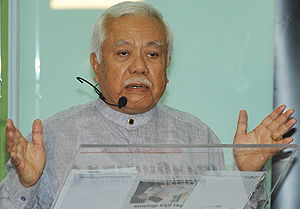 Another speaker, Malaysian Muslim Business Council chairperson, Muhammad Ali Hashim (
left
), proposed that a “corporate wakaf” (corporate benefaction) institution be formed to take over government-linked corporations owned by Malays and Muslims.
Another speaker, Malaysian Muslim Business Council chairperson, Muhammad Ali Hashim (
left
), proposed that a “corporate wakaf” (corporate benefaction) institution be formed to take over government-linked corporations owned by Malays and Muslims.
By doing so, Muhammad Ali said, the profits could be channelled to more Muslims compared with a limited amount of shareholders, who are normally the corporate elite, benefiting.
“The present government practises a liberal economy. It is like playing Monopoly... where there is corruption, compromise. We must make business a jihad (struggle) and not make it bad,” he said.
To a question from Institute for Democracy and Economic Affairs executive director Wan Saiful Wan Jan, Muhammad Ali agreed that government bureaucracy was hindering freedom in the system.
“If we are to discuss about wakaf, it cannot not be denied there is bureaucracy. This happens as a result of (the wakaf) being taken by the religious authorities and controlled by the government,” he said.


