




Adenan-Anwar duet could lift our discourse
COMMENT What may plausibly be the similarity between Adenan Satem, newly-installed chief minister of Sarawak, and Anwar Ibrahim, prospective menteri besar of Selangor?
COMMENT What may plausibly be the similarity between Adenan Satem, newly-installed chief minister of Sarawak, and Anwar Ibrahim, prospective menteri besar of Selangor?
What could be the link between the two ostensibly disparate political personalities such that aficionados of politics as sport would want to welcome them, if only as diversion for the ‘only bores are insufferable’ school of political spectatorship?
At first glance, there is no discernible similarity between the urbane and slightly arrogant-seeming Adenan and the charismatic and driven Anwar.
They are strangers - politically, definitely, because they belong to different halves of the Malaysian public affairs divide.
Personally and philosophically, the chasm appears just as wide.
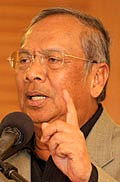 Law graduate Adenan (
right
) is the choice of Abdul Taib Mahmud, just retired CEO of the country’s biggest state and newly installed governor of it.
Law graduate Adenan (
right
) is the choice of Abdul Taib Mahmud, just retired CEO of the country’s biggest state and newly installed governor of it.
The fact that Malay studies graduate-turned Islamist politician Anwar has from the outset made clean and good governance a byword of his career would place him and Adenan, metaphorically, on opposite sides of the Rajang, the Sarawak river that is the biggest in Malaysia.
It’s not as if Adenan is dogged by the allegations of corruption that regular besiege his patron, Taib.
It’s that he is more like Prime Minister Manmohan Singh of India, who though free from even the suspicion of graft, is tainted by association with the incessantly alleged corrupt against whom he is reluctant to move.
This is the sort of position Anwar would disdain being saddled with.
Otherwise, he would have kept mum and allowed his one-time boss, former prime minister Dr Mahathir Mohamad, carte blanche in the late 1990s when the differences between the two were as wide as the Rajang and the menacing currents portended the submergence of the one simultaneous with the apotheosis of the other.
 Anwar did not elect to cut the tie with Mahathir; he got the boot instead. Malaysian politics has never been the same since.
This fate contrasts with Adenan’s.
After a long period of regency to Taib, he briefly gave up his subaltern status but came back to serve and then be tapped for the CM-ship by the boss himself.
This trajectory could not be Anwar’s.
Once he was ejected by Mahathir from Umno and government in 1998, there was no possibility of a return to the haunts of old, though carping critics are always ready to read in him a desire to return to the avenues they envisage are the only stomping grounds for the premiership of the country.
‘Empat budak Melayu’
The latest to float that bit of foetid air is Kadir Jasin, the former NST group editor-in-chief, once an integral part of the “empat budak Melayu” (four errand boys), to borrow Sanusi Junid’s infelicitous putdown of the quartet of placemen that pulled off a successful corporate-cum-editorial end-run for Anwar in the early 1990s in preparation for an eventual premiership by him.
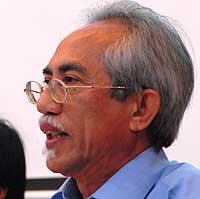 The assumed ascension was not to be but when acolytes become apostates, as Kadir (
right
) did, nothing about the object of their former devotion is too fantastical for belief.
The assumed ascension was not to be but when acolytes become apostates, as Kadir (
right
) did, nothing about the object of their former devotion is too fantastical for belief.
The philosopher George Santayana famously held that a healthy scepticism, a requisite of people in Kadir’s profession, helps preserve the chastity of the intellect.
What gives the intellect seasoning is humour and wit. English political writer William Hazlitt described the difference between the two:
“Humour is the describing the ludicrous as it is in itself; wit is the exposing it, by comparing or contrasting it with something else. Humour is, as it were, the growth of nature and accident; wit is the product of art and fancy.”
That Anwar is a man of humour one knows from his speeches on the election circuit; in Bahasa Malaysia, more frequently than in English, he can be funny, sometimes captivatingly so.
That Adenan is a man of wit only those who have had the privilege of private conversation with him would know; now the press knows it after his first few chats with them - following his swearing-in two weeks ago - had projected his ability to hold people and problems in ironic perspective .
In other words, the arrival of the one at the top of the greasy pole - to borrow Benjamin Disraeli’s witticism about the goal of a political career - and the anticipated decamping of the other at a penultimate perch, are set to enliven and refresh the political discourse in this country.
That’s reason enough to doff our hats to the onset of a season where the national political bourse will not just resound to the shrill notes of the know-nothings, of which we have a dreadful number, but will also resonate to the felicities of the well-read, two of whom are set to leverage from their vantage points.
TERENCE NETTO has been a journalist for four decades now. He likes the profession because it puts him in contact with the eminent without being under the necessity to admire them.


Are you sure you want to delete this comment?
This action cannot be undone.