




Crisis in the Malay mind
COMMENT Not so long ago I read a book with the title ‘Crisis in the Muslim Mind’ by AbdulHamid AbuSulayman, who is rector at Universiti Islam Antarabangsa, Petaling Jaya. He was writing about what he sees as the Muslim world facing some form of crisis. I am paraphrasing this title for this current writing as I, too, feel that the Malay-Muslim community is facing some form of crisis as I shall narrate below.
COMMENT Not so long ago I read a book with the title ‘Crisis in the Muslim Mind’ by AbdulHamid AbuSulayman, who is rector at Universiti Islam Antarabangsa, Petaling Jaya. He was writing about what he sees as the Muslim world facing some form of crisis. I am paraphrasing this title for this current writing as I, too, feel that the Malay-Muslim community is facing some form of crisis as I shall narrate below.
 This crisis surfaced when former prime minister Mahathir Mohamad conducted a public forum by asking Kassim Ahmad to revive the latter’s views and opinions on the Quran and its link with the Hadith.
I would describe him as a scientist, a person who will not accept anything as true until fully ascertained as so by human rationality. He is also an intellectual, i.e. a person who looks for alternatives to truth. I understand he is a senior lecturer at Universiti Sains Malaysia.
Non-Muslims readers might wish to be briefed on the background to this link.
The following principles are relevant in this crisis.
First, it is Kassim’s view that the Quran is the sole primary source of authority in Islam. He quoted in his book ‘Hadis Satu Penilaian Semula (The Hadith, A Re-evaluation)’ (1986) many passages directly from the Quran to support his contention.
For example: “ Janganlah menggerakkan lidahmu (wahai Muhammad) untuk mempercepatkan wahyu ini. Kamilah bertanggungjawab mengumpulkanya menjadi Quran. Bila kami membacanya, hendaklah kamu ikut Quran ini. Kemudian kamilah yang akan menghuraikannya. ” (75: 16-19).
My translation: Do not move your tongue (Oh Muhammad) to hasten this revelation. We have been responsible in compiling it to become the Quran. When we read it, you follow it. It’s us (and not you) who will explain it.
He quoted other passages well, all citing the same message.
Secondly, Kassim questioned the authenticity of the Hadiths. Muhammad died in 632AD but the imams collating the records of his acts and deeds did so two hundred years later. For example, Imam Shafie, one of the four imams, and to whom Malays are stout followers, died in 820AD. Latter codifiers or collators passed away later than that, like Abu Daud (888) and Ibn Majah (886).
Thirdly, he resorted to human logic: just how can the Hadith be free from inaccuracies and dissonances when transmitted orally for two hundred years?
Fourthly, he quoted the number of Hadiths collected by each collator as far too high. To illustrate, one of them, Bukhari, reputedly collated about 600,000. Should he had taken just three sentences per Hadith, then he would have reviewed and evaluated 1,800,000 spread over 40 years of work.
Fifthly, the number of rejects per collator seemed very high. In the case of Bukhari again, only about 7,275 (or 1.25 percent) of the original number were deemed as ‘sahih’ i.e. genuine or authentic. The inference is that with such a high percentage of rejection, just what would make the remainders authentic?
Response of the Traditionalists
At the other end of this crisis there are what can be termed as the Traditionalists, i.e. those who accept all past wisdoms and truths without any doubt or evaluation. Their responses can be summarised by the following comments made by writers calling themselves ‘Anonymous’ responding to my article articulating the emergence of the crisis and appearing in Malaysiakini (Feb 20).
From ‘Anonymous_4030’: It is perfectly ok to be critical on any issues, but to denounce eminent Muslim imams and scholars is totally unacceptable. Is Kassim Ahmad better than the 4 great imams and the prophet companions?? Sorry Pak Kassim.
From ‘Anonymous #37634848’: The Hadees, sayings and guidance of the Prophet has been recorded and accredited by God fearing people, unlike us the Satan worshippers. This is the Islamic believe (sic) system. If you believe in Allah and Rasool and follow the 5 principles of Islam and the 6 principles of Iman, You (sic) are Muslim. Otherwise, you opted (sic) out of it! You can call it inflexible, rigid or whatever. That is no consequence. Have you considered how you were created and by who? Science?
From these reactions we can see the thinking norm of the Traditionalists. They harbour the traditional thinking norm featured by an acceptance of past wisdom without much analysis and debate. This norm has a fixed mental paradigm and tends to protect the status quo.
The crisis went one notch higher recently when sixthly, Kassim Ahmad termed the ulama and various latter-day imams and muftis as a ‘priestly caste’. He felt that this caste or class of people are not supposed to be there in the first place, are interjecting between man and God, and causing the Malays not to want to think for themselves, but to be forever dependent on others.
In other words the Traditionalists say you can’t bring human logic when looking into matters of faith. Kassim’s views have been given a blanket rejection.
This rejection has been substantiated by the Malaysian Consultative Council of Islamic Organisation (Mapim). Its president Mohd Azmi Abdul Hamid said the views put forth by Kassim have been considered deviant by Islamic scholars and thinkers. This view was published by the alternative media (e.g. Malaysiakini , Feb 20).
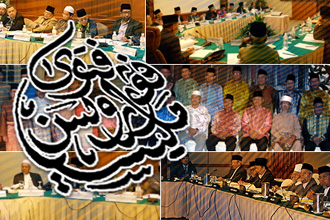 Expressing regret over Mahathir’s
defence
of Kassim, Azmi said Kassim’s comments on the
“priest caste”
were akin to rejecting the Fatwa Council, which comprises qualified muftis.
Expressing regret over Mahathir’s
defence
of Kassim, Azmi said Kassim’s comments on the
“priest caste”
were akin to rejecting the Fatwa Council, which comprises qualified muftis.
Mapim also called on the Islamic Development Department (Jakim) to put its foot down on this matter. The latter issued a statement earlier urging action to be taken.
“Just because he (Kassim) had been given an avenue supported by Mahathir as the ex-PM, it does not mean that the religious authorities cannot rebut Kassim and Mahathir and take action if the two continue to be stubborn (in their views).”
He went for the jugular: “Both of them are very old and those who are like-minded may not want to repent from this deviant view, but this view cannot be allowed to spread in the form of publications or talks.”
With the face-off, in comes Raja Petra Kamarudin, the popular blogger and realist, and I quote his comments taken from his blog Malaysia Today :
Now, (he writes) who is right and who is wrong? Herein lies the problem. How do you determine wrong from right if both are having differences in opinions regarding faith? Faith is faith. here is no right and wrong when it comes to matters of faith. Hence are there going to be any winners and losers in such a debate?
He writes further: So do we even need such a non-starter debate to begin with? What can you hope to achieve? Who can shout the loudest? Just because you can shout the loudest does not mean you are right and the other side is wrong.
As the writer I have to be fair, I have to state where I stand in this crisis. I am ‘for’ Kassim’s views because of his rationality and open-minded scientific approach.
A quotation from Socrates
So what can I do about it? For this I quote Socrates, one of the earliest philosophers in ancient history. One day a young man approached Socrates and the two engaged in a discussion: “I am about to marry a girl. What is your advice about marriage?”
“My man, marry by all means. If your wife is beautiful, kind, intelligent and charming, she’ll make you happy. And to be happy is good for you.”
He continues, “Should she be ugly, stupid, lazy and domineering, she’ll make you sad, and when sad you become philosophical. To be philosophical is good for you.”
 So as a single individual I have become philosophical over this issue. To be more specific I reproduce a comment made by ‘Pemerhati,’ over my same article on the same general issue:
“It is an undeniable fact that in Malaysia religion provides employment to a large number of people and if, like in the West, many people stopped believing in religion, the religious officials will become jobless. The religious officials thus have a vested interest in ensuring that people remain religious.”
The two sentences immediately above say it all, with thanks to ‘Pemerhati’, whoever you are.
AB SULAIMAN is an observer of human foibles, and has written and recently published a book ‘Sensitive Truths in Malaysia’.


Are you sure you want to delete this comment?
This action cannot be undone.