




Our leaders have failed us, says NGO Musawah
The failure of Malaysian leaders to denounce extremist views as unpatriotic shows that there has been failure on the part of the country’s leadership , says NGO Musawah director Zainah Anwar.
In particular, Zainah highlighted the statements of Home Minister Ahmad Zahid Hamidi, de facto Religious Affairs Minister Jamil Khir Baharom and former Information Minister Zainuddin Maidin.
The failure of Malaysian leaders to denounce extremist views as unpatriotic shows that there has been failure on the part of the country’s leadership , says NGO Musawah director Zainah Anwar.
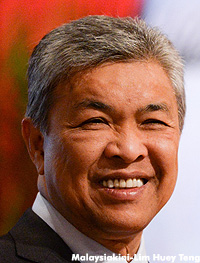 In particular, Zainah highlighted the statements of Home Minister Ahmad Zahid Hamidi
(left)
, de facto Religious Affairs Minister Jamil Khir Baharom and former Information Minister Zainuddin Maidin.
In particular, Zainah highlighted the statements of Home Minister Ahmad Zahid Hamidi
(left)
, de facto Religious Affairs Minister Jamil Khir Baharom and former Information Minister Zainuddin Maidin.
"Where is the voice that de-legitimises these (extremist) voices?
"They have a right to speak their extremist voices, but the dominant voice coming from the leadership should be one that puts down these views as un-Malaysian, unpatriotic, anti-national and (against) the 1Malaysia vision," she said today.
Zainah, a founding member of the movement Sisters in Islam, said this at a forum on national unity themed 'Overcoming impediments to unity'.
In her talk, she also spoke on the US-based Brown University political scientist Ashutosh Varshney’s studies of ethnic conflict in India and drew parallels with the situation in Malaysia.
Lessons from India
She said Varshney had found that inter-ethnic groups were "decisive" in preventing inter-ethnic violence by building bridges and defusing tensions at times of conflict.
In contrast, she said intra-racial groups similar to Perkasa and Ikatan Muslimin Malaysia (Isma) were found to be breaking down inter-ethic relations and causing instability.
"His studies show that the most important thing is the trust, and we know this already, but is ten years of research.
"There is evidence there – trust built on inter-ethnic social and civic ties. That makes the difference," she said.
Zainah ( left ) said Ashutosh had compared two sets of Indian cities for this study - one set with cases of ethnic conflict escalating into violence, and another set where the conflict did not result in violence.
The findings was published in the 2003 book 'Ethnic Conflict and Civic Life: Hindus and Muslims in India'.
Another important cause of ethnic conflict in India, Zainah said quoting from Varshney’s study, are politicians seeking political mileage by polarising Hindu and Muslim communities.
These politicians even collude with thugs to "engineer" conflict and violence, she said, adding that a situation can also be seen in Malaysia.
In addition, she said the media in cities with violent ethnic conflicts were found to have the tendency to publish rumours planted by politicians without checking.
On the other hand, she said, the media in cities without violent conflict "neutralises" the rumours by checking and finding that the rumours were unfounded.
Normal to have differing views
Meanwhile at a separate session of the same forum, Global Movement of Moderates Foundation CEO Saifuddin Abdullah (below) said Malaysian politicians often view a person’s choice of political parties to be divisive, and said this is problematic.
Instead, he said differences in opinion - including political opinion - are normal in a democracy, and not necessarily divisive if different groups can agree to differ.
For example, he said some Malay politicians had lamented that Malays have divided their support amongst different political parties.
"It is problematic if we look at the choice of political parties as divisive; that is not divisive at all!
"The problem is that when you use political definitions to equal divisiveness, I think there are other areas of divisiveness like gender inequality that are more worthwhile to look into," he said.
Although he did not name any persons, Saifuddin was apparently referring to a statement by Umno supreme council member Ismail Sabri Yaakob.
"The (Malay) race is divided into 'Umno Malays', 'PAS Malays', 'PKR Malays', and lately 'DAP Malays'.
"If we unite as one, others would not dare to challenge us," he was quoted as saying on Aug 30.


