




Anwar - the dynamics of then and now
It began in September 1998 when former premier Dr Mahathir Mohamad gave his heir-apparent Anwar Ibrahim the marching orders. He was accused of being an immoral leader.
The nation was shocked. And the Reformasi movement was born.
But what Mahathir and the rest of Umno did not envisage was that Anwar would inflict a devastating blow on the ruling regime exactly a decade later.
It began in September 1998 when former premier Dr Mahathir Mohamad gave his heir-apparent Anwar Ibrahim the marching orders. He was accused of being an immoral leader.
The nation was shocked. And the Reformasi movement was born.
But what Mahathir and the rest of Umno did not envisage was that Anwar would inflict a devastating blow on the ruling regime exactly a decade later.
When he was sacked as deputy premier, his cause gained little traction with the non-Malays as they viewed him with caution due to the perception of Anwar being an Islamist and pro-Malay leader.
During his first incarceration, Anwar conceived Keadilan (now known as PKR) - a multiracial set-up - and reinvented himself as a moderate leader, who is sensitive to the needs of all races and faiths.
Following his release in 2004, the now opposition stalwart’s fortunes began to shine among Malaysians of all races as the ruling coalition’s faded.
Malaysiakini looks at the differences in the dynamics surrounding his first conviction and the current one.
Age factor
When he was sacked from government, Anwar was 51 and his political future appeared far from over.
Now, he is 67, and must spend the next five years in jail. This coupled with the five-year ban from active politics means that he can only return to the frontline at the age of 75, at the earliest.
To most observers, the final nail has already been hammered into his political coffin. But his hardcore supporters claim that Anwar is someone that can never be written off.
Sodomy conviction
When he was first charged, there was widespread disbelief, especially since Anwar was seen as a devout Muslim leader.
But in the latest case, it appears that there are those who are convinced or at least do not rule out the opening of it having happened. This was further strengthened when Anwar refused to provide his DNA samples.
On that note, most believe there was consent and a political conspiracy had been hatched, while there are also arguments that Anwar’s sexual orientation (true or false) is not a cause for concern as the people are more interested in issues like corruption and abuse of power among the ruling elites.
Sex videos
Back then, there were secretly distributed recordings, purportedly showing the confession of some witnesses, including Anwar’s adopted brother Sukma Darmawan Sasmitaat Madja ( centre in photo ) claiming to have had sexual relations with him.
There was also the infamous book prior to his sacking, which detailed "50 reasons" why he should not become prime minister.
Now there is a video of a man resembling Anwar engaging in sex with an alleged sex worker, and the opposition leader’s denial and defence have been far from convincing. Those who released the video were prominent figures, who even took an oath before God.
No longer mere street activists
Back then, most of his supporters had nothing much at stake apart from being arrested and clobbered when they took to the streets in support of Anwar during the Reformasi movement.
Now, Pakatan Rakyat is the ruling government in three states. They have a sizeable number of MPs and state representatives. The focus is on ruling and retaining the status quo or improving their standing.
They must perform and can no longer function as a mere opposition force. The coalition is also divided due to infighting.
The PAS factor
Back then, Abdul Hadi Awang wrote a book on Qazaf, defending Anwar on the grounds that he had been slandered. The then president Fadzil Noor rallied behind Anwar. Other Islamic groups and leaders also joined hands.
Now, Hadi is president of PAS and appears to have major differences with Anwar. He seems reluctant to back the latter with regard to the latest sodomy charge. There is also a huge split in PAS.
The image factor
Back then, Anwar was the deputy prime minister. He was revered by his supporters, who sincerely believed that he had been wronged.
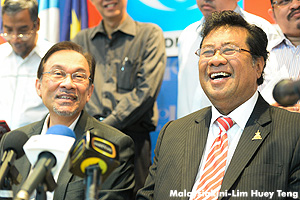 Now, he is the opposition leader, and some of his decisions have irked those in Pakatan. The protracted Selangor menteri besar crisis had also affected his image.
Some believe that since his wife and daughters are in the top echelons of the party and given seats to contest, there is no difference between him and those on the other side who are accused of nepotism.
The people factor
Back then, the shockwaves from Anwar’s sacking and jailing were limited to the Malay populace and the opposition, who saw it as a chance to hit out at BN. Being a student leader turned politician, he had an immense following among undergraduates and those in the academia.
His oratory skills could ignite the flames of revolution in his audience. He was placed on par with Malay warriors who stood up to the oppressors.
Now, the reception has been rather dismal in terms of numbers at his ceramah prior to his conviction. The people are suffering from political fatigue. Previous mass rallies such as the ones organised by Bersih and the Black 505 failed to bring about significant changes.
The younger generation, or Gen Y, has little knowledge about Anwar. For them, the opposition is bigger than one man and his personal struggle.
Some claim that the people would rather express their anger through the ballot box as opposed to taking to the streets and attending ceramah.
Compared to the past, there is now the social media, where recordings of ceramah and speeches are almost instantaneously uploaded, thus negating the need to physically attend such events.
Conclusion
To surmise, charlatan or political messiah, the undeniable fact is that Anwar, albeit for narcissistic reasons or otherwise, was the instrumental force that pried open the democratic space in Malaysia and brought about check and balance.
The question now, is what happens next.


Are you sure you want to delete this comment?
This action cannot be undone.