




Punjab workers allege human rights violations
Eighteen foreign workers from the Punjab in India have lodged a complaint with the Human Rights Commission of Malaysia (Suhakam) alleging that they were abused, humiliated and exploited by their employer.
Eighteen foreign workers from the Punjab in India have lodged a complaint with the Human Rights Commission of Malaysia (Suhakam) alleging that they were abused, humiliated and exploited by their employer.
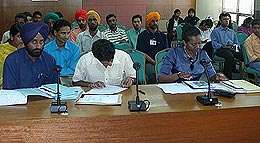 At a meeting this afternoon with Suhakam vice-chairperson Simon Sipaun and Jamaludin Othman, who heads the complaints and inquiry division, the group detailed their experiences since their arrival in Malaysia in April.
The workers, who range in age from 19 to 32, include a university graduate and a woman. They are currently seeking shelter in a Sikh temple in Kuala Lumpur.
They were accompanied by Aegile Fernandez, the programme co-ordinator of migrant worker's lobby group Tenaganita, whom they had approached for assistance.
The workers claimed they had not been paid since starting work, and that they had been 'sub-contracted' by their employer Kuala Lumpur-based Juju Power Sdn Bhd to PESB Electronics (formerly Pernas Electronics Sdn Bhd), to install power lines around the Klang Valley.
In their statement to Suhakam, the group claimed that they had met Juju Power managing director Khatijah Fateh on Jan 5 when she visited their village to offer them jobs in Malaysia.
"She spoke Punjabi fluently. She managed to gain our trust as she was very soft-spoken and promised us safe and secure employment... with a salary of RM1,500 a month, free accommodation and medical benefits," they said.
Sixteen of the villagers paid her 95,000 Rupees (about RM8,000) while in India, for visa fees and travel expenses. In order to meet these costs and the air fare to Kuala Lumpur, they sold personal possessions and borrowed money at high interest rates.
Range of complaints
Group spokesperson Darshan Singh, who addressed the Suhakam officials with the help of a translator, said Khatijah met 16 of them at the airport where she took their passports and money in order to help them "clear immigration".
However, he said they did not see their travel documents or money again.
The men took turns to relate their complaints which ranged from allegations of physical abuse to extreme humiliation.
Darshan said he was manhandled by several men on April 16 in Khatijah's presence in her home. They removed his turban and cut his long hair against his will, and was told not to let his hair grow again.
He said the employer wanted them to wear safety helmets and that she told them they were free to return home if they could not comply with her rules.
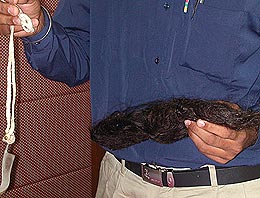 Two other workers, who said they were subjected to the same act, explained that this was disrespectful to their religion. As Sikhs, they are not allowed to cut their hair.
"It was possible for us to put on those helmets (over our turban). Furthermore, we were not told about this rule when she asked us to work for her," they said.
One of the workers displayed a broken tooth which he attributed to being hit in the face with a thick piece of wood by a supervisor.
Long working hours
 The group further alleged that they were beaten by their supervisor whenever they asked for their wages, and that they were forced to share two rooms and a bathroom in a house in Salak South from April until they left the company on July 25 with a sum of RM130 each for three months' work.
"There was only one fan in one of the rooms and we slept on the floor. Sometimes, the food provided was insufficient and we went hungry for a couple of days," Darshan said.
Without money to buy food, the workers bought food on credit from a shop until they could 'repay' this with rations of flour and dhall (lentils) from their employer.
On July 8, Darshan and another worker made their way to the Indian High Commission, where they informed an official of their predicament.
"The official contacted Khatijah and she took all of us to the commission at the official's request. We could not understand the conversation between them because it was in English.
"After they spoke, the official told us that we had to continue working for the company or return to India. He claimed our employer had said we were not productive."
Disputing this, the workers told the Suhakam officials that they had worked for up to 13 hours a day while being employed.
They asked for Suhakam's help to resolve their problems including getting back their travel documents, and enabling them to find alternative employment while remaining in Malaysia to pursue their complaints.
'Abolish system'
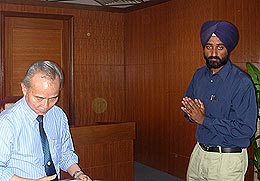 Commenting on the situation, Simon said the case would be studied and investigated, but did not hold out hope that any decisions or recommendations to the authorities could be enforced.
"I cannot comprehend how one human being can treat another so cruelly and inhumanely. It's such a sad story and I wonder how the employer would feel if the roles were reversed," he said.
Fernandez, who submitted a memorandum to Suhakam, said the government should act firmly against agents or contractors who "cheat and abuse foreign workers", as well as abolish this system of recruitment.
"These workers from Punjab have been abused, tortured, humiliated and exploited by an agent who must be investigated and charged accordingly. These victims are at risk of being construed as illegal immigrants once their work permits expire," she said.
Tenaganita is to meet the Indian High Commission tomorrow morning. It also plans to file complaints with the International Labour Organisation and the United Nations Special Rapporteur on Rights of Migrant Workers.
The employer and the Indian High Commission could not be contacted for comments today.


