




Stay out of media complaints, Suhakam told
More expressions of disappointment and frustration have been registered over the move by the Human Rights Commission of Malaysia (Suhakam) to set up a media complaints working committee.
More expressions of disappointment and frustration have been registered over the move by the Human Rights Commission of Malaysia (Suhakam) to set up a media complaints working committee.
When contacted, The Star deputy group chief editor II Wong Chun Wai said he considers the move to be a further restriction on the media, in addition to the host of laws that shackle the press currently.
"I personally feel that the Malaysian press does not need another monitoring body or mechanism," he said in a telephone interview.
 "There are already enough restrictive laws such as the Printing Presses and Publications Act 1984, the Official Secrets Act 1972 and the Sedition Act 1948, to name a few. As it is, the print media has to be cautious over content on a daily basis."
Urging Suhakam to devote its resources and energy to removing anti-press laws and practices, he said that most Malaysians are more concerned about available space in the media.
"Suhakam should facilitate more room for the press to operate. I daresay that a majority of newspapers have been responsible in covering certain issues such as rape stories," he said.
"Whether it's an Internet media like malaysiakini or the print media, we all put our heads on the chopping block because we generally care for society."
On Tuesday, journalists' groups took issue with Suhakam's move, which was unexpectedly announced on Monday.
Referring to the widely-covered Noritta Samsudin murder trial which sparked off public outcry due to the detailed reports, Wong said only some newspapers may have gone overboard.
"The point is that it is unnecessary to have this committee, and Suhakam has not even achieved its original objective of removing repressive laws."
"Frankly, I'm much more interested in a self-regulatory mechanism instead of something like this," said Wong, who has yet to discuss the issue with colleagues or counterparts in the other media companies.
'Abandon committee'
The Sun editor Zainon Ahmad, in questioning Suhakam's role in setting up the committee, said it has no business in monitoring the media.
"It shouldn't bite off more than it can chew," he said, upset over the sudden move to launch the committee.
"Suhakam should just leave it to the editors to decide on how the industry should be run because the human rights body already has too many issues on its plate that remain unresolved."
Kuala Lumpur-based Centre for Independent Journalism (CIJ) said it regrets the setting up of the committee and questioned the composition and monitoring mechanism of a move that is seen as a bid that will lead to a media council being formed.
CIJ director Sonia Randhawa said that by launching the committee, Suhakam has ignored fundamental concerns raised by journalists at a consultation dialogue that it hosted in early January to discuss a draft media council proposal.
"We regret that (the launch) was done without prior and sufficient consultation," she said in a statement.
Citing the stand of journalists asking for the repeal of the licensing provisions in the Printing Presses and Publications Act 1984, she felt that a media council - under current circumstances - would only serve as another layer of control.
"The same point applies to Suhakam's working committee. We also rejected a statutory model (but) the committee is ambiguous on this point," she said.
"It is, however, disconcerting that two of the main proponents of the statutory model form half of the current committee (of four members)."
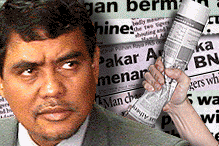 The committee is chaired by Suhakam Complaints and Inquiry Working Group chairperson Prof Mohd Hamdan Adnan, commissioner S Siva Subramaniam and the drafters of the media council proposal - Dr Mohd Safar Hashim and Dr Ahmad Murad Merican.
Sonia said the idea behind the proposed media council was to enforce a journalistic code of ethics but in "a situation of very restricted space for media freedom, the canons of journalism are paid mere lip-service".
She was convinced that a media council or a complaints committee with a similar function "will not address the root of the problem of unethical reporting in Malaysia".
"(Neither will it address) the impact of political control and manipulation of the media."
At the January consultative dialogue, she said, representatives were appointed from three major groups - editors/owners, journalists, civil society bodies - to negotiate on their behalf.
"These representatives were not given the authority to act as arbiters of the media industry, as what Suhakam appears to suggest.
"We suggest that Suhakam abandon the working committee, initiate consultations and follow-up discussions that have been agreed upon in the January meeting and ensure that all parties are consulted in any related initiatives in the future," said Sonia.
'Widen space'
Anil Netto, co-ordinator of citizens' media initiative Charter 2000, objected to the "back door attempt to set up a pseudo-media council".
"We feel Suhakam should be addressing the larger issue of press freedom rather than going after journalists all the time," he said.
"If the intention is to improve the quality of Malaysian journalism, Suhakam should create more democratic space by removing restrictive laws and address the issue media ownership."
 Anil felt that one of the reason newspapers resorted to sensational reporting is because they cannot report on much else.
"The only way to boost sales is probably by reporting on crime and court cases sensationally," he said.
He felt that reporting on corruption, consumer rights, economy and human rights would also help to increase newspaper sales "as that would provide more relevant news".
"These days, a lot of people start reading from the sports pages at the back of the newspaper and work their way to the front page. Many even skip or glance through the first few (news) pages."
He added that this was telling of the current state of affairs in terms of the quality of content.


