




Plantation workers say No to pesticides
About 200 plantation workers who participated in the People's Caravan - an internationally-linked event promoting land and food rights around Asia this month - have firmly rejected the use of pesticides.
About 200 plantation workers who participated in the People's Caravan - an internationally-linked event promoting land and food rights around Asia this month - have firmly rejected the use of pesticides.
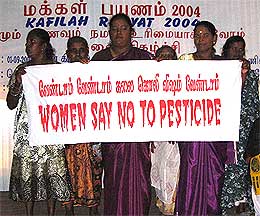 The workers, from oil palm estates in Teluk Intan, Perak, carried banners saying 'Women Say No to Pesticides'. They also pledged to tell their families and friends to stay away from poisons that have adverse effects on their well being.
Guests were entertained to a mini-concert during which participants performed songs, dances and skits on their struggles as plantation workers suffering the effects of pesticide poisoning.
The women, who mainly work as sprayers, claimed that their health has deteriorated since they began working on the plantations, while their daily income is stagnant.
Malathi, 39, a single mother of three school-going children, said she was determined to tell her friends that there is "life after the plantation".
"What is the point of risking my life in the plantations when I earn hardly enough to feed my children and have to go on buying medicines to treat my sickness?" she told a packed community hall in a village in Hutan Melintang.
"I had sores on my skin, my eyes hurt, I had aches in my back, knees and legs, but when I went to the doctor, all he did was give me painkillers," alleged Malathi, who has since left her job.
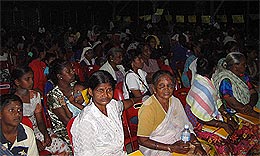 There are reportedly 30,000 plantation workers in Malaysia .About 70 percent are believed to be suffering from eye problems and rashes as they do not wear protective gear while spraying pesticides.
Sprayers carry a heavy steel tank as they conduct the spraying between 16 to 20 times daily, resulting in their suffering body aches.
It is learnt that their daily income ranges from RM14 to RM18.80. Most are contract workers with no employment contract or health insurance.
'Reach out for help'
Another former sprayer, Radha, 45, also a single mother of four grown-up children, urged women to leave the plantation sector and learn skills that can help them become financially independent.
"We can learn sewing or cooking, or even how to use the computer and get better jobs than what we have in the plantations," she said, when met after the event.
Radha, who quit her job after injuring her right arm in an accident, now lives on meagre allowance from the Social Security Organisation.
"Women must not feel ashamed anymore. There are many people out there who are willing to help us, we just need to respond to their call," she said, referring to non-governmental organisations who have reached out to create awareness of the dangers of pesticide use.
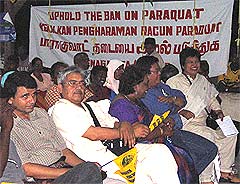 The Caravan, organised by Pesticides Action Network Asia-Pacific (PAN-AP) and local host Tenaganita, kicked off in Permatang Pauh, Penang on Tuesday. It will travel to 13 countries in Asia and three in Europe before culminating in Nepal at the end of the month.
Expressing solidarity with the participants in Teluk Intan, All Nepal Peasants Association's Prem Prasad Dankel said these workers have toiled day and night on the fields and yet " were landless people".
"They have no right to their land and their products. They are poor and have not enough money to purchase these resources. The landlords live in towns and cities, most have not set eyes on their lands, and yet the land is theirs," he said.
"These are the reasons why we have chosen the issue of food sovereignty. Peasants and farmers grow food for the world to eat, yet most of them are poor and hungry."
SUSAN LOONE is a researcher at Pesticide Action Network Asia-Pacific, a regional non-governmental organisation based in Penang, Malaysia.


