




Pak Lah likely to unveil 'credible budget' to spur growth, cut deficit
Prime Minister Abdullah Ahmad Badawi is expected to unveil a "credible budget" tomorrow to spur Malaysia's private sector-driven economic growth and deflate a swollen budget deficit after years of pump-priming, economists say.
Prime Minister Abdullah Ahmad Badawi is expected to unveil a "credible budget" tomorrow to spur Malaysia's private sector-driven economic growth and deflate a swollen budget deficit after years of pump-priming, economists say.
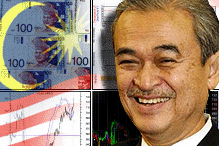 The budget for 2005, which will be Abdullah's first since taking over the premiership from Dr Mahathir Mohamad who retired in October after 22 years in power, is expected to contain measures to boost Malaysia's economic competitiveness and woo foreign investment, they said.
Some "goodies or surprises" may be in store as Abdullah, who is also finance minister, may want to thank Malaysians for their strong support in March's general election but any impact is likely minimal on the markets and the man-in-the-street.
"We will be entering 2005 on a strong footing," CIMB Securities' chief economist Lee Heng Guie said.
"The government need not worry about a slowdown in consumption. In this context, the budget is likely to be credible, with the government balancing its fiscal position and ensuring private sector growth is sustained."
Fiscal discipline
RAM Consultancy Services economist Yeah Kim Leng said the budget was likely to be "austere" in terms of expenditure and move towards further fiscal consolidation.
"The government needs to show its fiscal discipline and its commitment in cutting spending so as to achieve a balanced budget within one or two years," he said.
Malaysia is likely to chalk up its eighth straight budget deficit but the government hopes to balance the books by 2006.
Both Lee and Yeah said the government was unlikely to cut corporate or personal income taxes but may again raise "sin taxes" to deter the consumption of cigarettes and liquor, and gradually reduce petrol subsidies.
Other economists said the government may introduce new business incentives and stimulate growth in selective sectors such as agriculture, services and small- to medium-sized enterprises.
Lee of CIMB Securities said the government may also take steps to promote bonds and asset-backed securities and incentives for unit trust companies as part of efforts to enhance the country's capital markets.
Boosting property market
A research manager, who asked not to be named, said the government may waive stamp duties to give the property market a boost but was unlikely to raise development spending given its fiscal constraints.
Abdullah, who has been cutting back on big projects since coming to power, last month said the government was on track to cut its budget deficit to 4.0 percent of gross domestic product this year from 5.3 percent last year despite high oil prices.
 "We are within the target, we should be able to see some improvement," he said, adding the government has enough funds to finance its economic activities without raising foreign loans.
The premier is expected to unveil new growth targets, above the original estimates of 6.0-6.5 percent this year, following a stronger-than-expected expansion of 8.0 percent year-on-year in the June quarter, the highest quarterly growth in four years.
Economists however, warned Malaysia's growth could moderate in the second half of the year due to a possible global economic slowdown and high oil prices.


Are you sure you want to delete this comment?
This action cannot be undone.