




New policy to cut reliance on foreign labour
The government said today it aims cut its reliance on foreign labour as the number of legal foreign workers soared to 1.3 million or 12 percent of the country's total workforce.
The government said today it aims cut its reliance on foreign labour as the number of legal foreign workers soared to 1.3 million or 12 percent of the country's total workforce.
The Finance Ministry, in its annual report released alongside the budget, noted that foreign workforce had increased nearly tenfold from about 136,000 in the early 1980s due to the country's economic growth and tight labour supply.
While foreign workers have contributed to Malaysia's growth by alleviating labour shortages in selected sectors, it said their presence has also put stress on public amenities and services.
Remittances by foreign workers have also risen steadily, with the outflow rising from RM10.22 billion in 2001 to RM13.08 billion in 2002 before easing at RM11.23 billion last year, it said.
"As a long-term measure to ensure sustainable growth as well as minimise socio-economic implications, a medium- to longer-term policy on foreign workers will be devised with the view to reducing the over-dependence on foreign workers while attracting the more skilled and trained professionals," it said.
Expatriates, who are largely professionals and highly skilled workers, account for about three percent of the foreign workers in the country.
Crackdown on illegals
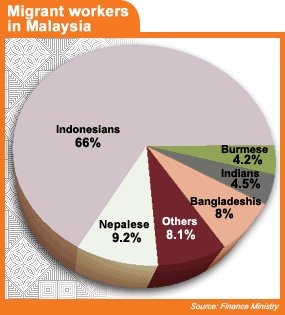
Indonesians account for some 66 percent of Malaysia's migrant population, followed by Nepalese at 9.2 percent, Bangladeshis 8.0 percent, Indians 4.5 percent and those from Burma 4.2 percent.
 About 31 percent of foreign workers are employed in the manufacturing sector, with the rest in low-paying, non-skilled sectors such as services, construction and plantations.
Malaysia, which is also home to an estimated one million illegal immigrants, mainly from Indonesia, has long sought to cut its reliance on foreign labour.
It introduced harsh new immigration laws in August 2002 and cracked down on illegal immigrants which saw nearly half a million being repatriated during a four-month amnesty period that year.
The Finance Ministry in its report acknowledged, however, that labour shortages remained a problem in many key sectors due to Malaysia's economic recovery, rapid industrialisation and corporate restructuring towards more capital intensive manufacturing.
As such, foreign labour intake is still flexible to "avoid disruption to the economic growth process," it said.


Are you sure you want to delete this comment?
This action cannot be undone.