




CAP: Regulate pharmaceutical drug prices
The Consumer Association of Penang (CAP) today expressed concern over the absence of any regulation governing the price of pharmaceutical drugs in the country.
The Consumer Association of Penang (CAP) today expressed concern over the absence of any regulation governing the price of pharmaceutical drugs in the country.
 Its president, SM Mohamed Idris urged the government to implement necessary measures to alleviate the financial burden on consumers.
He compared prices and policies from other countries and advised the government to impose price controls on drugs which are essential and life saving.
"Other products that are deemed essential on the Malaysian market are already subjected to government control when it comes to pricing.
"Drugs are essential...price control for this group of products is sorely needed," he said in a statement.
Mohamed Idris referred to a report by the country's Auditor-General which found the government paying up to 36 percent above the market price for certain medicines used in public hospitals and clinics.
"These are for drugs that are obtained through tenders and usually from overseas. It is noted, however, that sometimes the government is forced to pay more for medicine due to the delays in processing tenders," he said.
Currently the pricing of drugs sold in the country are dictated by distributors with market forces and manufacturers contributing to the exorbitant prices, he assessed.
He said despite public outcry, drug prices varied "from one distributor to the next, as well as from one area to the next throughout the country".
"CAP is also concerned that there are no details on prices of the different brands of drugs being made available to the public for comparison," he added.
Tantalizingly high
He quoted Andrew Creese, a health economist with the World Health Organisation's essential drugs and medicine policy division as saying that drug prices in Malaysia are "tantalizingly high".
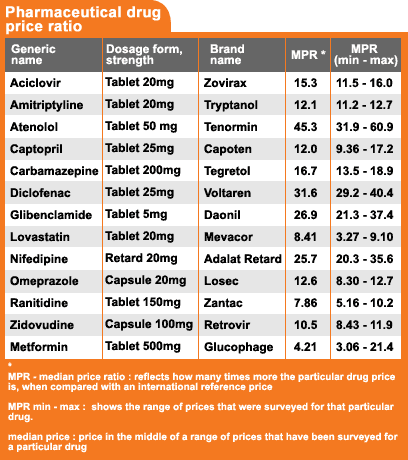
Mohamed Idris presented a table taken from an issue of the Essential Drug Monitor magazine where a survey on prices of some popular branded drugs was conducted by two local university lectures.
 "Atenolol (Tenormin) which is a popular drug in Malaysia costs about 45 times more than the chosen international reference price, while drugs like Captopril 25mg (Capoten) costs twelve times more," he quoted the preliminary results of the survey.
He said two other drugs - frequently used here - Glibenclamide 5mg (Daonil) and Diclofenac 25mg (Voltaren) are about 27 times more and 31 times more, respectively, when compared with the reference prices but admitted the survey was non-exhaustive.
"It does help to give an idea of the existence of great variation in prices," he noted on the results available in the magazines' 33rd issue in 2003. ( see chart )
Glibenclamide is an anti-diabetic medication, Diclofenac is a popular painkiller while Atenolol and Captopril can act as blood-pressure medication.
"Patent branded drug prices are already high, but even generics sold here are known to be costly," he said.
Pakistan and India he added, are among countries which price their drugs much lower than Malaysia.
Standard guidelines
Among other countries practising price control on drugs, Lebanon and Jordan take into account prices in the international community when determining the costs of medication for consumers.
Policies for regulating retail drug prices also exist in Syria, Egypt and Oman.
"CAP has already written to the minister of domestic trade and consumer affairs, as well as to the minister of health calling for measures to control the drug prices on the Malaysian market," he said.
Among others, Mohamed Idris urged the government to make it compulsory for medical practitioners to follow standard guidelines, encourage the use of generic drugs and compulsory licensing when introducing drugs.
He made his case in relation to both public and private practitioners and pharmacies.


Are you sure you want to delete this comment?
This action cannot be undone.