




Survey confirms Pak Lah factor in BN polls victory
The ruling coalition Barisan Nasional (BN)'s track record in delivering progress and material development and the 'Pak Lah factor' were the keys to the ruling coalition's success in the March general election, an independent survey has shown.
The ruling coalition Barisan Nasional (BN)'s track record in delivering progress and material development and the 'Pak Lah factor' were the keys to the ruling coalition's success in the March general election, an independent survey has shown.
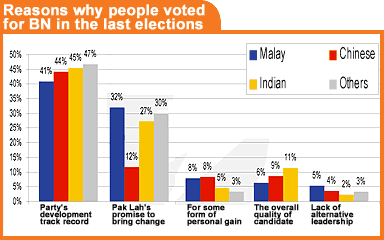
The survey , by the Merdeka Centre for Opinion Research, had 42% of its respondents across all ethnic groups saying that BN's promise of continued development had been the ruling front's strongest appeal to them.
A close second was Prime Minister Abdullah Ahmad Badawi's promise for change which got the support of a quarter of the survey's respondents.
Interestingly, the survey also registered about 8% of respondents indicating that they had supported BN 'for some form of personal gain'.
The survey, carried in collaboration with Universiti Kebangsaan Malaysia's Malaysian and International Studies Institute (Ikmas), interviewed a nationally representative quota sample of 1,017 adults between July 15 and 21 - about four months after the March 21 general election.
The results of the survey were revealed to the press on Thursday.
'Clean image'
Asked what they perceived to be the BN's strength, the survey's respondents cited 27% 'generating economic growth' to be the ruling front's principle strength followed by maintaining racial harmony and political stability.
Thirty-two percent of the respondents chose to describe Pak Lah as a 'man of the people' while 22% described him as having a 'clean image'.
Another 19 percent saw him in the context of his religious background.
"Demographically, it was found that the 'Pak Lah factor' had the greatest traction amongst Malays and Indians, those below 35, and those in lower and middle-income groups," said the report.
The perception of the prime minister as an able manager of the economy appeared more popular with respondents from the lower-income group as opposed to those from higher-income households.
On the performance of members of parliament, 61% of the survey's respondents said that they were satisfied with their output.
However, 25% of Chinese Malaysians respondents said they did not know their MPs, twice as many compared to Malay and Indian Malaysians.
National issues
On state of the nation, nearly 80% of the respondents said were satisfied with the way things were with 16% saying they were 'very satisfied' and 65% somewhat satisfied.
Nearly half those answering 'somewhat dissatisfied', meanwhile, were below 30 years of age and more prevalently from Malay and Chinese Malaysians.
"Those who expressed dissatisfaction were also found to be more likely to vote for the opposition," noted the report.
The poll also found that national issues of top concern were crime and public safety at 42%, followed by concerns about social problems involving the young at 12%.
Concerns about the economy encompassing factors such as inflation, employment and business growth was the third most important concern at 9%.
On public perception of the economy, over 61% of respondents were optimistic about the prospects of the economy for the coming year.
"This is an improvement compared to October last year where 57% respondent optimistically," said the report.


Are you sure you want to delete this comment?
This action cannot be undone.