




Survey: Media coverage of elections slanted
Nearly two-thirds of the 1,017 respondents in an independent survey viewed the media coverage of the recent general election as being biased in favour of the ruling parties.
Nearly two-thirds of the 1,017 respondents in an independent survey viewed the media coverage of the recent general election as being biased in favour of the ruling parties.
Carried out by the Merdeka Centre for Opinion Research , the survey showed that television reporting ranked higher than its print counterpart in terms of prejudice.
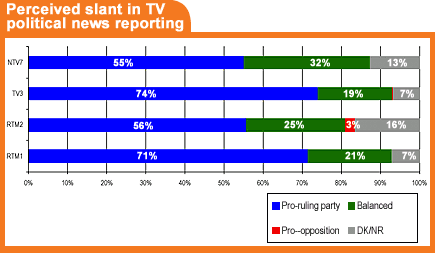
TV3 and RTM1 topped the list with 74 percent and 71 percent respectively, followed by NTV7 at 55 percent and RTM 2 by 56 percent.
As for newspapers, New Straits Times and Utusan Malaysia ranked the highest with 81 percent and 77 percent of respectively while Berita Harian came in at a close third with 76 percent.
The country's leading English daily, the Star polled 69 percent while unnamed Tamil papers 67 percent.
Comparatively, Chinese newspapers fared much better in the survey. Nanyang Siang Pau (52 percent), China Press (47 percent) and Sin Chew Daily (45 percent).
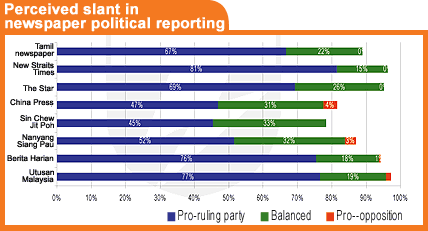
"A relatively lower proportion (approximately half) of the readers of Chinese newspapers report biases in favor of the ruling parties," said the survey.
Swayed by the media
The survey, in collaboration with Universiti Kebangsaan Malaysia's Malaysian and International Studies Institute (Ikmas), was carried out between July 15 and 21.
The survey also found that a larger plurality of respondents (45 percent) reported that they were influenced by the mass media.
"In terms of ethnic breakdown however, proportionally more Chinese (nearly two third) were swayed by the media as opposed to a third of Malays and Indians," it said.
The survey said a third of Indian respondents cited that they made decisions based on their personal observation and interpretation of political events, a figure markedly higher than Malays (21 percent) and Chinese (7 percent).
 Meanwhile, the survey found that a majority (54 percent) of the respondents had decided more than three months before the elections on which party to vote for.
"One month to elections, a further six percent had made up their minds," the survey said, adding that 24 percent only made up their minds on the final two weeks including those on election day itself.
"Of these voters, we found that they were predominantly Chinese and tended to be from the upper income households," the survey revealed.
The survey found a majority of Malay and Indian voters, 69 percent and 58 percent respectively, had made up their minds even before the March 21 elections were called.


Are you sure you want to delete this comment?
This action cannot be undone.