




Burmese couple camps outside UNHCR
A Burmese family has been camping outside the United Nation's High Commissioner for Refugees (UNHCR) office in Kuala Lumpur, hoping to be resettled in a third country.
A Burmese family has been camping outside the United Nation's High Commissioner for Refugees (UNHCR) office in Kuala Lumpur, hoping to be resettled in a third country.
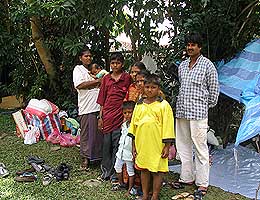 Siddik, his wife Nurjah and their six children have been staying there for the past 10 days in a makeshift tent made of plastic sheets.
The tent is only able to shelter the children. The parents sleep on the grass, covering themselves with plastic sheets.
The couple are determined to provide a better future for their children, aged between 12 years and four months. Except for the youngest child, who was delivered in a local hospital, the rest do not have local birth certificates.
"We are doing this because we are very poor refugees. I also cannot get a job legally because I sneaked into the country 15 years ago. The constant threat of arrest and deportation prevents us from providing for our kids,"" claimed Siddik, 41.
Refugee status
"We want UNHCR to give us refugee status and help us go to another country where we can get more help for education, housing and money," said Nurjah, 32, as she tried to keep ants and flies off the baby.
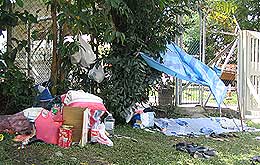 Relating their experience over the past 10 days, Siddik said passers-by have been donating things to the family including food and toys.
"Whenever it rains my wife and younger children seek shelter at a car park in a nearby house - whose owner is kind enough to give us water to drink and clean ourselves," he said.
He dismissed the possibility of going to the office of the Islamic Youth Movement of Malaysia (Abim) - which has been tasked by UNHCR to process protection letters for Burmese Rohingyas.
According to Siddik, a large number of his friends who have done this are still being harassed or have been arrested by the police.
"They go to Abim, get a letter, try to find a job but are eventually arrested and deported to Burma," he said.
Siddik and his wife stressed that they are Muslims but not Rohingyas , a predominantly Muslim ethnic minority deemed stateless people in their land.
Lengthy process
UNHCR community services officer Jan Field said the agency cannot accommodate Siddik's request for immediate resettlement as this is a lengthy process.
"We have been constantly speaking to him since he set up camp and he is adamant on getting out of the country immediately. He has refused to go to Abim for processing. We prepared a temporary protection letter and offered it to him yesterday but he declined to accept it," she said.
"Furthermore, it is the decision of the third country that matters. It is not UNHCR but the country of destination which has the final say in accepting refugees."
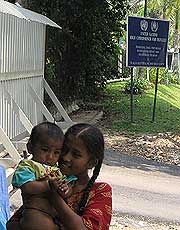 She said numerous officials including UNHCR's chief Volker Turk have spoken to Siddik but there is a "lack of understanding on his part as he will not budge from his decision to live with his family outside the building until he is resettled".
Field said she was informed that Siddik is a Rohingya while his wife is a Burmese Muslim. But she also said this does not make much of a difference in matters of resettlement.
The agency issues two types of protection letters - a 'blue paper' which recognises a refugee under the agency's mandate and the other, a 'white paper' which provides temporary protection to asylum seekers.
Siddik, who has been offered the 'white paper', wants a 'blue paper' instead for better protection while in Malaysia.
A UNHCR officer who declined to be named explained the function of the two separate letters in the hope that "misconception" among refugees and local authorities will be clarified.
"Both letters are the same in the sense that UNHCR provides protection to its holders - ensuring that they are not returned to their homeland," he said.
"Due to limited resources, the 'blue paper' is given to a small number of asylum seekers to undergo a long precess of refugee determination."
The 'white paper' is generally given to Burmese Rohingyas and Acehnese as many having been living in Malaysia for years and third countries are less inclined to receive them.
"The idea in issuing the 'white paper' is for them to return to their home countries once the situation there changes," the officer added.
Siddik was issued a temporary protection letter in 1992 but this has since expired.


Are you sure you want to delete this comment?
This action cannot be undone.