




OIC must focus on economic development, redistribute Muslim wealth
Prime Minister Abdullah Ahmad Badawi urged Muslim countries to focus on economic development rather than politics and take steps to redistribute wealth among themselves.
Prime Minister Abdullah Ahmad Badawi urged Muslim countries to focus on economic development rather than politics and take steps to redistribute wealth among themselves.
"I believe that the focus should increasingly be on the issue of economic development of Muslim nations," Abdullah told a conference of business leaders from the 57-member Organisation of the Islamic Conference (OIC), currently chaired by Malaysia.
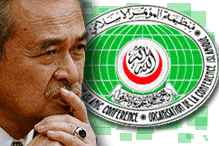 "The two issues - political and economic development - are no doubt tied to each other. But it must be remembered that there is little political clout to be derived from weak economic achievement," he said.
"Indeed, economic success is perhaps the most important factor in determining political strength, and must be pursued relentlessly," he added.
Abdullah, whose country's economy is regarded as one of the most successful and diversified in the Islamic world, said it was "disheartening to note that Muslim countries are often perceived to be synonymous with poverty, illiteracy, malnutrition, corruption, oppression and even tyranny."
He reiterated export-driven Malaysia's offer to take the lead in "energising trade and services in the Muslim world," saying the Quran itself urges Muslims to engage in trade and commerce and undertake journeys to seek "the bounty of Allah".
Poor and uncompetitive
He noted that the Organisation of Islamic Conference's members now have a combined total of 1.25 billion people or one-fifth of the world's population, providing 70 percent of the world's energy requirements and about 40 percent of global raw material exports.
But Abdullah said most members are poor and uncompetitive, and he found it "more distressing" that richer members are not investing a large portion of their wealth in poorer Muslim countries.
"The situation is compounded by the fact that we are unable to have our voices properly heard when dealing with powerful nations of the West, including in financial and multilateral negotiations," he said.
"Given the dismal outlook, there is little hope in individual solutions to the problems of member states," he said, adding that "the solution lies in collective thought and combined action."
The OIC's collective gross domestic product is less than five percent of the global total and trade among its members, estimated at 800 billion dollars annually, constitutes only six to seven percent of world trade.
"These numbers are relatively small given the total population size of the OIC. As such, we should work hard to realise the huge growth potential for trade and investment in the OIC, quickly and effectively," Abdullah said.
Blinding the investors
Olive Zaitun Kigongo, president of the Uganda National Chamber of Commerce and Industry, said negative perceptions have blinded investors to the economic opportunities in OIC countries.
"Africa, Asia and the Middle East from which the OIC draws its members have all suffered from the gratuitously negative images painted by the international media.
Parts of Asia and the Middle East have been widely associated with terrorism and this stigma "has impacted negatively on capital flows to these regions especially from the western world", she said.
Kigongo called for strategic business alliances between Africa and other regions with large Muslim populations.
"Africa is resource-rich but capital-poor. The Middle East and much of Asia are capital-rich," she said.


Are you sure you want to delete this comment?
This action cannot be undone.