




Govt irresponsible for sending journalists to Iraq war
A journalist has blasted the government for being "totally irresponsible" in sending a team of reporters to cover the Iraq war last year, which almost got some of them killed.
A journalist has blasted the government for being "totally irresponsible" in sending a team of reporters to cover the Iraq war last year, which almost got some of them killed.
Terence Fernandez, who was part of a 35-member joint media team sent last April to present a "Malaysian perspective" of the United States-led war on Iraq, described the effort as a "public relations exercise".
"It was a rush job, another ' Malaysia Boleh ' stunt. We were not given ample time to prepare ourselves. We were not ready when we entered Iraq," he told participants of a one-day seminar on ' Media Reporting on Humanitarian Issues in Conflict Areas ' in Kuala Lumpur last week.
During the mission, two vehicles ferrying media members and personnel from Mercy Malaysia, a medical relief group, came under gunfire in Baghdad, killing two local guides hired by the Malaysians.
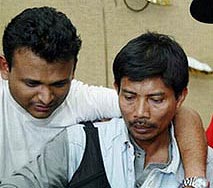 Fernandez (
left
) was in one of the vehicles, together with Omar Salleh (
right
), the chief cameraman of state-owned TV station RTM, who had left his camera rolling until the tape finished.
Fernandez (
left
) was in one of the vehicles, together with Omar Salleh (
right
), the chief cameraman of state-owned TV station RTM, who had left his camera rolling until the tape finished.
Omar's footage recorded the sound of bullets raining on the convoy, screams of terrified team members and grim orders from their Iraqi captors.
Excerpts of the footage had been aired by CNN, BBC and local TV stations.
Fernandez, currently The Sun assistant news editor, said the government had failed to adequately prepare the Joint Media Team Malaysia (JMTM) for such an assignment, and had thus put all their lives at risk.
"(It) was another lawatan sambil belajar (a study tour). I am sore over the whole episode. I think it was a very irresponsible thing for the government to do."
According to Fernandez, most war correspondents they had met in Iraq had experienced covering other conflict areas, and despite this they had at least a one-month training - given by their respective media organisations - to prepare for the Iraq assignment.
Fernandez was also upset that none of the officials from several ministries responsible for sending the media team to Iraq were present at last Thursday's seminar.
The seminar was jointly organised by the Asian Institute for Development Communication and the International Committee of the Red Cross to sensitise Malaysian journalists to the role of reporting humanitarian issues during an armed conflict.
Military-issued flak jackets
Relating the days prior to the 40-odd members' departure to Jordan and later Iraq, Fernandez said the briefings conducted by the Defence Ministry had fallen short of what he had expected for such a high-risk assignment.
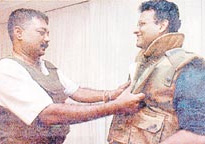 "Mindef (Defence Ministry) gave us flak jackets as opposed to the blue jackets that journalists are required to don in war zone.
"After some of us asked if it was appropriate attire, some generals conceded that it may pose a problem but said that we should take them first," said Fernandez, who was a panelist of the ' Reporting from the Frontlines: Are we ready? ' session.
He said the team was promised police blue jackets to replace the military-issued flak jackets but this did not materalise.
"A briefing based on military intelligence on the ground situation in Iraq turned out to be a slide show on scorpions, mountain goats and the desert," added Fernandez, who was still vexed by the year-old issue.
"We were never told of the different sects that were fighting in Iraq and the so-called military intelligence reports were actually news reports by foreign agencies including Reuters and the BBC."
Upon their return from Iraq, he said some journalists were told that the government never had any emergency evacuation plan for the media team.
Fernandez said that then information minister Khalil Yaakob had also proposed an institute to train journalists in covering conflict areas.
"But I don't know what happened to that proposal now that he has been appointed the Yang di Pertua of Malacca."
Contacted today, a JMTM source said the team was only given one week to prepare for the Iraq assignment.
"We faced many problems making arrangements on such a short notice and team members were given specific instructions on the dos and don'ts once they get into Iraq," said the source who declined to be identified.
"But some people did not follow the instructions, which led to the unfortunate incident. Luckily, no media team member was injured. The situation could have been much worse."
Funds unaccounted for
The Sun group executive editor Zainon Ahmad, who chaired the session, said that he was against the mission to Iraq.
"I was totally against the government's plan to send a media team to Iraq... because it kind of removed the cover of independence that newspapers had," he quipped.
He insisted that the Iraq war coverage should have been left to the respective media organisations to sponsor.
"I'm totally against government funding of the media in covering such matters."
It had been reported that RM8 million were allocated for the media mission.
"There are many things that remain unaccounted for, including the funds. Where the money went to, no one knows till now," said Zainon
According to the JMTM source, only those directly involved in the mission would have the full details of how the funds were used.
JMTM was led by New Straits Times editor Ahmad A Talib, who could not be reached for comments on the matter.
Other journalists who sat as panelists for the seminar were The Star 's Shahanaaz Sher Habib and Sira Habibu, New Straits Times executive editor Rajan Moses and Paris-based Reporters sans Frontieres Southeast Asia representative Philippe Latour.


