


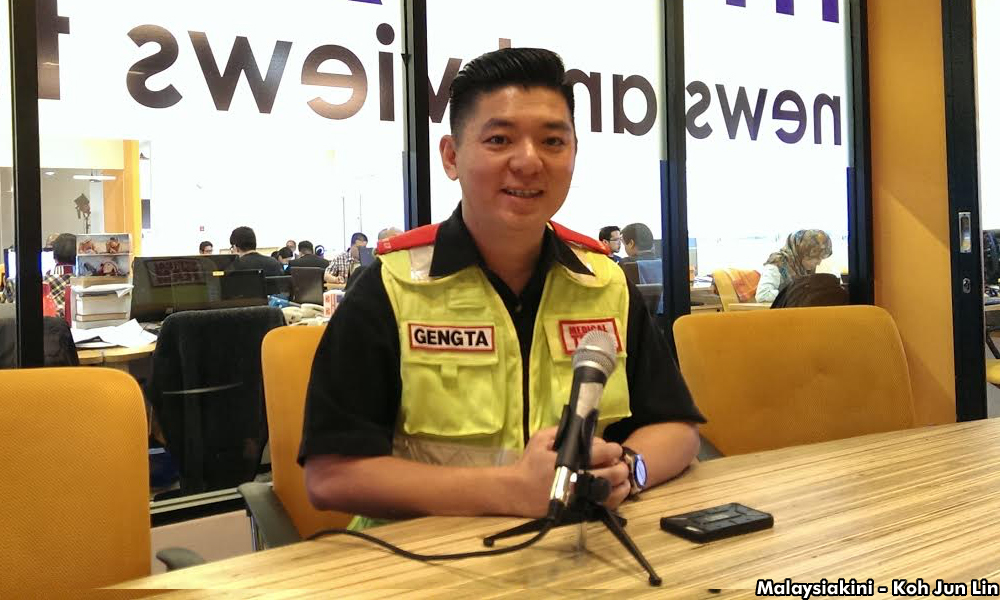

Paramedic goes 'white to black' to lead medic team at Bersih 4
As things took a turn for the worse during the Bersih 2.0 rally in 2011, a young white-clad paramedic was told not to help the injured protestors around him.
He was in the Pudu area, which had seen the worst of the skirmishes between the police and protesters, and before him was a man bleeding from his forehead after being struck by a hard object.
His orders: You’re not allowed to touch the casualties.
He disobeyed.
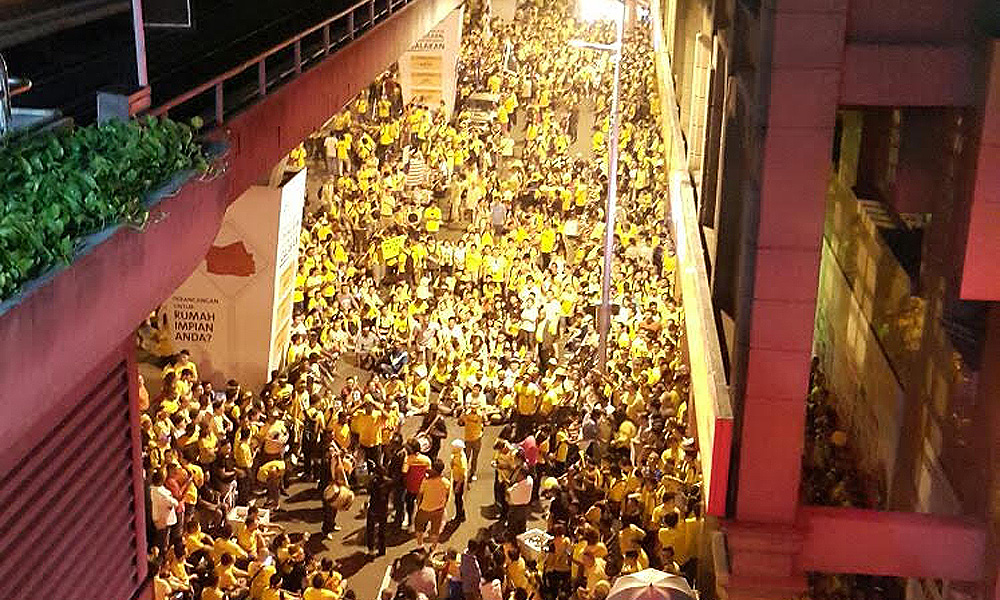
Four years later at the Bersih 4 rally, the same paramedic Tan Gengta was back in the field – this time swapping into a black uniform and coordinating a team of 218 like-minded medical personnel to provide care for the protestors.
MALAYSIANSKINI | As things took a turn for the worse during the Bersih 2.0 rally in 2011, a young white-clad paramedic was told not to help the injured protestors around him.
He was in the Pudu area, which had seen the worst of the skirmishes between the police and protesters, and before him was a man bleeding from his forehead after being struck by a hard object.
His orders: You’re not allowed to touch the casualties.
He disobeyed.
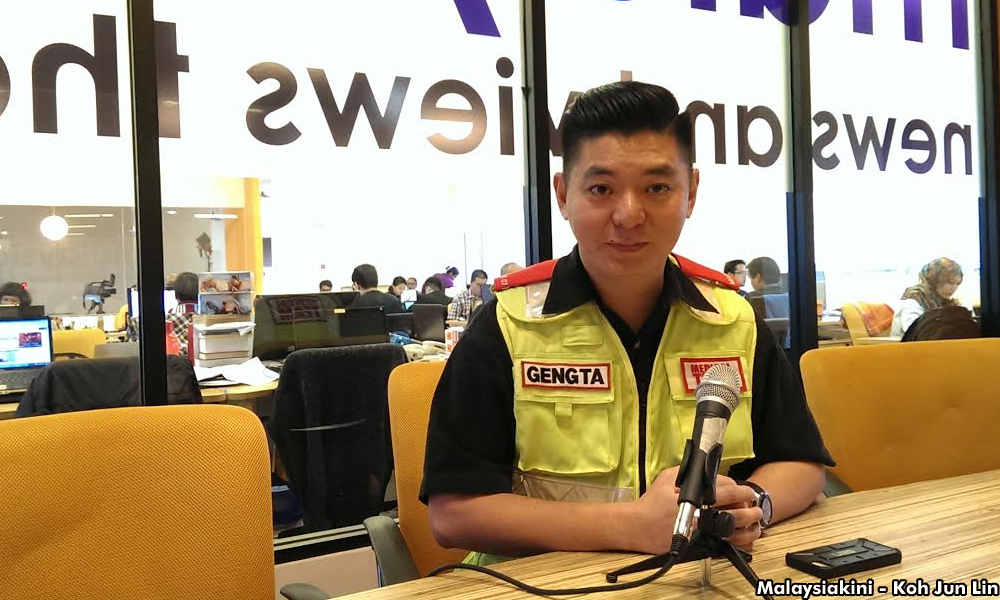
Four years later at the Bersih 4 rally, the same paramedic Tan Gengta was back in the field – this time swapping into a black uniform and coordinating a team of 218 like-minded medical personnel to provide care for the protestors.
For the 35-year-old, saving lives is a calling he heard at the tender age of eight, when he saw his late father use his handkerchief to stop the bleeding of an injured motorcyclist they didn’t know.
"We could have waited for the ambulance but without further ado he just stopped his car at the corner, ran out and immobilised the patient, waited until the ambulance came, and only then handed him (the casualty) over to the ambulance driver.
"I found that it is quite a noble job. It helped me (make up my mind) that I want to be a medic," he said.
Those who had been close to Dataran Merdeka during the Bersih 4 rally may have spotted him, a man with a stylish haido wearing a lime-green vest bearing his name over his uniform, with numerous pouches around his waist, and red shoulder boards marking him as the leader of team number 7.
But being on the front lines of the mammoth demonstration does little to prepare one for the limelight, and Tan spoke haltingly at first as he sat down for an interview with Malaysiakini on Friday.
The Teluk Intan native’s discomfort at being the centre of attention, however, paled in comparison to his passion as he spoke of his journey to become a paramedic.
At 10, two years after the road accident that changed his life, Tan followed his father’s footsteps by joining the St John’s Ambulance unit at his primary school.
He continued to serve with the unit in his secondary school and enrolling to train as a paramedic after that was a no-brainer. But the journey there would prove more difficult.
The Black Ops Medic
Short of money to pursue his dreams, he took up a scholarship to study hospitality management only to find himself drawn back to the medical line as a salesperson peddling medicine and medical equipment after graduation.
This would be his day job, and on the side, he would pursue paramedic training through a course offered at Hospital Universiti Kebangsaan Malaysia (HUKM), finally earning his paramedic qualifications and white uniform in 2005.
It was his white uniform which led him to the Bersih 2.0 rally six years later, and another turning point in his life.
"When I was helping under the white uniform, I was asked (by Kuala Lumpur City Hall (DBKL) enforcement officers) to stay back and not to help those protestors. So my question is, why not?"
"They told me, ‘No, let the police handle it.’ […] In my mind, I was very angry.
"Why can’t I touch the patients? The patients need medical attention, which I have to go attend to," Tan said, clearly still agitated, years later.
He said he was upset with his superiors for not helping the injured and made up his mind to disobey – a move which some of his colleagues looked down upon as being "out of control".
As the chaos moved to calm that night, Tan, still disturbed, and some friends who were doctors and paramedics shared their experience in a debriefing session. That was the night the ‘Black Ops Medic’ was born.
The name not only alludes to their signature black uniform that Tan deems to be more suitable for fieldwork, but also the fact that the group operates without official sanction.
Word then spread by mouth, and more people asked to sign up. The group started mobilising to assist in disasters, like flooding in the East Coast, when photos of Tan assisting protestors at Bersih 2.0 caught the attention of then Bersih steering committee Dr Ahmad Farouk Musa.
Two months before the rally on April 28, 2012, the group was roped in with several other medical professionals to assist in the rally under the generic and more neutral name – ‘Medical Team’.
Tan explained that some of the group’s members and supporters did not want to be overtly associated with Bersih – some were doctors at government hospitals while others held consulting positions and were concerned about job security.
“That’s why you’d see that I’m always the spokesperson, always the one who would appear. A lot of my doctors don’t even want their photos being taken.
“They don’t want their faces to be published because they are senior consultants and things like that. It is quite risky for their future,” the father-of-two said.
(Tan himself is confident he will be able to land a new job if he gets sacked, through the doctors he has worked with, and the contacts he had made as a salesperson.)
Man collapses, paramedics can't help
For the Medical Team’s baptism of fire during Bersih 3.0, Tan had a team of of 156 paramedics, emergency doctors, general practitioners, first responders, anaesthesiologists, and other healthcare workers in the field including himself.
The equipment and medication were either sponsored, loaned or borrowed by the group’s members and supporters on the team's behalf, while the ambulances were chartered with money contributed by doctors who support the cause.
As tear gas filled the air during Bersih 3.0, one man within Tan’s sight showed early signs of a heart attack. But again, he was barred from crossing a police line to provide help.
"They wanted us to show the entry permit ( surat keluar masuk ) from the police or something like that, which we don’t have. They only give those letters to the Ministry of Health, which is the government hospital’s ambulance and crew.
“For us, we are a neutral body. Who wants to give us this kind of letter?”
Unrelenting, he got in a shouting match with the police only to witness the protestor collapse on the other side. “Let us settle this first, we will talk later,” he told the police officer and rushed to the casualty with his team members.
Using a borrowed automatic external defibrillator, he was able to resuscitate the casualty and send him to hospital. One othe person was resuscitated in the same manner along Jalan Raja Laut that day.
Another team stationed at the adjacent Jalan Tunku Abdul Rahman similarly revived one casualty.
There were no fatalities during Bersih 3.0, compared to one in Bersih 2.0, and Tan believes the Medical Team’s presence helped make the difference.
Tan believes among contributing factors to Baharuddin Ahmad’s death due to cardiac arrest in Bersih 2.0 were poor communications, and the fact there were no medical teams stations stationed in the area where he collapsed.
This was the reason the Medical Team during Bersih 3.0 were armed with walkie talkies and spread out to various areas of the protest.
'When no one comes to help, we'll be there'
There were no tear gas fired during the peaceful Bersih 4 rally on Aug 29 and 30, but the Medical Team was not without challenges. There was one heart attack case, he said, and rushing the casualty to hospital proved a challenge.
The authorities only allowed government ambulances past roadblocks, and the team was forced to carry the casualty to the DBKL headquarters where the government ambulances were stationed.
It was only after much persuasion to the police, the DBKL, and the government doctors that the Medical Team’s chartered ambulances were allowed through on the second day, but even then, they had to be parked some distance away from where the team had set up its medical stations.
"We’re upset, but what can we do? The authorities control the whole thing," he said.
Looking forward, Tan said he hopes to register the Medical Team as an NGO by the end of the year.
“Whenever things happen such as a rallies, no (medical) NGO will come to help you especially if they think you are with the opposition party or things like that.
"If nobody comes to help you, we are the team that will come and assist you."
MALAYSIANS KINI is a series on up-and-coming politicians and activists.
Related reports
Foreign Ministry monitoring M’sians involved in global Bersih 4
Kuala Langat Umno Youth lodge police reports against Bersih 4
Wan Azizah joins call for emergency session over Najib criticisms


Are you sure you want to delete this comment?
This action cannot be undone.