




Ex-judge: Restrictions on people, media must be reasonable
If the authorities are to impose restrictions on the people, these must be proportionate and reasonanble, former Court of Appeal judge Mohamad Ariff Md Yusof said today.
Speaking at the Role of Media in a Democracy, Ariff said freedom of speech should not be limited by laws on defamation and contempt.
If the authorities are to impose restrictions on the people, these must be proportionate and reasonable, former Court of Appeal judge Mohamad Ariff Mohd Yusof said today.
Speaking at the 'Role of Media in a Democracy' conference in Kuala Lumpur today, Ariff said freedom of speech should not be limited by laws on defamation and contempt.
“This is the wrong analysis and not the right approach. One has to evaluate whether the restrictions imposed are proportionate, reasonable and protective of fundamental liberties, or the other way round,” he said.
Ariff ( photo ) noted the actions taken by the Home Ministry in suspending two publications of The Edge Media Group and described the High Court ruling to lift the suspension last month as a landmark decision.
The former Court of Appeal judge who sat in the Sisters In Islam case at the High Court, involving a book which was banned by the authorities following an order from the Home Minister on the grounds of public order.
However, he said that he decided to lift the ban as the book had already been in the market for five years and during those years, the authorities had not provided evidence how it had caused disruption to public order.
“The High Court's decision was upheld by the Court of Appeal who agreed with me,” he said.
Lifting ban on Zunar's cartoons
Justice Ariff also sat on the panel at the Court of Appeal in lifting the ban on Zunar's (photo) cartoons book 1 Funny Malaysia and Perak Darul Kartun based on the same grounds of disrupting public order.
He said the court could not see how cartoons could overthrow a government.
“We would not be persuaded by the arguments (by the Home Minister and government) on how it is detrimental to public order let alone be seditious,” he said.
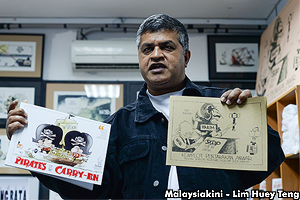 In his judgment on the lifting of the ban in October last year, Justice Ariff
wrote that
cartoons, satires and parodies should not be dealt with in the same seriousness as written prose.
In his judgment on the lifting of the ban in October last year, Justice Ariff
wrote that
cartoons, satires and parodies should not be dealt with in the same seriousness as written prose.
“We are not dealing with serious and sober works of literature in written prose. We are instead dealing with cartoons, political cartoons, satire and parody. No reasonable person will read a cartoon with the same concentration, contemplation and seriousness as one would when reading a work of literature.
“When read (more likely, glanced through), they would tickle the ribs, perhaps evoke a chuckle, and make one reflect for a momentary instance the humorous side of life," he had ruled.
Justice Ariff noted that another of Zunar's work was being investigated for seditious tendency by the authorites.
Media bastion of democracy
He also said the people believed that the media was part of the bastion of democracy and that they were now more careful about what is put up on the Internet.
If in the past, he said, the people may have believed that what is put up on the Internet as possibly the truth, but now they were more discerning in filtering such information.
“This shows that there is maturity of thought in the people as they do not believe anything put up, from funny-sounding names or pseudonyms,” Ariff noted.
Related report


Are you sure you want to delete this comment?
This action cannot be undone.