




More non-bumi civil servants needed in urban areas
A social psychologist today said the government should seriously establish multi-racial, multi-disciplinary civil service teams so that public services become more accessible to all the low-income families, irrespective of race.
 Dr Denison Jayasooria (photo right), executive director of MIC's social arm Yayasan Strategik Sosial (YSS), said there must be specific targeting in increasing the number of non-bumiputera civil servants in urban areas where a majority of low-income families live.
A social psychologist today said the government should seriously establish multi-racial, multi-disciplinary civil service teams so that public services become more accessible to all the low-income families, irrespective of race.
 Dr Denison Jayasooria (photo right), executive director of MIC's social arm Yayasan Strategik Sosial (YSS), said there must be specific targeting in increasing the number of non-bumiputera civil servants in urban areas where a majority of low-income families live.
"This is to ensure that the target group has access to government services and programmes including getting information, accessing it through people-friendly civil servants and designated civil society organisations," he told participants at a one-day national seminar in Kuala Lumpur.
He cited the example of Kampung Medan, the suburban slum which witnessed bloody clashes between ethnic Malay and Indians in March 2001 that claimed many lives, leaving scores more injured.
"Till today, departments like social welfare does not have a multi-racial team. This has a negative impact towards equal access to public services," he said, adding that most Malaysians took race relations for granted.
"The Petaling district like Klang and Shah Alam have a high percentage of Malaysian Chinese and Indians, so there must be a number of non-bumi civil servants."
Pak Lah's social agenda
Denison's paper entitled 'Pak Lah's Social Agenda: Relevance & Impact of Low-Income Families' was presented at the seminar 'Abdullah Ahmad Badawi: Satu Tahun di Putrajaya - Perubahan Dalam Kesinambungan' (Abdullah Ahmad Badawi: One Year in Putrajaya - Changes in Equilibrium).
He also reiterated the National Social Policy's aim of ensuring the participation and contribution of every individual, family and community regardless of ethnic group, religion, culture and location to development and a self-sustainable living standard.
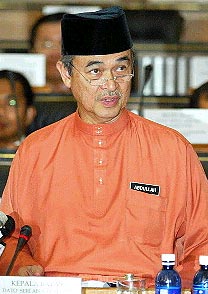 Reflecting on Abdullah's one-year in office, he said the premier merely continued with existing policies without any "radical departure" from prevailing socio-economic agenda.
"However, he has given greater importance and emphasis to people-centered development."
In addition, he said, the prime minister has sought to strengthen public institutions through performance indicators for parliamentarians, promoting a corrupt-free police force, improving the judiciary and improving the civil service.
Commending the Housing and Local Government Ministry's push for active participation of local residents, however, he said the "only drawback" was the resistance to the re-introduction of local elections.
Denison said the Economic Planning Unit has also drawn the distinction between rural and urban poverty, leading to a new index and measurement that will be introduced at unveiling of the 9th Malaysia Plan.
Focusing on Abdullah's people's PM image, ISM director Prof Dr Roziah Omar listed down all his social strategy announcements since taking up office November last year, and linked them to the United Nations' Millennium Development Goals (MDGs).
All 191 member states have pledged to meet the eight-point goals by 2015 encompassing poverty, education, women's empowerment, child mortality, maternal health, HIV/AIDS and other diseases, environmental sustainability and global development partnership.
'Radical strategy'
She said Malaysia's Vision 2020 and the MDGs place strong emphasis on socio-economic development.
"We are grateful that Malaysia is now a developed and respected nation that has been able to overcome poverty and social inequalities and thrust our people forward as international entrepreneurs," she said.
"Clearly, he (Abdullah) is very passionate about humanitarian issues such as hardcore poverty, family unit, sexual violence and drug abuse among youths."
Citing a 'radical strategy', she said the premier had urged the media to widely report on sexual violence to galvanise public anger and eliminate the problem more effectively.
Today's seminar was jointly organised by Universiti Sains Malaysia's (USM) school of social science, YSS, Institut Sosial Malaysia (ISM) and Asian Strategy and Leadership Institute.
The challenges facing Abdullah in managing success was analysed by Utusan Karya Sdn Bhd director Prof Dr Firdaus Abdullah, Universiti Malaya's Civilisational Dialogue Centre director Prof Dr Azizan Baharuddin and social science lecturer Dr Sivamurugan Pandian.
Papers on the national social agenda towards ensuring citizens' well being were presented by Roziah, Denison and Biro Tatanegara Director-General Dr Nordin Kardi, whose paper summary was read out by a representative.
The topic on Islam Hadhari was addressed by Yayasan Dakwah Islamiah Malaysia chairperson Mohd Nakhaie Ahmad, International Institute of Islamic Thought and Civilisation Fellow Uthman El-Muhammady, and Prof Muhammad Syukri Salleh from USM.
Panelists for the forum session entitled 'Halatuju Negara: Cemerlang, Gemilang, Terbilang' (Nation's Direction: Excellence, Glory and Distinction) were Umno information chief Muhammad Muhd Taib, MIC vice-president G Palanivel and MCA Youth chief Ong Tee Keat.


Are you sure you want to delete this comment?
This action cannot be undone.