




PKR tugged between populism and principle
COMMENT Today's meeting of the central leadership council of PKR, convened by demand of members reportedly unhappy with the alleged haste behind Pakatan Harapan's formation, is simply a continuation of the intramural feuding within the party.
The feuding accelerated last year after the faction allied to Azmin Ali were denied the spoils of victory in the party's internal polls in spite of having done well in the elections.
When deputy president Azmin not only comfortably retained his post in the polls and went on to become Selangor menteri besar - largely through the support of PAS - members of the group opposed to him were appointed to key posts in the hierarchy by the party's de facto leader, Anwar Ibrahim, who had maintained a posture of dubious neutrality during the polls.
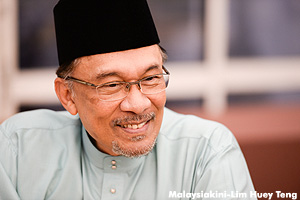 After the elections, Anwar (
photo
), in an exercise of the aura stemming from his stature as party supremo, appointed to key posts individuals from the camp that was opposed to Azmin.
After the elections, Anwar (
photo
), in an exercise of the aura stemming from his stature as party supremo, appointed to key posts individuals from the camp that was opposed to Azmin.
The choices only worsened the feuding.
Because factions are endemic to democratic party politics, a wise unifier would seek to coopt, if not balance them.
Anwar's appointments served not only to deepen the divide but, after his jailing on sodomy charges last February, to drive underground the antagonism between the pro- and anti-Azmin factions.
Now this antagonism has re-emerged by way of discontent by the pro-Azmin faction over the alleged haste in the formation of Pakatan Harapan on Sept 22.
Harapan groups DAP, PKR and the PAS splinter, Parti Amanah Negara, in a new opposition coalition.
Its predecessor, Pakatan Rakyat, expired in June from mutual hostility between PAS and DAP.
Worse was to follow as PAS itself split up, with the progressives in the party leaving after they were routed by the conservatives in June 's party polls.
Ties cut
PAS is loath to join Harapan because PAS had cut ties to the DAP last June and views the formation of Amanah as an act by traitors aimed at destroying it.
The pro-Azmin faction in PKR is unhappy that the speedy formation of Harapan has left it no time for its wooing of PAS to succeed.
The faction is in favour of Harapan's formation but want the gelling of this new coalition to be gradual rather than expeditious, presumably allowing them enough time and space for PAS to see the liberating light of intra-opposition collaboration.
The pro-Azmin faction thinks PKR's courtship of PAS will succeed in convincing it this collaboration is better than fighting the ruling BN at Election 2018 singly and separately.
This view fails to reckon with the deviousness of elements in the leadership of PAS who are in cahoots with Umno in attempting to detach DAP from PAS.
This collusion was manifested in Kelantan Umno's support last March of legislation in the state assembly that paves the way for hudud to be implemented in Kelantan.
This manoeuvre forced the secularists of DAP to part company with PAS, with PKR not only unable to prevent the split but also prevaricating as to where it stood on the issue of hudud.
PKR's stand on hudud contains a disconcerting parallel to the pro-Azmin faction's attitude to Pakatan Harapan: PKR is not in favour of hudud but does not think it should protest the measure too loudly; the pro-Azmin faction is in favour of Pakatan Harapan but is against haste in forming it.
All this makes for a general incoherence about its positions that is attributable to the party's preference for electoral populism over ideological principle.
Shared traits
The strange thing is that this is the reverse of what the present top leadership of PAS, as vented by president Abdul Hadi Awang ( photo ), claims is their position, which is a preference for ideological purity over electability.
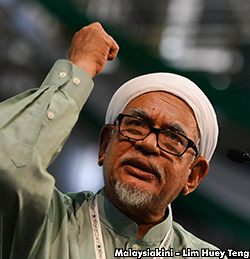 PKR and PAS do have some shared traits, even significant ones like the quest for justice.
The question is what is the commonality that counts for PKR and for PAS, and when, and why.
Politics always entails the choice of some commonalities over others.
Otherwise the search for commonalities would involve a decision to scant significant differences in favor of dubious similarities.
PKR ought to bear in mind that the common ground is not always the high ground.
When the search for common ground is without end, it informs the other side that what you most want is the deal – that you will not acknowledge the finality of difference, and not value the integrity of opposition.
This just leaves the searcher with his halo and his populism.
TERENCE NETTO has been a journalist for more than four decades. A sobering discovery has been that those who protest the loudest tend to replicate the faults they revile in others.


Are you sure you want to delete this comment?
This action cannot be undone.