




How Dutch prove Buk missile downed MH17
Despite Russian denials, Dutch Safety Board (OVV) chairperson Tjibbe Joustra said there is ‘overwhelming’ evidence to support the conclusion that Malaysian Airlines flight MH17 was downed by a Buk missile.
“The Russian Federation concurs with the conclusion that the crash was caused by the detonation of a warhead, but has reservations regarding the missile and warhead type.
“However, in our judgment, the arguments of the report overwhelmingly support the conclusions as presented,” Joustra said in a video released by the OVV yesterday.
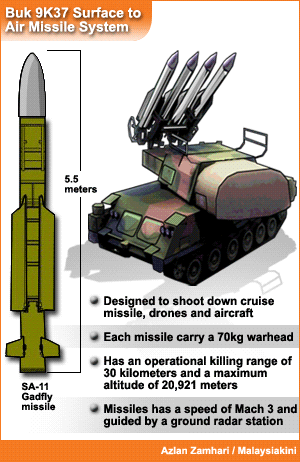
The OVV identified the weapon that had shot down MH17 as a 9N314M warhead carried on a 9M38-series missile, which is consistent with the Russian-made Buk missile system.
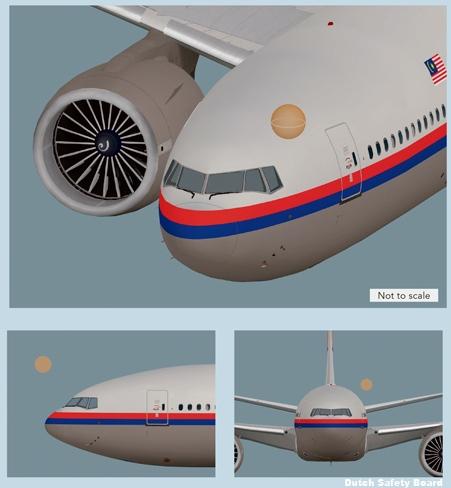
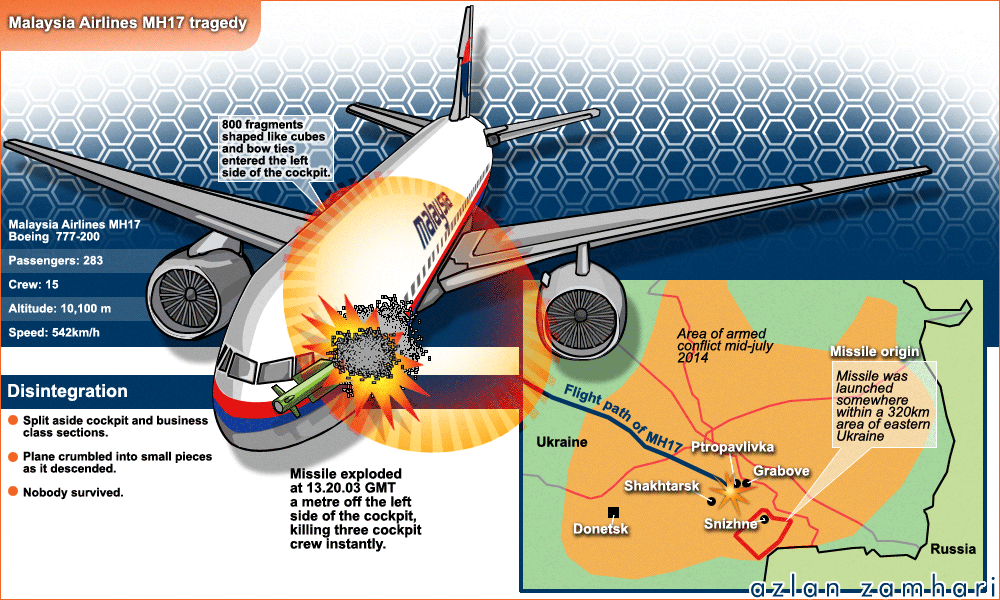
 It said the missile was launched from Ukrainian separatist-held territory in Eastern Ukraine, and detonated about four metres from the aircraft’s nose, slightly to the left of the cockpit where the flight crew was seated.
Russia has consistently denied supplying the separatists with Buk missiles.
It had previously purported a number of alternative theories, such as a shoot-down by missile and/or cannon fire by the Ukrainian air force, or a Ukrainian Buk missile.
Ukraine, a former Soviet republic, is known to field these Russian-made weapons.
According to Reuters yesterday, which quoted Russian news agencies, the Russian government now disputes the claim that a Buk missile (photo) had been used on MH17.
The report is “an obvious attempt to draw a biased conclusion, and carry out political orders,” its Deputy Foreign Minister Sergei Ryabkov is quoted as saying.
The OVV said in its investigation report yesterday that the blast sent thousands of shrapnel fanning out from the sides of the missile, hundreds of which struck the aircraft and killing the flight crew instantly.
The explosion also caused the front of the aircraft to separate from the rest of the aircraft and the mid-air disintegration of the rest of the aircraft soon ensued.
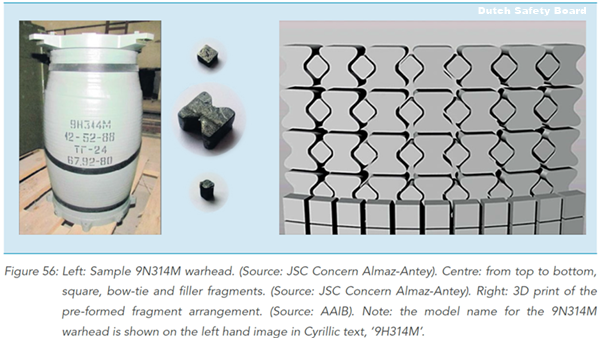
Cube, bow-tie shaped fragments
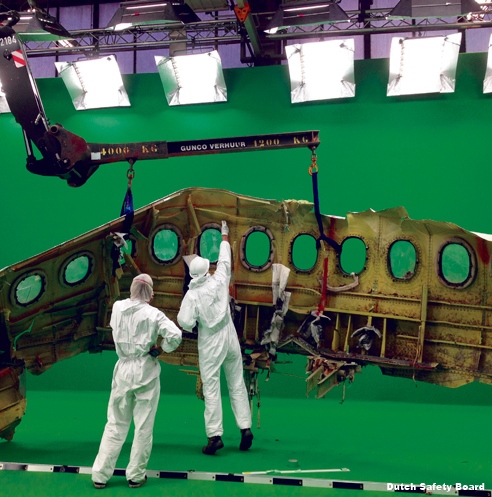
The OVV said these fragments have been found in the wreckage as well as in the bodies of the captain, first officer and purser.
Although deformed, it said the fragments were found to be of bow-tie and cubic shapes.
Based on this, air-to-air gunfire had been ruled-out as the possible cause, as this does not produce cube and bow-tie shaped fragments.
 In addition, a jet fighter attacking the upper front portion of an airliner is not expected to be able to land several dozen hits at best.
“This is a much lower number than the 350 high-energy object hits that were found on the wreckage of the cockpit,” it said.
As for the ‘air-to-air missile’ theory, the OVV said none of the air-to-air missiles in use in the region produced these bow-tie and cube fragments.
Instead, the air-to-air missiles produce rod-shaped pieces of metal to damage its target or other shapes of fragmentation.
“In addition, for an air-to-air missile to have caused the damage found, another aircraft would have been recorded by at least primary radar data,” it said.
The report also noted that there was no military aircraft within at least 30 kilometres from MH17 at the time of the incident on July 17, 2014.
 The OVV also ruled out shoulder-launched anti-aircraft missiles on basis that these could not fly high enough to reach MH17, which was flying at 33,000 feet (more than 10km) at the time.
As for larger weapons that could reach MH17, the report said there are about 20 types of such weapons in use in the region, all of which are fitted with radar-guidance and fragmentation warheads.
However, only one type of warhead produces the distinctive bow-tie and cube-shape fragments.
“It is noted that the shapes of the pre-preformed fragments found in the wreckage and the bodies of the crew members in the cockpit; bow-tied and cubes, are only found in the 9N314M warhead.
“The 9N314M warhead can be fitted to the 9M38M1 missile. These missiles are launched from a Buk surface-to-air missile system,” the OVV report states.
Computer simulation tests
It quoted the Ukraine-based Kyiv Research Institute for Forensic Expertise as saying that this warhead can be fitted onto either the 9M38 or newer 9M39M1 missiles, which would have been carried on the Buk, Buk M1 and Buk M1-2 models of the missile system.
These weapon systems were introduced in 1979, 1983 and 1988, respectively.
It also quoted the Russian arms manufacturer JSC Concern Almaz-Antey as saying that this type of warhead was not equipped to the oldest or latest versions of the system, namely the Kub and the Buk-M2.
“The 9N314 and 9M314M warheads are composed of two layers of pre-formed fragments. The inner layer of pre-formed fragments in the 9N314M warhead is composed of bow-tie shaped fragments together with square-shaped ‘filler’ fragments.
“The outer layer consists of larger square-shaped fragments. On detonation, the warhead’s casing will shatter into irregularly shaped pieces...
 “The total number of pre-formed objects in a 9N314M warhead is, according to Russian Federation defence groupJSC Concern Almaz-Antey, between 7,000 and 8,000,” the report says.
It adds that the missile warhead also carries 70kg of high explosive.
This provided a good match to computer simulation tests conducted by the Netherlands Organisation for Applied Scientific Research (TNO), which tested various types of warheads and the predicted damage to an aircraft in MH17’s situation.
The tests found that the damage to MH17’s cockpit was best explained by a detonation of a 70kg warhead, it said.
However, the Dutch report did not assign blame to any group or country for firing the Buk missile.
That falls outside of the scope of OVV’s investigation and is instead the subject of a parallel criminal investigation.


Are you sure you want to delete this comment?
This action cannot be undone.