




MIER director: Chinese-bumi income gap narrowing
The average household income gap between Chinese and bumiputera has indeed been narrowing over the years, Malaysian Institute of Economic Research (MIER) executive director Zakariah Abdul Rashid said today.
"(The gap) is narrowing over time, but at a very slow pace. It's improving, but not satisfactorily acceptable by all people," Zakariah said.
The average household income gap between Chinese and bumiputera has indeed been narrowing over the years, Malaysian Institute of Economic Research (MIER) executive director Zakariah Abdul Rashid said today.
"(The gap) is narrowing over time, but at a very slow pace. It's improving, but not satisfactorily acceptable by all people," Zakariah said.
Actually, he explained, the household income gap was even worse back in the early days of the country's independence.
 "It all started during the Merdeka days. The gap was already there, and in fact, it was larger back then," he said.
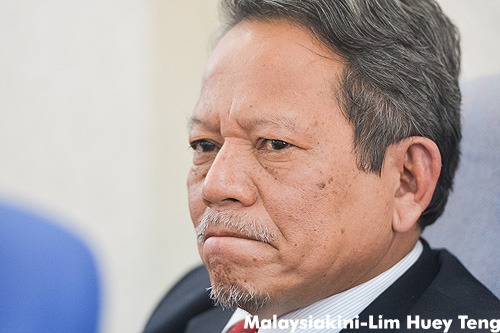
Zakariah ( photo ) was responding to the government statistics released yesterday, which revealed that the average household income gap was widest between the Chinese and bumiputera, at 38 percent.
"This means that the New Economic Policy (NEP) doesn't address this issue of income gap. It addresses some other things," he concluded.
He did not elaborate on what the NEP actually addressed.
Meanwhile, Zakariah expects the Budget 2016, which will be tabled tomorrow, to reflect the people's main concerns right now.
"(And that) is the long-term objective of making the economy able to achieve high-income status by 2020.
"Secondly, to be able to achieve the fiscal deficit target," he said.
Very challenging
However, Zakariah cautioned against focusing too much on achieving the high-income economy status,
Under the New Economic Model, achieving high-income economy status is only one part of the model.
The other two are sustainability and inclusiveness, he said, with quality of life at the centre.
"High-income economy doesn't mean that people will have a good life, because high-income and household income are different things.
"If you want to focus on high-income economy alone, you're forgetting about the other two and the quality of life," he said.
Regardless, Zakariah added, it would now be very challenging for our country to achieve high-income economy status by 2020.
This is due to the drastic depreciation of the ringgit against the US dollar since April this year.
"My (previous) calculations said that we can easily achieve high-income status even before 2020 under the previous exchange rate," he said.
Zakariah also said he did not expect the exchange rate to fluctuate too much from where it is now till the end of this year.


Are you sure you want to delete this comment?
This action cannot be undone.