



'Beware of higher GST if oil prices slip as gov't now addicted'
The government will become addicted to using the goods and services tax (GST) as an easy way to raise revenue, PKR’s Pandan MP Rafizi Ramli has warned.
If the oil prices fall further next year for example - which is expected to happen - the government will raise the GST rate because it is easy to do, even if it is just a fraction of a percent, Rafizi said.
The government will become addicted to using the Goods and Services Tax (GST) as an easy way to raise revenue, PKR’s Pandan MP Rafizi Ramli has warned.
If the oil prices fall further next year, for example - which is expected to happen - the government will raise the GST rate because it is easy to do, even if it is just a fraction of a percent, he said.
The implementation of the GST, he said, represented a clear shift in government policy – from relying on oil, gas, government-linked companies (GLCs) and other national assets for revenue – to taxing everyday Malaysians.
“The danger of having GST in place is that the GST will become ‘opium’ for the government. There will be an addiction to implement easy taxation, through GST.
 “GST can be increased by 0.5 percent, or from six percent to seven percent, as urged by the International Monetary Fund (IMF), and there will be no end to it,” Rafizi (
photo
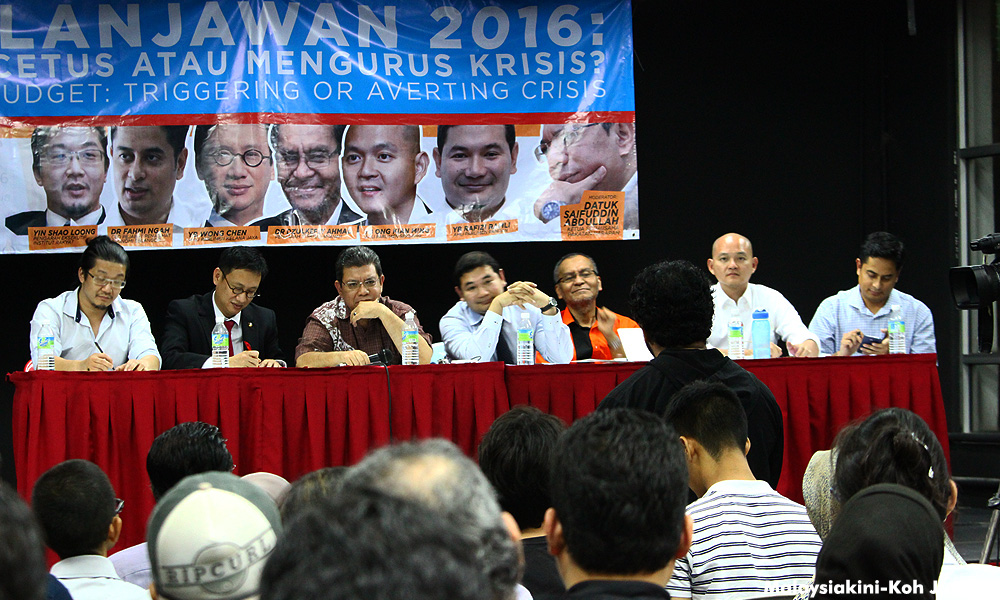
) said at a forum on Pakatan Harapan’s alternative budget in Kuala Lumpur last night.
“GST can be increased by 0.5 percent, or from six percent to seven percent, as urged by the International Monetary Fund (IMF), and there will be no end to it,” Rafizi (
photo
) said at a forum on Pakatan Harapan’s alternative budget in Kuala Lumpur last night.
He explained that Najib would believe that the people would eventually become used to paying the tax, and hence it would essentially be ‘painless’, once the GST rate is increased.
The government’s Budget 2016 also assumes that crude oil prices would not fall below US$48 per barrel, Rafizi said.
However, banking firm Goldman Sachs is betting that the oil prices would fall below US$20 per barrel next year, which would mean a huge shortfall in government revenue.
'Easy to collect more GST'
“What would they do? They would collect more GST, because it is easy,” he said.
Second Finance Minister Ahmad Husni Hanadzlah yesterday said that further budget cuts would be made if oil prices fall below US$48 per barrel.
 “If it is above that, it would be good in terms of our revenue but if it goes lower, we would have to cut here and there so that we do not miss the targeted 3.2 percent to GDP deficit and 55 percent government debt to GDP,” Husni said.
Meanwhile, the rating agency Moody’s was quoted by Bernama as saying that the government’s macroeconomic assumptions are ‘realistic’ .
Moody’s expressed concern that the government’s efforts to lower its deficits were slowing, but hailed the implementation of GST.
“Still, increasing reliance on the GST receipts over oil-related income to drive revenue growth enhances the sustainability of the government's fiscal tightening,” it reportedly said.
The Brent crude oil is currently being traded at US$47.54 per barrel, according to Bloomberg .
Related reports


Are you sure you want to delete this comment?
This action cannot be undone.