


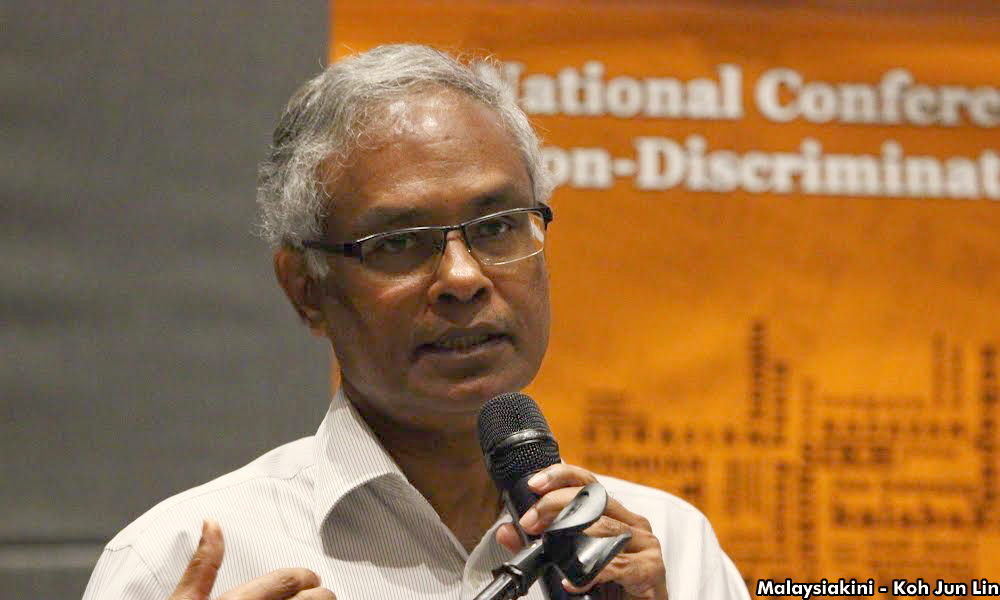

NEP has made M’sia more stable, says PSM leader
Despite its flaws, the affirmative action policies under the New Economic Policy (NEP) has helped to create more stability in the country, said Sungai Siput MP Dr Jeyakumar Devaraj.
The Parti Sosialis Malaysia (PSM) central committee member argued this is the reason why the Low Yat incident on July 22 had not been worse.
 “Despite everything, NEP has made Malaysia more stable. That’s why Low Yat (incident) didn’t flare up any further.
“I think it is because there is a very large Malay middle class; there is a Malay elite class. To be fair to NEP, I think it has made Malaysia more stable racially […]
“It’s true that our kids don’t play with other kids and there is more segregation at school, but in other ways, I think we are more stable and there is hope that we can move forward from this,” he said at the National Conference on Non-Discrimination today.
The NEP is a series of affirmative action policies adopted from 1971 to 1991, and has been replaced by other affirmative action policies since.
It was formulated to resolve the socio-economic issues that led to the May 13, 1969, racial riots, but critics claim that it merely created a crony-capitalist class and did little to redress those issues for many from the ethnic community.
'Have empathy for other races'
Jeyakumar said many non-Malays have difficulty understanding why Malays feel so insecure despite occupying nearly all of the positions in the civil service, the army, the police force, and the GLCs, including the top positions.
He said these insecurities are not without basis, and urged for better understanding of the underlying reasons.
If each ethnic group is only concerned with issues affecting themselves, it would not help solve any issue.
“We have got to start thinking as Malaysians and start thinking for other communities as well, instead of only talking about your own constituency or your own race. There has got to be empathy.
“I think all the people who are active have got to have empathy for other races as well. There has got to be reaching out, there has got to be respect; that’s the only way forward.
“We cannot be talking from the culture of ‘I’ve been wronged’,” he said.
Among others, he highlighted that despite many years of NEP programs, Malays comprise about three-quarters of the bottom 40 percent (B40) of income earners.
Meanwhile, bumiputras own 2.4 percent of the small and medium enterprises (SMEs) by number of units, or 0.85 percent by value, as of 2012, he said.
For comparison, Malays make up 50.1 percent of the Malaysian population while non-Malay bumiputras make up another 11.8 percent of the population, according to the 2010 census.
While needs-based policies would benefit poor Malays because they make up a disproportionate part of the B40, such policies cannot be formulated to increase bumiputra participation in SMEs.
He said these issues are not being talked about, and hence it should be no surprise if opposition coalition Pakatan Harapan or Bersih found little traction amongst Malays.
“So, it is important for us to understand when Malays don’t support Bersih 4 - what is the reason? Is it because they see a ‘Little Pakatan’ that is going to do away with the NEP, and what is going to happen to their children?” he said.


Are you sure you want to delete this comment?
This action cannot be undone.