


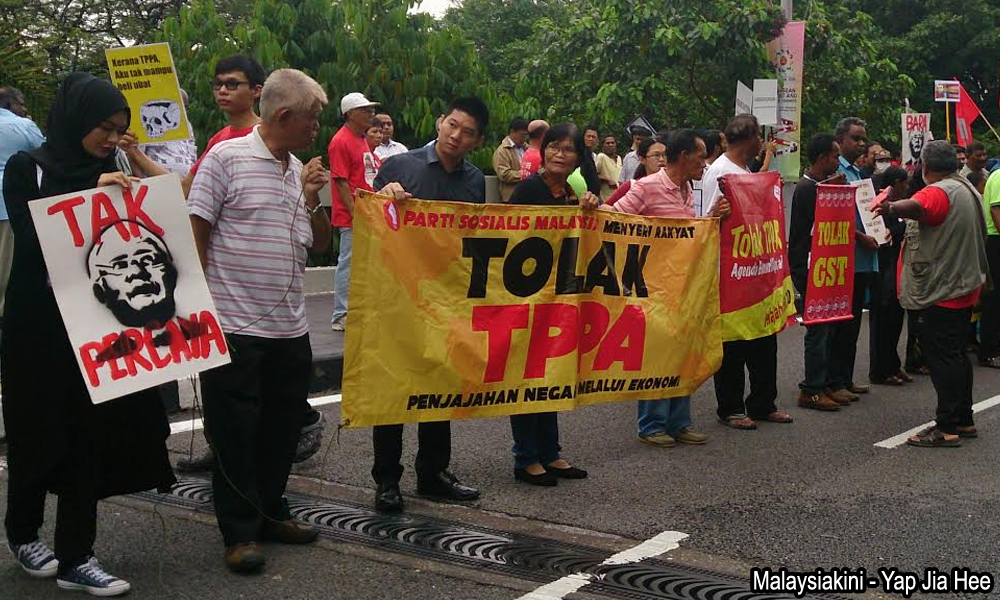

Our worst fear confirmed, pricier meds under TPPA
COMMENT The completed and finalised text of the Trans-Pacific Partnership Agreement (TPPA) has finally been released to the public.
An initial review of critical chapters has confirmed our worst fears. Despite claims made by government leaders and their cheerleaders, our concerns have not been overblown.
COMMENT The completed and finalised text of the Trans-Pacific Partnership Agreement (TPPA) has finally been released to the public.
An initial review of critical chapters has confirmed our worst fears. Despite claims made by government leaders and their cheerleaders, our concerns have not been overblown.
Based on the information that we had gathered from leaked documents and comparing them with the final negotiated text, we are right in our opinion that the TPPA is not the best deal for Malaysia.
Given that we will be legally bound to follow the TPPA – or face trade or other sanctions should we be found in violation – the prospects are dire.
The document containing 30 chapters will be analysed over the next few weeks and we shall release our analysis of various chapters in phases.
Briefly, below is our initial review of two of the most controversial chapters: Intellectual Property and Investment.
The Intellectual Property chapter will jeopardise access to affordable medicines:
- It enables drug companies to press for patent term extensions beyond the standard 20 years, to compensate for any 'unreasonable' time a patent office or drug regulatory authority takes to approve a patent application or grant marketing approval. Patent term extensions will significantly delay the entry of cheap generic medicines into the market.
- Generic companies will be prevented for five years from registering an equivalent generic version of a patented drug for market approval based on originator company data, thereby curbing the supply of cheaper drugs. While Malaysia already has this market exclusivity provisions, these have various safeguards, while the TPPA locks this in.
- Data exclusivity extends to the new generation of ‘biologics’ medicines (medicines derived from proteins isolated from pants, animals and micro-organisms) that have been developed to treat human diseases and conditions, such as vaccines, cancer medicines and therapies such as insulin. Under the TPPA, Malaysia must provide five years data exclusivity for biologics. The Malaysian law currently does NOT have data exclusivity for biologics and therefore will have to be amended to incorporate this. The number of years of biologic exclusivity have led to such high prices that even in the US, the Obama administration has repeatedly sought to reduce the number of years of biologic data exclusivity in that country.
- ‘Evergreening’ of already existing monopolies will happen through market exclusivity if a ‘new’ medicine is an old drug that has been found to be useable for a condition other than that which it was originally developed to treat, or for old medicine that has been found to be useable for a different population of patients. A pharmaceutical company can also seek exclusivity for new combinations of an old drug and a new chemical entity. The Investment Chapter overrides national sovereignty, allowing foreign investors to sue the government directly and preventing government from protecting citizens’ interests
- It provides for overly-wide definition of 'investment' that extends the coverage of the foreign investor rights, exposing the government to challenges and multi-million dollar compensation over their actions and policies. The definition of 'investor' is also overly-wide, allowing corporations from non-TPPA countries to sue under the chapter’s investor-state dispute settlement (ISDS) system.
- Rights will be granted to foreign investors that are not granted to domestic firms, such as the ability to challenge and demand compensation in an international court, which is a system that is lopsided in favour of private commercial interests.
- There are some provisions meant to improve on certain procedural aspects of the ISDS regime, but there remains no solution to the problem of the lack of an appeals mechanism, or the lack of a vigorous code of conduct for the ISDS judges that is comparable to most domestic judicial systems.
- Although Malaysia has signed investment agreements containing ISDS provisions as far back as 1959, the situation today is vastly different. Multinational corporations today wield far greater power, some of which have individual budgets exceeding that of entire countries.
The scope and depth of investment provisions today provide for the enjoyment of rights, but no obligations, by multinational companies.
These are just some pertinent areas that we can cover a few hours after the document was released. We shall be releasing further analyses over the next few days.
Still, we call on the government to finalise and release the Cost Benefit Analysis (CBA) and National Interest Analysis (NIA) as soon as possible so that an informed analysis or study can be done in reference to the final document so that we do not make the wrong decision for our country’s future.
Let us just say this again: Malaysia is not for Sale!
MOHD NIZAM MAHSHAR is chairperson of Bantah TPPA.


Are you sure you want to delete this comment?
This action cannot be undone.