
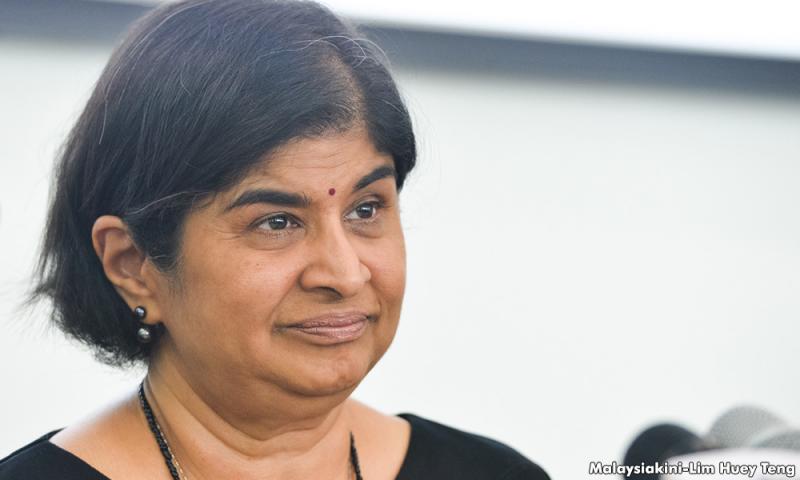
Ambiga: Work with Dr M if he wants to fix system
Civil society should consider working with former prime minister Dr Mahathir Mohamad if he wants to remove the problems within the government and Umno of his own making, said Ambiga Sreenevasan, the president of National Human Rights Society (Hakam).
If Mahathir is willing to recognise that the system needs an overhaul instead of just thinking of ousting Prime Minister Najib Abdul Razak, she said civil society should then be open to the notion of working with him.
Civil society should consider working with former prime minister Dr Mahathir Mohamad if he wants to remove problems within the government which allows racisim and uses draconian laws against political opponents, says National Human Rights Society (Hakam).
Hakam president Ambiga Sreenevasan said if Mahathir is willing to recognise that the system needs an overhaul, instead of just thinking of ousting Prime Minister Najib Abdul Razak, she said civil society should then be open to the notion of working with him.
"Anyone who is trying to do that (overhauling the system), I think we should be open to (the idea of) working with him," she said, adding this was merely her personal view.
"But it has to be a change of the whole system, and not just getting rid of Najib and allowing Umno to carry on as it is," she said.
The former Bersih co-chairperson was referring to the system which she said is tainted by corruption and abuse of power, and has allowed racism to fester.
"Najib is not the best prime minister," she added.
Ambiga, however, regretted that Mahathir wants only the prime minister to be replaced.
She was responding to G25, the group of eminent Malays, which declined to work with both Mahathir and former deputy prime minister Muhyiddin Yassin to oust Najib.
It was reported by The Star that G25 member Tawfik Ismail, the son of second deputy prime minister Dr Ismail Abdul Rahman, had said that Najib is still the best person to helm the country as he was a moderate by nature.
G25, however, issued a statement last night to distance itself from Tawfik's claim, stressing it remains neutral and non-partisan.
Mahathir was often given the cold treatment on his quest to oust Najib, not only by Umno, the party he once led, but also by the people and civil society.
The longest-serving prime minister was often criticised for having to face the consequences of his own making, particularly when he was being probed by police for making controversial remarks at Bersih 4 rally.
Critical changes unacknowledged
At a book launch for ‘Malaysia Post-Mahathir: A Decade of Change?', a compilation of articles written by eight scholars today, Ambiga took a jibe at Mahathir, saying she never imagined Mahathir would attend Bersih rally and later be probed by the cops.
She also pointed out three positive changes which occurred in the post-Mahathir era which the government refused to acknowledge.
They are the critical voice from the opposition in seeking accountability from the government, the rise of civil society, and people’s political awakening.
“There are positive (things during the) post-Mahathir era. We have an opposition; if they could act together, then they are very effective.
“Because we have the opposition that questioned in Parliament, there is some level of accountability. That is an important shift in Malaysian politics.
“We have civil society. Give credit to former Prime Minister Abdullah Ahmad Badawi. When he came to power, he said, let civil society be his eyes and ears.
“He allowed more democratic space during his time,” said Ambiga, who is also the former Bar Council president.
“The third thing is people have changed. Everyone has woken up to the reality that they have moved on, but the policies remained the same – the oppressive, the arbitary, the abuse of power.
“They (the government) haven’t taken into account that the country and the world have moved on. We have more information and it is a completely different scenario,” she said.


Are you sure you want to delete this comment?
This action cannot be undone.