




What ails the country and what's to be done
COMMENT Among the plethora of pronouncements on our national malaise, no one perhaps has pointed so unerringly to its causes and the way out of it than Tawfik Ismail, the son of Dr Ismail Abdul Rahman.
This year is the birth centenary of the man whose untimely death in August 1973 deprived the country of his counsel that would possibly have averted two wrong turns the politics of the country subsequently made and has eventuated in our present predicament of political paralysis and bewitchment with the forms of Islamic religion.
One could as well make it three wrong turns, if you consider the fate that befell Sabah and Sarawak, the two territories in Borneo that federated with Malaya and Singapore to become Malaysia in 1963.
Both were hustled into becoming 'states' in the federation rather than separate territories enjoying specific rights that should be accorded respect under the federal auspices of an enlarged national entity.
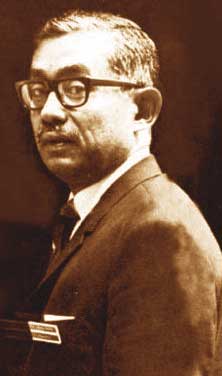 Ismail was head of the review committee on the implementation of the articles under which Sabah and Sarawak merged with the rest of Malaysia, which was required after the first 10 years of the new federation.
But he died before the review could get under way, depriving the exercise, which eventually did not take place, of his renowned fairness and concern for constitutional propriety.
Ismail’s untimely death at the age of 57 left a void in the leadership of Umno at the place where it was necessary to have a man of his mettle.
He was, as his biographer Ooi Kee Beng suggested in ‘Reluctant Politician’, not interested in the grubby details of the political climb, abstention from which enabled him to scrutinise issues unblinkered by personal ambition and racial bias.
His son, Tawfik, in remarks in connection with the launch of his father's diary jottings ‘Drifting into Politics', said that Ismail's concern for democratic constitutionalism would have prevented the country's slide into its negation under Dr Mahathir Mohamad's long tenure as prime minister and the ‘Arabisation of Islam’ that came with Anwar Ibrahim's inclusion in government from 1982.
Cutting scrutiny on our 'Arabisation'
Tawfik's diagnosis of the ills besetting the country is the acutest there is: he cuts to the bone with a surgeon's scalpel.
He did not spare Mahathir this incisiveness when, as a member of G25, the group of eminent Malays which met the former premier, he said he told Mahathir that the latter had negated the safeguards to democracy that now make the removal of Prime Minister Najib Abdul Razak for corruption and misgovernance well-nigh impossible.
Tawfik's father, Ismail, displayed as home minister a scrupulous concern for those safeguards.
G25 is a group of retired senior civil servants, diplomats, and judges who in December 2014 banded together to air their concern over creeping Islamisation of the country.
 This 'Arabisation' of Islam in Malaysia has come as the expense of democratic constitutionalism. Both trends were allowed reign in the 22-year premiership (1981-2003) of Mahathir.
Mahathir and, before him Muhyiddin, had in recent weeks sought the support of G25 to battle Najib when the group met the two for discussions on their core concern.
It appears that Tawfik was coruscatingly candid in the discussions, telling Muhyiddin that he did not think he would be an improvement over Najib, and letting Mahathir know that he was responsible for voiding the democratic safeguards which make Najib's removal from office impossible.
This is the kind of cant-free analysis that Tawfik's father, Ismail, whose birth centenary was marked on Nov 4 with Diary's launch, was renowned for.
Since Tawfik's clear-eyed scrutiny of the national malaise, aired in the G25 meetings with Muhyiddin and Mahathir, has made the rounds of web news portals, the G25 has hastened to counter the perception that the group is not in favour of Najib's removal.
The group contends it is nonpartisan and is focused on the enduring issue of institutional restoration in Malaysia rather than the transient one of individual removal.
In the wake of Tawfik's musings to web portals on what transpired at G25 meetings with Muhyiddin and Mahathir, word has gotten around that the group feels Najib's trajectory is alterable for reason of his moderate worldview: it is said he is amenable to moderate counsel.
This view and G25's refusal of Muhyiddin's and Mahathir's importunings to oppose Najib have been conflated such that the group is seen as opposed to the PM's removal.
Hence G25's quick interjection in the ensuing discourse to correct the impression of it being politically aligned.
In their focus on perdurable issues, G25 and its spokesperson in the news, Tawfik, are emulating the centenarian whose untimely death 42 years ago left a grievous void in our political culture.
TERENCE NETTO has been a journalist for more than four decades. A sobering discovery has been that those who protest the loudest tend to replicate the faults they revile in others.


Are you sure you want to delete this comment?
This action cannot be undone.