


Budget 2016 makes many sector cuts, education badly hit
MP SPEAKS It has now become clear that Budget 2016’s veneer in the form of marginal increments in BR1M payments, increased pensions, a revised minimum wage and a widened list of zero-rated items under the goods and services tax (GST) regime actually masks many cuts in key sectors, particularly in education.
It has previously been revealed that the Ministry of Higher Education will suffer a reduced budget of RM13.37 billion next year, which is RM2.4 billion lesser compared to 2015.
This significant cut will mainly affect public institutions of higher learning, with 19 out of 20 universities set to see budgetary shortfalls of up to 27 percent, if compared with the year before.
However, budget cuts in education are not limited to the tertiary sphere. For example, despite grand rhetorical commitments, the total allocation of RM135 million announced by Prime Minister and Finance Minister Najib Abdul Razak to strengthen the teaching and learning of English is a far cry from the RM208 million annually allocated for the Uphold Bahasa Malaysia and Strengthen the English Language (MBMMBI) policy.
For 2016, MBMMBI has been halved to RM97 million, while two new initiatives – the Dual Language Programme and the Highly Immersive Programme – have been added with a total budget of RM38.5 million.
However, even more disconcerting is the sharp fall in budgetary allocations for teacher development, which has been reduced to RM783 million for 2016, compared with RM1.5 billion two years ago in 2014. This represents a massive cut of 49.12 percent, with breakdowns listed in the table below.
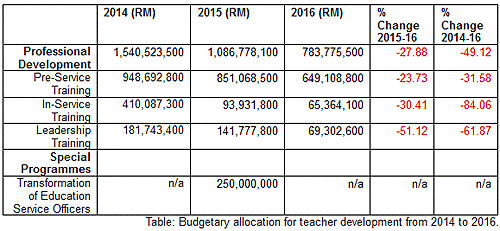 As evidenced in the table here, all teacher training programmes, including pre-service training, in-service training and leadership training, have been drastically cut from 2014 to 2016.
Pre-service training, for example, has been reduced from RM948 million in 2014 to RM851 million in 2015 to only RM649 million next year, representing a total reduction of 31.58 percent.
Meanwhile, in-service training of teachers is the most affected, slashed by a colossal 84.06 percent from RM410 million in 2014 to RM93 million in 2015 to a measly RM65 million in 2016. Finally, leadership training has also been cut by 61.87 percent from RM181 million in 2014 to RM69 million next year.
At the same time, a special programme introduced in 2015, called “Transformation of Education Service Officers”, which had been allocated RM250 million, has now been discontinued.
It is simply confounding that funds for teacher development have been so drastically cut. This goes against the grain of the Malaysia Education Blueprint, which states that “the quality of teachers is the most significant school-based determinant of student outcomes.”
In fact, the document quotes research conducted in the United States, which showed that when two average schoolchildren were given different teachers, one high-performing and one low-performing, their academic performances diverged by more than 50 percent. Such an analysis has been similarly reported by studies in other parts of the world.
Hence, if the quality of teachers has been identified as such a critical aspect of our education system, why is less instead of more being invested in them?
ZAIRIL KHIR JOHARI is the MP for Bukit Bendera and DAP parliamentary spokesperson for Education, Science and Technology.


Are you sure you want to delete this comment?
This action cannot be undone.