
Important places but too inaccessible to the disabled
The theme for this year’s International Day for People with Disabilities (PWDs) is “Inclusion matters: access and empowerment”.
However, two very important places in Penang – the General Hospital and Welfare Department – are simply inaccessible to PWDs, especially those who wish to live independently, or those who have to travel on their own.
The theme for this year’s International Day for People with Disabilities (PWDs) is “Inclusion matters: access and empowerment”.
However, two very important places in Penang – the General Hospital and Welfare Department – are simply inaccessible to PWDs, especially those who wish to live independently, or those who have to travel on their own.
“We’re not asking for everything, all we need is more accessibility, to be able to travel on our own, especially to these two important destinations, without having to be a burden to others, and without having to meet with accidents,” said Lee Yew Yi, a computer instructor, who lives in the St Nicholas Home for the Blind.
“People often ask me why they do not see blind people on the streets, other than near our home, but the question is: are the places accessible to us? If they are, people will see us walk in public,” said Lee, who hails from Perlis.
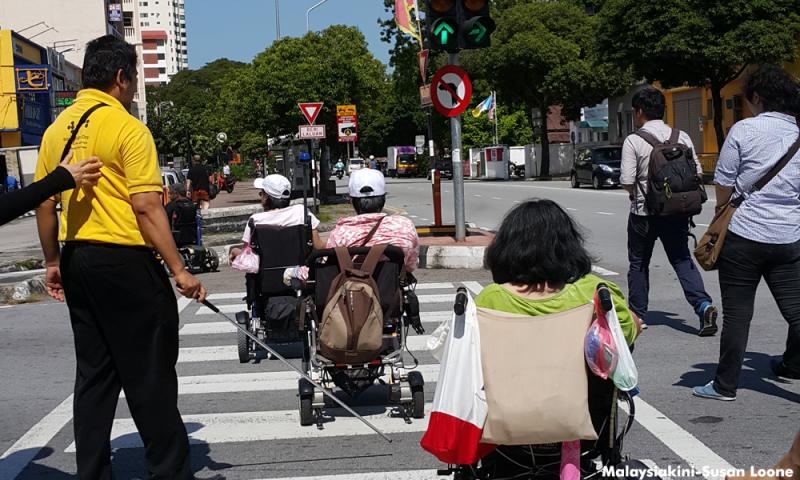
Lee was among a group of disabled people who travelled by road from Pulau Tikus, took the local Rapid bus to the General Hospital, and later proceeded to the Welfare Department at the Caring Society along Scotland Road.
Accompanying them on the 6km walk yesterday was DAP’s Pulau Tikus assemblywoman Yap Soo Huey.
“Until you walk with your friends, you will never know what challenges they face. And if you have not experienced what they go through on a daily basis, you will never understand that even 100 metres away from their homes is too far away,” Yap said.
The first-time assemblywoman, who has been quite vocal on public interest issues, was wheelchair-bound for a month, and on crutches for another.
Malaysiakini travelled with the disabled group and found their journey paved with many challenges, potential accidents, and unfriendly spots. These difficulties are faced daily even by people without disabilities.
Due to space constraints, roads in Penang lack pedestrian paths and even if these were available, were often crowded with trees and overgrown grass, and potholes.
The five-foot ways along shops and offices are filled with goods, furniture, and spaces designated for PWDs are used by insensitive people who park their bicycles and motorcycles in those places.
PWDs, including those who are blind or wheelchair-bound, eventually have to travel on the roads alongside the cars, which make them susceptible to accidents and injuries.
Curbs are either too small, too steep, or filled with holes, and are too dangerous for PWDs to navigate on their own.
Although the Penang Island City Council recently launched the “Pedestrian are Kings” campaign, yellow beacons are needed in more zebra crossings other than the two currently installed in Farquhar Street near the Penang High Court and Burmah Road near the Pangkor Road junction.
“I am just too scared to travel on road on my own but I have no choice. I have to go to work everyday,” said Suresh, 50, who sells parking tickets at the stadium in Sungai Pinang.
Poor town planning
Although buses have available spaces for PWDs, and bus drivers are kind enough to aid wheelchair- bound PWDs to alight the bus, they do not take you directly to the General Hospital or Welfare Department.
This route is especially unavailable for PWDs who travel from the north of the Island like Tanjung Bungah or Pulau Tikus, as the group of PWDs with Yap had discovered.
The bus would stop at Dato Keramat Road (en route to Air Itam or Bukit Gelugor), at least one kilometre from the General Hospital, and PWDs need to cross the road to get to seek government health services.
At the General Hospital, PWDs have only two designated toilets (one for male, the other female) and even then the accessories inside, like the toilet bowl is placed to high that it becomes useless for those who can’t use their limbs.
Lily Looi said that PWDs often have to hold their bowels because the toilets designated for them are too inconvenient and unaccessible for their use.
“At one time, I had an emergency, and even then, can’t use the toilets at the General Hospital. I had to call for someone to take me home and it was unbearable for me,” she said.
The hospital authorities was not happy with Yap inspecting the toilet at their premises, but the latter said it was a public place.
“An official has informed state executive councillor on environment, welfare and caring society Phee Boon Poh that the General Hospital is currently building two '5-star toilets for PWDs', which is expected to be ready in two weeks' time, in conjuction with International Toilet Day,” Yap told Malaysiakini later.
Yap said the way forward to make Penang accessible to PWDs is proper town planning, where the local plan is important, and special focus must be paid to the locations of houses, hospitals and welfare homes.
“PWDs must first be able to get out from houses and travel at least 100 metres to the nearest bus stops, shops or markets,” she added.
“Why do we place the Welfare Department where it is so inaccessible to the PWDs? This is the outcome of poor town planning,” she said.


Are you sure you want to delete this comment?
This action cannot be undone.