


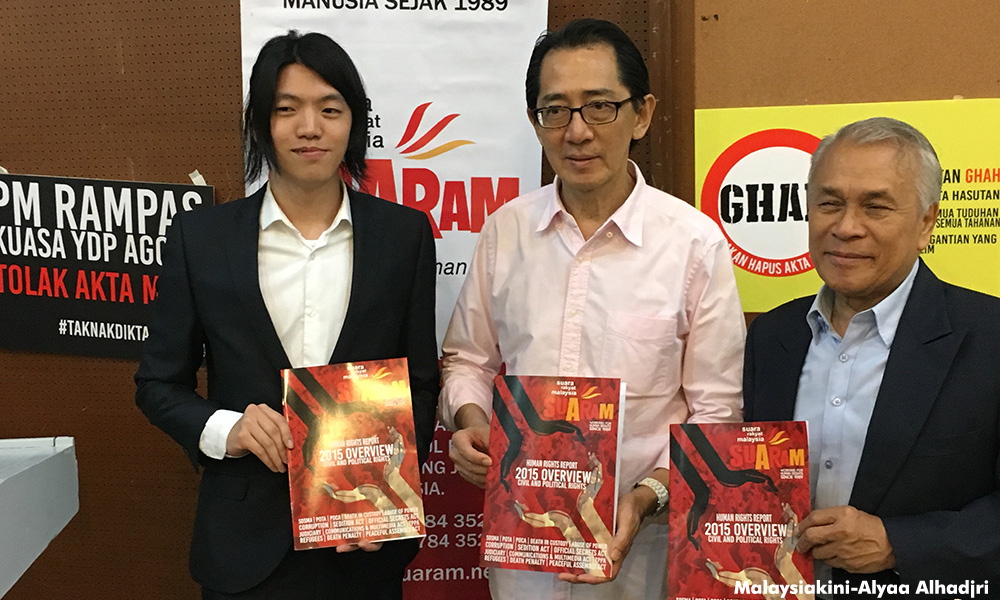

Suaram: Corruption root of most civil, political rights violations
At the launch of its annual Human Rights Report today, Suara Rakyat Malaysia (Suaram) said corruption was at the root of most civil and political rights violations that it has recorded so far.
Suaram project coordinator Dobby Chew, who earlier presented an overview of the report, concurred with the observation made by rights group Hakam president Ambiga Sreenivasan during a panel discussion afterwards.
“Certainly corruption is at the root of most of the issues raised. Just take for example the migration problem.
“There has been a lot of allegations and reports from the ground that police and military might be involved with the traffickers and the root of that is corruption,” said Chew in response to Ambiga who said up to 70 percent of the recorded violations could have been prevented if more emphasis was placed on combating corruption.
“Unfortunately we can't do much about it but we do try,” he added.
Chew was referring to one of the six most worrying trends identified this year - the situation faced by refugees and victims of human trafficking.
Specifically, Chew highlighted the shocking discovery of mass graves in Wang Kelian, Perlis, earlier this year.
In May, it was reported that security forces had found 106 remains of human trafficking victims, believed to be ethnic Rohingyas from Myanmar, at several mass graves in Bukit Wang Burma, Wang Kelian.
In the Suaram Human Rights Report 2015, it was recorded that there are 153,850 registered refugees and asylum seekers as of September this year, and an unknown number unregistered.
Numerous complaints
Aside from impact of corruption on the rights of refugees, Chew also noted complaints from Malaysia’s indigenous communities regarding allocations channelled through the Orang Asli Development Department (Jakoa).
“There has been numerous complaints made about Jakoa not channeling funds to the orang asli for basic infrastructure. Again, this could be due to corruption.
“A lot of money has been given to safeguard their welfare but they're still suffering from a lack of basic needs like fresh water,” he said.
In the report’s overview, it was also highlighted that the general apathy of relevant government agencies remains prevalent as reflected in the case of the seven missing orang asli children in Kelantan.
Also present during the event held at Kuala Lumpur Chinese Assembly Hall were National Human Rights Commission (Suhakam) chairman Hasmy Agam and Suaram adviser Kua Kia Soong.
'Cease and desist’
Suaram executive director Sevan Doraisamy, meanwhile, urged the government to take effective steps to “cease and desist” human rights violations in Malaysia and provide due remedy to those who have suffered.
“Laws that are incompatible with recognised international human rights listed in the Universal Declaration of Human Rights and other Bill of Rights, must be repealed immediately.
“Suaram calls on the government to be accountable to the people and to place human rights and democracy on top of any government and political agenda,” he said, adding that anything less would undoubtedly jeopardise the country’s future generations.
Aside from the rights of refugees and indigenous groups, other worrying trends identified include the rapidly shrinking space for political dissent; overall gender discrimination and sexist slurs uttered in Parliament; no human rights impact assessment prior to signing the Trans Pacific Partnership Agreement; and passing of legislation that undermines civil liberties in the name of national security.


Are you sure you want to delete this comment?
This action cannot be undone.