



Institutionalise the NSC, but this bill must be rejected
COMMENT Historically, the National Security Council (NSC) was set up after the incident of May 13, 1969, by the cabinet on July 7, 1971. Since its inception, the NSC’s main task was to deal with issues stemming from racial issues instead of external ones.
A statement on the NSC portal reads : “Since the future racial peace in this country depends on how well the government handles the sensitive issues, it is suggested that the NSC shall be the body to look into the matter”.
Unlike other security authorities, the NSC is not a statutory body and does not possess any lawful enforcement and executive powers, as well as not subject to parliamentary review. Born out of a need to deal with rising security threats, the government hastily tabled the bill to ‘institutionalise and empower’ the NSC.
COMMENT Historically, the National Security Council (NSC) was set up after the incident of May 13, 1969, by the cabinet on July 7, 1971. Since its inception, the NSC’s main task was to deal with issues stemming from racial issues instead of external ones.
A statement on the NSC portal reads : “Since the future racial peace in this country depends on how well the government handles the sensitive issues, it is suggested that the NSC shall be the body to look into the matter”.
Unlike other security authorities, the NSC is not a statutory body and does not possess any lawful enforcement and executive powers, as well as not subject to parliamentary review. Born out of a need to deal with rising security threats, the government hastily tabled the bill to ‘institutionalise and empower’ the NSC.
By right, the NSC should be institutionalised properly and subject to parliamentary review. However, the bulldozing of the highly controversial National Security Council Bill recently by Barisan National lawmakers has aroused much suspicion that it might jeopardise our constitutional rights and basic liberties.
Many quarters have pointed out the weaknesses of the bill, but the arguments and discussions should come under a broader spectrum, i.e. the security reform agenda.
Personally, the NSC Bill worries me because the term ‘national security’ is not clearly defined. What constitutes the threats of national security? Are Bersih rallies a threat to national security? Is the act of asking the prime minister to step down a threat to national security?
No one knows because the interpretation is solely the prerogative of the prime minister who is the chairperson of the NSC.
Even though the definition of national security is highly contentious in contemporary academic discussion, the most agreed upon is national security should be a matter of protecting the integrity of territory and sovereignty of Malaysia, and dealing with external threats than internal ones.
The first country which created a National Security Council was the United States through the enactment of the National Security Act in 1947. Since then the US’s version of the NSC has inspired others to follow suit, including Malaysia.
According to the act, the US NSC serves as an advisory and policy forum for the president to discuss national security and foreign policy matters. It also helps the president to coordinate the policies among the various government agencies, and to reform security and intelligence-related agencies and policies without empowering it with more essential power.
Internal security threats
My second worry is that the Malaysian NSC Bill is designed to deal with internal security threats rather than external ones. The statutory members of US NSC are the president, the vice-president, the secretary of state who deals with foreign affairs, the secretary of defence, and the chairperson of the National Security Resources Board.
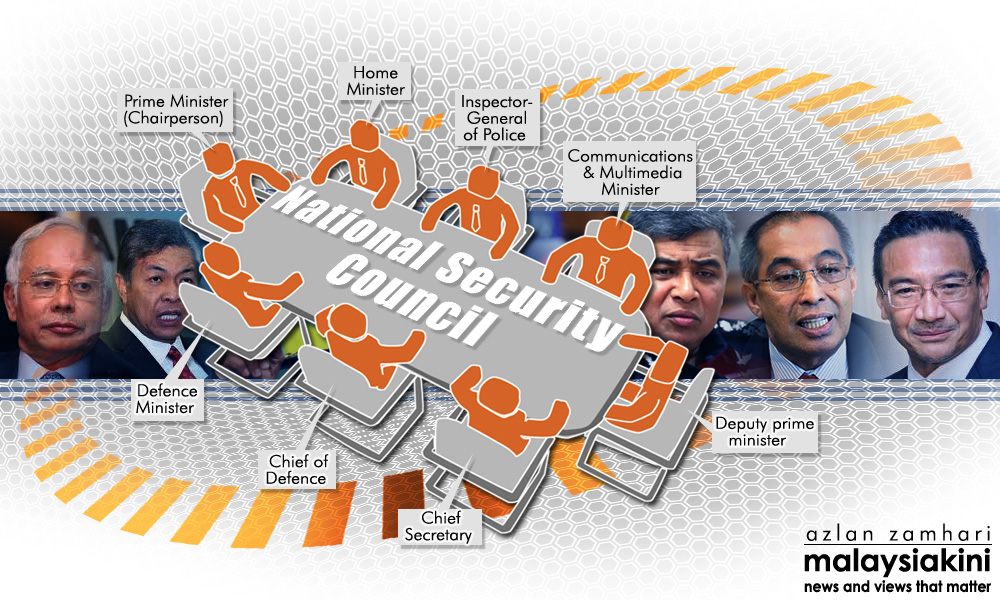
In comparison, the Malaysian NSC will consist of the prime minister, deputy prime minister, defence minister, home minister, communication and multimedia minister, chief secretary, chief of defence forces and inspector-general of police. The foreign minister’s absence in the panel list of the Malaysian NSC implies that external issues are not the main concern of our security council.
Apart from the NSC, the US National Security Act also created the Central Intelligence Agency and the National Security Resources Board; reorganised the US Armed Forces; and mandated that the Secretary of Defence must be appointed from civilians. The same Act also established the Joint Chiefs of Staff, which reformed the US security agencies in a revolutionary way and has greatly influenced today’s world.
My third worry is that the Malaysian NSC bill weighs in heavily on empowering the executive head while reform in security agencies is completely absent. The fact that Malaysian security agencies failed to prevent the Lahad Datu tragedy from happening - although early intelligence warnings were made prior to 2008 - proves that reforming security agencies must be a high priority on the agenda.
The unnecessary emergency powers empowered to the prime minister has been well articulated by many quarters, but Section 17 which requires the director-general of NSC to coordinate intelligence collected from government entities has been completely overlooked.
Even though the bill doesn’t point it out clearly, the NSC is in fact empowered to be a super intelligence agency. Subsection (1) and (2) of Section 17 demands that all government entities shall transmit national security -related information or intelligence to the NSC immediately, and Subsection (3) empowers the NSC to be the sole intelligence coordinating agency.
Those subsections are quite similar to Subsections 102(d) and (e) of US National Security Act which stipulates the functions of the CIA. To put it simply, the NSC is being shaped to become as powerful as the CIA. This is my fourth worry - that abuse of power may happen if no adequate check and balance is inserted into the equation.
My fifth worry revolves around the fact that the officials who drafted the bill had over-focused on empowering the prime minister that they forgot to require the NSC to produce a National Security Policy. Essentially, the National Security Policy is a very important document which serves as an over-arching policy that guides the formulation of the National Defence Policy as well as the National Foreign Policy.
NSC should focus on policy issues
In the US, it is compulsory by law for the president to table a National Security Strategy document to Congress each year. Given the fact that the Malaysian government has not produced a single document on National Security until today, the NSC should focus more on policy issues than getting more ‘emergency power’.
The tabling of the NSC bill is to make Malaysia safer than ever, but the burning questions are ‘From what or who are we saving Malaysia?’ and ‘Who is our enemy?’
Excluding the foreign minister from the NSC panel list and merely focusing on gaining more emergency power implies that the ‘enemy’ comes from within Malaysia. It would be a highly dangerous perception if it were true, and this form of threat perception is a problematic one which must be rectified.
Despite the draconian Internal Security Act being scrapped, the government is trying to approve more and more security-related laws to fill in the vacuum left by the ISA. Other examples include the Security Offences (Special Measures) Act (Sosma), Prevention of Terrorism Act (Pota) and Prevention of Crime Act (Poca), with the NSC bill being the latest to join that list.
By right, those Acts are designed to protect Malaysia, but it seems that the essence of the bills is to protect Najib Abdul Razak’s regime security instead of national security. If Najib is confused about regime security and national security, I would suggest that he reads Barry Buzan’s ‘People, State and Fear’ to learn about the differences.
In a nutshell, all federal lawmakers should do their utmost to stop the bill from being passed and take into account the valid concerns raised in this article to prevent the creation of this absolute secretive and powerful agency.
LAM CHOONG WAH is a senior fellow at Research for Social Advancement (Refsa). He holds a Master’s degree in Strategic and Defence Studies from Universiti Malaya.


