


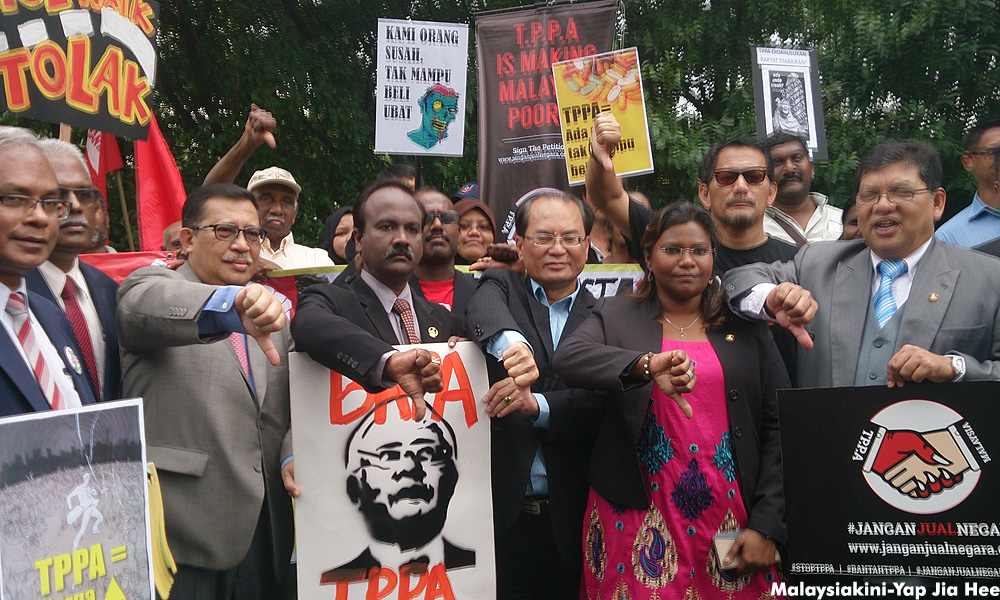

High cost of non-participation in TPPA
COMMENT A few days ago, I met a prominent political observer and academic in South-East Asia. She asked me to rate, on a scale of one to five, on how much Malaysia will benefit from participating in the Trans-Pacific Partnership Agreement (TPPA).
My explanation to her was brief and concise. Malaysia’s participation in the TPPA is not monocausal.
The TPPA is a complex agreement because the dynamics of the world economy is such. The complexity of trade agreements is not only apparent in the TPPA but also in other agreements such as with the European Union.
COMMENT A few days ago, I met a prominent political observer and academic in Southeast Asia. She asked me to rate, on a scale of one to five, on how much Malaysia will benefit from participating in the Trans-Pacific Partnership Agreement (TPPA).
My explanation to her was brief and concise. Malaysia’s participation in the TPPA is not monocausal.
The TPPA is a complex agreement because the dynamics of the world economy is such. The complexity of trade agreements is not only apparent in the TPPA but also in other agreements such as with the European Union.
The standard of trade agreements can only get higher over time, never lower. The cost of non-participation in the TPPA is high and will only get higher in future.
An overall positive outcome for participating in the TPPA is a privilege and not an entitlement. Countries are not guaranteed a positive outcome as a result of being a party to a trade deal.
The overall benefit, at least, is not reaped simultaneously. This is largely due to the different levels of development and dynamics of the domestic economies of participating countries, where benefits accrued are usually unequal and deferred over a period of time.
Besides, it is worth mentioning that international trade is a multilateral process and not bilateral. No two countries, or all countries for that matter, can result in trade surplus.
Nonetheless, there are still those who choose to ignore this fact and hold strong views against trade deficit, or short-term rise in imports, without acknowledging the overall outcome of a trade deal to participating countries.
Quick sectoral gains are estimated based on the country’s current investment profile which relies heavily on present and past data.
The conclusion of the National Interest Analysis (NIA) of Malaysia’s participation in the TPPA is bound to the limitations of all quantitative forecasting methodologies that use historical data.
The data reflect that which have happened in the past and it cannot tell much about the future.
Estimations, however, are only possible when employing statistical methods and analysing trends of such over a period of time. In other words, the gains highlighted in the NIA are probable but indefinite.
Based on available data, there will be sectors that can immediately take advantage of the bigger TPPA market by Malaysian exporters, such as textiles, automotive parts and components, palm oil, and electrical and electronics.
However, there is no data to predict the types of foreign direct investment that will come into Malaysia once the TPPA is in effect.
New investments may or may not have local resources, and this may cause a capacity gap if we are unable to participate in the TPPA.
This can be negatively viewed from the social viewpoint, but positively viewed from an overall national interest perspective as the country will benefit, even without having local content.
Smooth transition
Having an extensive list of exclusions and exemptions does not mean that these are enough. The government must introduce the necessary policy directions to allow for a smooth transition towards high-quality commitments.
It is imperative to address the present regulatory gaps in order to ensure that there are adequate laws to regulate, monitor and enforce an activity before the full implementation of the TPPA.
That said, the carve-outs that the government has successfully secured do not mean that adjustment is not needed to address regulatory gaps.
We have to acknowledge that the carve-outs are only meant to provide some form of transition and safety net, so that adjustments can be made in a progressive manner.
These carve-outs are not perpetual. We must be ready to challenge the status quo for future prosperity, participation, and welfare.
At the end of the day, being a party to a trade deal is akin to having a car that gets us to where we want to go.
The buyer is first attracted by the overall design and technical specifications before recognising the quality and the driving experience of the car. All drivers must adhere to traffic rules.
No matter the type of car, there is no guarantee that the buyer will drive it in the long term as there will be newer and more technologically advanced cars to choose from in future.
More importantly, having a top-spec car does not exempt the driver from getting into accidents.
Similar to any trade deal, including the TPPA, having the best negotiated outcome does not negate a country from adjustment costs.
ISIS Malaysia’s NIA report, which was released just over a week ago, attempts to highlight the impact of the agreement on Malaysia’s national interests in as much detail as possible.
The study team is aware that the report is not a crystal ball. Determining the future outcome is not easy, let alone an accurate process.
There is no doubt that the TPPA is a risky venture for Malaysia. But it is a risk that we are able to manage for the future of this country.
If you are wondering about my answer to the earlier question, I did not state a number. It is a must.
FIRDAOS ROSLI is a fellow at the Institute of Strategic and International Studies (ISIS).


