


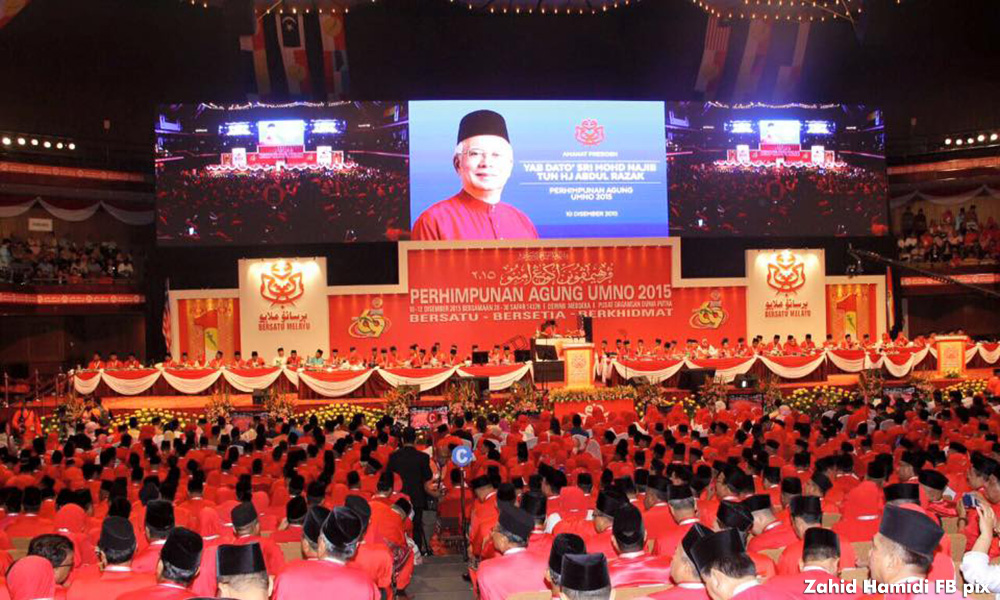

The anatomy of an Umno general assembly
COMMENT The Umno general assembly or perhimpunan agung Umno is Malaysia’s most closely watched political event, according to the Straits Times of Singapore.
With 3.5 million members, 191 divisions and nearly 22,000 branches, the Umno AGM is a five-day congress attended by thousands from the party.
It is not without its controversies. Demands of Malays at at the meeting have often been construed as being racist and intolerant.
COMMENT The Umno general assembly or perhimpunan agung Umno is Malaysia’s most closely watched political event, according to the Straits Times of Singapore.
With 3.5 million members, 191 divisions and nearly 22,000 branches, the Umno AGM is a five-day congress attended by thousands from the party.
It is not without its controversies. Demands of Malays at at the meeting have often been construed as being racist and intolerant.
Malaysian Progressives UK (MPUK) intends to objectively understand the evolution of the Umno AGM. We have laid out the highlights of the meeting since 1961 and formed inferences from these data collected. These are done as empirically and objectively as possible.
We are aware of the possible shortcomings of such findings - including the incompleteness of information - and thus this article is in no way a comprehensive or conclusive understanding of the Umno meet.
Timeline
1961 - The Umno AGM supported establishment of Malaysia. Prime Minister Tunku Abdul Rahman openly clashed with Agricultural Minister Abdul Aziz Ishak where Aziz wanted to promote user fertiliser projects through cooperatives but Tunku chose to back a multinational corporation because it was more cost-effective.
1965 - The Umno AGM proposed an extreme resolution to detain Lee Kuan Yew but it was toned down.
1968 - Malay educated class displayed growing uneasiness over the Malay community’s failure to gain economic interest from BN’s policies.
1972 - Prime Minister Abdul Razak Hussein proposed unity government and invited opposition parties to support his new NEP.
1991 - Prime Minister Dr Mahathir Mohamad emphasised strengthening Malaysia as an Islamic state through economic means. Debates on monarchy to accustom Malays to the concept of criticising royalty.
1992 - Mahathir talked about 'New Malay' concept, to raise efforts to build economic power. Delegates critical that lucrative contracts awarded to non-Bumi businessmen.
1993 - 'Money politics' was discussed as extensive uses were a major issue. Mahathir called for amendments to curb money politics'.
1994 - A year after being elected as deputy president, Anwar Ibrahim was compared to Brutus (man responsible for killing Julius Caesar) by Mahathir. This was the beginning of the Anwar-Mahathir spat.
1995 - Mahathir and Anwar said they did not want Umno to split. Both maintained unity despite their differences. Anwar called Mahathir a generous teacher. Mahathir said he did not mind if he won over Anwar .
1996 - Support from Anwar-Mahathir camps grew divisive. Wanita and Youth favoured Anwar; supreme council favoured Mahathir. Mahathir wept in his speech, assailed money politics.
1997 - Anwar-Mahathir rivalry continued. Mahathir said Anwar was still his deputy and successor.
1998 - Ahmad Zahid Hamidi denounced Mahathir’s government for nepotism and corruption after Anwar’s sacking. Book titled “Why Anwar Cannot be PM” was circulated.
2000 - Mahathir reminded Umno on importance of loyalty and honour and to differentiate loyalty to party and its leader.
2001 - Malay unity was important to foster progress in Malays’ social and economic growth.
2002 - Mahathir talked of disunity and weakness of Malays, who always favoured the easy way out, and NEP was beneficial only to cronies. Mahathir insisted Malaysia was an Islamic state.
2003 - Mahathir and Abdullah Ahmad Badawi accused PAS of planting hatred among Muslims and deviating teachings.
Before Mahathir’s resignation, he reminded: “Don’t give others the weapon to stab us back, and while making criticisms, watch our language and keep focus”.
2004 - Abdullah, now prime minister, said “money politics” was just a myth.
2005 - Abdullah endorsed “Malay agenda” not with the intention to deprive rights of other races since evidence from the past does not support it. Umno Youth chief Hishammuddin Hussein branded the keris as a symbol of Malay nationalism.
2006 - Abdullah decried Malay groups who took advantage of privileges given by government for personal gain. Set up Gabem to govern this issue. Najib Abdul Razak urged Malays to foster first-class mentality with intellectual focus.
2008 - Puteri Umno suggested Islamic status of country shouldn’t be questioned.
2009 - Now Umno chief, Najib, said Umno had to be more inclusive and spoke of 1Malaysia concept.
2010 - Najib highlighted significant change in profile of voters and Umno should not rely on past deeds to secure votes. He also claimed Pakatan Rakyat wanted a secular state and rejected the Islamic state.
2012 - Islam (the threat of Shiism) was discussed extensively. Strong praises for Najib: Wanita Umno shed tears, Muhyiddin lauded Najib’s administration.
2013 - First time themedia is allowed to cover event. Sharizat coined Najib as ‘Chess Grandmaster’ who knew what moves to take.
2014 - First time the Umno AGM revolved around rakyat issues, and not internal party politics.Khairy asked non-Malays to not question Malay rights and challenge Malay pride. Najib showed screened slides of bloody May 13 riots.
Inferences
- The Malay Agenda
In 1968, The Umno AGM urged Malay community to be empowered through economic means, and this was similarly carried by Mahathir in his ‘New Malay’ concept in 1992.
In 2005, Abdullah urged a ‘Malay agenda’ that did not deprive the rights of other races, and this was followed by in Najib’s ‘1Malaysia concept’ in 2009. It was notable that, in 2005, Hishamuddin’s ‘keris waving’ incident sparked a lot of racial dissatisfaction.
The moderate approach has taken a notable shift in 2010 since Najib highlighted the significant change in voter profile and how Umno should not rely on past deeds. In 2014, Najib showed screened slides of bloody May 13 riots and Khairy asked non-Malays to not challenge Malay rights.
Another notable agenda in the Umno general assembly was Islam. Mahathir started the discussions in 1991 to assert that Malaysia was an Islamic state, and this was carried on in 2002 and 2003 where PAS was singled out for 'Islamic deviations.'
In 2008, Puteri Umno said Islamic status of Malaysia should not be questioned, and similar assertions were made by the Umno AGM in 2010. The peak of this was the extensive discussion of Islam in 2012 and its rejection of Shiism.
Corruption
There are two types of corruption commonly discussed - money politics and crony politics, with the former directed more internally within the party.
In 1992, cronyism in the form of giving lucrative contracts to non-bumiputera businessmen at the expense of Malays were discussed. In 2002 and 2006. It was noted that only certain Malay classes had benefited from government policies. In 1998, Zahid had called out Mahathir for his administration’s nepotism and corruption. “Money politics” was commonly decried between 1993-1998, to the point of weeping by Mahathir in 1996. This took an unusual turn in 2004 when Abdullah called ‘money politics’ a myth.
A startling highlight was the leadership tussle forming the main agenda between 1994 -1998 between Anwar and Mahathir. Camps from both sides reasserted their support for respective leaders, but both leaders remained magnanimous during the Umno AGM before the sacking of Anwar in 1998.
The notable similarity in is Najib’s leadership assertion in 2012 where the whole assembly stood in support of him with placards.
Conclusion
Considering Umno’s foundation of success lies in Malay nationalism, it is unsurprising that Malay rights and Islam were consistent points of discussion over the years.
The issue of corruption was also a common concern, since this was tied towards a fundamental aspect of fairness which the Malay community holds dear to. The success of weeding corruption out, however, remains up for debate.
The recent leadership assertion by Najib is certainly a new phenomenon, with the exception of Anwar-Mahathir leadership tussle in 1994-1998.
While the claim of racism has its validity, it is hard to expect a race-based party to not talk about race.
Malaysian Progressives UK is a global network which aims to promote political discussions among Malaysian youths. Apart from posting regular interview clips of prominent Malaysians and articles on current affairs on the group's Facebook page , they also host lectures for Malaysian personalities visiting London.


