


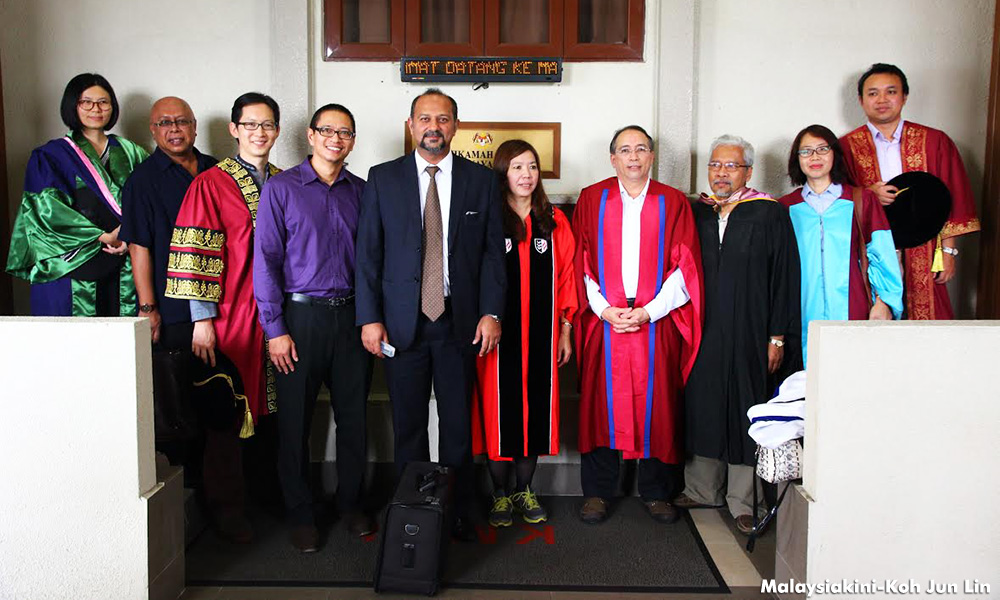

More dons donning robes at Azmi's sedition trial
More academicians have turned up in the hearing of Universiti Malaya law lecturer Azmi Sharom's sedition case today, wearing their academic robes.
One of them, University of Malaya Academic Staff Union (PKAUM) exco member Lai Suat Yan, said the move is to highlight that academic freedom is under attack.
More academicians have turned up at the hearing of Universiti Malaya law lecturer Azmi Sharom's sedition case today, wearing their academic robes.
One of them, University of Malaya Academic Staff Union (PKAUM) exco member Lai Suat Yan, said the move is to highlight that academic freedom is under attack.
“We wanted to draw attention to the fact that as academics, we should be given the space to express our expert opinion on matters, especially when we are trained in a certain field.
“Imagine all the years we went through in university where we gained our expertise, by doing research and what not. By the same token, we should be able comment on issues when it pertains to our field,” she told Malaysiakini outside Kuala Lumpur Sessions Court after today's hearing.
The move is a joint effort by PKAUM and the Malaysian Academics Movement (Move), and had about 20 academicians from various universities show up in court today.
About 10 of them were wearing their robes, including University of Nottingham media studies professor Zaharom Nain, and the Universiti Malaya developmental studies lecturer Lee Hwok Aun.
At the first day of Sessions Court hearing yesterday, only two came wearing their academic robes.
The Sessions Court made a ruling today that it has jurisdiction to hear the case, hence dismissing Azmi's lawyer Gobind Singh's request to adjourn the hearing pending an application for the case to be heard at the High Court.
Judge Amernudin Ahmad said that while the court would not interfere with the application, the hearing would proceed in the meantime.
However, the judge allowed Gobind's application to postpone the hearing until 2.30pm tomorrow, to allow him to prepare his submissions to the court regarding Section 3(3) of the Sedition Act 1948.
Ruling on Section 3(3) sought
Gobind told the court that if the hearing is to proceed in the Sessions Court, he needs a ruling from the same court on whether Section 3(3) of the Sedition Act applies to this case, and he needs time to prepare his submission on the matter.
“A ruling on that will give direction to us on how we should proceed, given the fact that the court has decided that it would hear the trial of Azmi,” Gobind told reporters outside the court.
He said that while the Federal Court had ruled that the Sedition Act is constitutional because there are statutory defences available to those charged under Section 3(2) of the Act, Section 3(3) of the same Act appears to contradict Section 3(2)'s provisions.
Section 3(2) states, among others, that a statement shall not be deemed seditious if it is made to point out an error by any government with a view to remedying it.
Section 3(3) states that the intention of a person charged under the Sedition Act is irrelevant, if the statements indeed have a seditious tendency.
Previously, Azmi was charged under Section 4(1)(b) of the Sedition Act over a comment he made to the Malay Mail Online regarding the Selangor menteri besar crisis brewing at the time, which was published in an article titled 'Take Perak crisis route for speedy end to Selangor impasse, Pakatan told'.
He also faces an alternative charge under Section 4(1)(c) of the same Act.


Are you sure you want to delete this comment?
This action cannot be undone.