
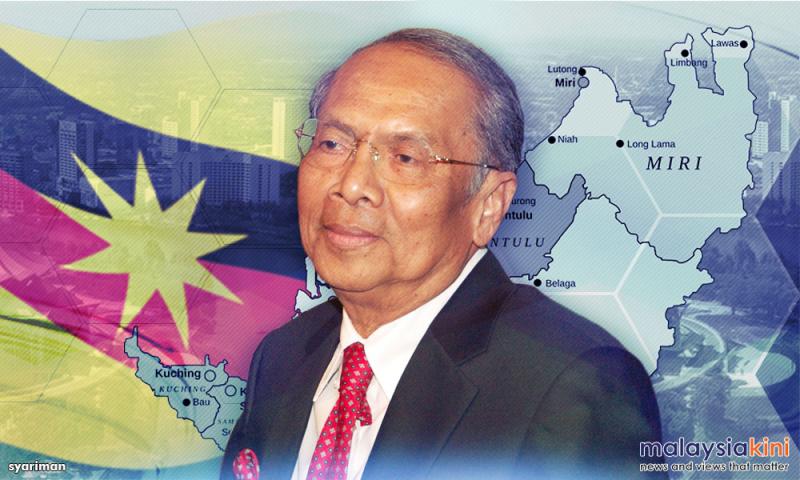
A distinctly Sarawakian political battlefront
COMMENT Political spheres of both sides grew uneasy with Sarawak’s political development as it drifted further into the unchartered territory of unheard symbolism and lingo.
The Umno old guards are already riled up against most of Chief Minister Adenan Satem’s stance - either on the position of Sarawak within the federation or the usage of the English language. Pakatan federal leaders, on the other hand, are still hissing over Sarawak’s decision to ban several prominent opposition leaders from West Malaysia - missing the point entirely by harping on freedom of expression.
Meanwhile in Sarawak, a new force rising from the populace has changed the political battlefront into one that is distinctly Sarawakian in nature. If Sarawak BN is a thin flaking blue glaze that covers a different set of political parties and ideologies as compared to the BN in West Malaysia, then the support for the opposition is a thin red glaze that camouflages the population’s dissent against the ruling government’s policy that affected Sarawak.
COMMENT Political spheres of both sides grew uneasy with Sarawak’s political development as it drifted further into the unchartered territory of unheard symbolism and lingo.
The Umno old guards are already riled up against most of Chief Minister Adenan Satem’s stance - either on the position of Sarawak within the federation or the usage of the English language. Pakatan federal leaders, on the other hand, are still hissing over Sarawak’s decision to ban several prominent opposition leaders from West Malaysia - missing the point entirely by harping on freedom of expression.
Meanwhile in Sarawak, a new force rising from the populace has changed the political battlefront into one that is distinctly Sarawakian in nature. If Sarawak BN is a thin flaking blue glaze that covers a different set of political parties and ideologies as compared to the BN in West Malaysia, then the support for the opposition is a thin red glaze that camouflages the population’s dissent against the ruling government’s policy that affected Sarawak.
Despite not having its own local narrative, Pakatan Harapan in Sarawak is set to remain strong in the urban areas by banking on the issues of transparency and ‘check and balance’. What it lacked in narrative, it banks on latent sentiment.
The struggle to realise Sarawak’s nation-of-intent within the federation is a major theme, whether explicit or not, in all of Sarawak’s state elections ever since the formation of Malaysia. However, 2016 will witness the first explicit talk of the realisation of Sarawak’s nation-of-intent and its position within the greater federation of Malaysia.
Indeed, the ubiquitous cries of “Sarawak for Sarawakians” were once a major battle cry last heard during Stephen Kalong Ningkan’s administration as the chief minister, prior to him being kicked out through an Emergency proclamation declared by the federal government.
Readers, particularly from the peninsula, were aghast at the explanation on why Sarawak BN remained strong in my previous writing. I understand why it was seen as a pro-BN write-up. But alas, if one wishes to truly understand why Sarawak remains as BN’s strong deposit - one must understand the locals’ worldview, particularly in the rural areas. Sarawakians perceive politics, particularly when it comes to the state leadership - beyond the Blue/Red divide.
The local issues, component parties and individuals play a much more major role in affecting their choice. True, Sarawak is part and parcel of Malaysia. But alas, as similarly noted by Malay Mail Online columnist Erna Mahyuni - Bornean politics differ vastly from West Malaysia. Their political choice and how they made that choice, differs from West Malaysia. And this is entirely true for the upcoming Sarawak state election.
Let’s elaborate, shall we?
1. What Matters for Sarawakians
Despite the election fever, I could barely see many political flags around town as compared to the general election season. But, I can easily spot ‘Sarawak for Sarawakians’ (S4S) bumper stickers and shirts all around town. Not forgetting, the omnipresent old flag of the long lost Sarawak Kingdom.
These telltale signs are hard to miss. While these telltale signs are not keenly observed by West Malaysian observers, the sentiment of being marginalised in the federal political discourse (which gave way to many issues such as hudud, which is irrelevant to Sarawak) eclipsed even that of 1MDB among the local populace.
Popular votes for Sarawak BN in the previous state election took a huge dip, most ostensibly in the urban areas. But bear in mind, it has more to do with localised issues (Taib Mahmud, illegal logging and native customary land or NCR) rather than issues that affect the nation as a whole). Remember: this is the state election we are talking about, not Malaysia’s general election.
I’ve explained through my previous article that federal issues won't really affect the upcoming state polls in Sarawak. Even if a national concern becomes an issue, it will be 'localised' and given a ‘local twist’. Take the National Security Council (NSC) Bill for an example - what bothers many Sarawakians is not the bill itself, but the absence of Sarawak’s representative in the council.
Sarawak DAP has grilled the ruling government on the absence of representatives from Sarawak in the council, considering that Sarawak is the equal partner to Malaya in the 1963 Malaysia Agreement. Sarawak DAP has also grilled the state government on the effect of the NSC on Sarawak’s autonomy.
This take on the issue of NSC is different from that in West Malaysia - where it boils down to the question of the suspension of human rights and the centralisation of power. In this upcoming state polls - it is about Sarawak’s power projection and realignment of Sarawak within the Malaysia framework as both political alliances are trying to tap into the heightening sense of nationalism among Sarawakians.
Sarawak BN has taken this fight through its constant challenge towards federal policies. Sarawak Pakatan, particularly Sarawak DAP - has constantly emphasised on its autonomy from the central party machinery.
Even the Bersih 4 tumultuous protest witnessed a meagre outcome in Kuching. In contrast, the ‘Sarawak For Sarawakians’ march which urged the state government to be more assertive in defending the Malaysia Agreement witnessed far larger attendees in all of Sarawak’s major towns. Clearly, as I have explained - Sarawakians in general do not share the same sentiments with those in West Malaysia.
2. Consociationalism-pull
It is a fact that splinter parties and individuals are eager to rejoin the Barisan Nasional coalition in Sarawak. In fact, in the rural areas, Independent candidates will claim that they are a part of the Barisan Nasional coalition. In big cities such as Kuching and Miri - this is not the case. Nor is it in the peninsula.
Pakatan Harapan should be humble enough to learn what attracts these voters to the ‘dacing’. Take the case of SNAP for an example - despite the terrible blew the ruling alliance gave it after ousting Stephen Ningkan - it persisted to join the Sarawak BN coalition.
In fact, PBDS and SNAP had been pushing one another out of the Sarawak BN coalition - which eventually witnessed the ouster of SNAP from BN Sarawak. Sarawak Pakatan Harapan has yet to come up with a platform stable enough to thwart the ruling coalition out and attract local power bases into their fold. This reflection of old Sarawak’s politics has yet to see any signs of abating.
3. Opposition line-ups in Sarawak
In the previous elections, Sarawak witnessed three-cornered fights for too many times (BN vs PKR vs DAP) in many constituencies. Sarawak BN, too, is not free from infighting but as I have explained, the presence of PBB that acts as the primus inter pares absorbed the impact. Whether the umpire is fair or not in its deliberation, that can be debated. But it has a coherent, localised system of decision making.
Sarawak’s Pakatan Harapan needs to have a similar mechanism. The longer the parties remain at loggerheads - the longer shall their woes be. Sarawak DAP’s constant attacks and jibes at Sarawak PKR is not healthy at all. For many who wished to see a two-party democratic system, this is unfortunate. But what of the Sarawak-based opposition parties? What happened to them?
Historically, Sarawak used to have its own opposition parties which reflected Sarawak’s diverse nation-of-intents. The Sarawak United People’s Party (SUPP) was one such example. The party, as it is now, represents the urban areas.
Historically, it was strongly against the creation of Malaysia and the grassroots consist mainly those who were in antipathy against the federal government for a long while. In the tumultuous year of 1965, it was a bedfellow of the Singapore-based People’s Action Party. But after much accosting and political manoeuvres, SUPP joined BN.
The once-roaring, confident multiracial party which consist of mainly ethnic Chinese is now suffering a similar fate to Gerakan, i.e. subverted by the DAP.
Another political party worth mentioning is the old Sarawak National Party (Snap). Though originally a party of the Sarawak Alliance in 1963, it was kicked out from the Alliance after the declaration of Emergency in 1966. It re-joined the ruling coalition in 1976 and was later expelled in 2004.
The Dayak-based Parti Rakyat Sarawak (PRS), which originated from the now defunct Parti Bansa Dayak Sarawak (PBDS), which in turn was a splinter of SNAP, claimed to continue with its original fight to have the Dayaks’ voices heard at the federal level.
Wait - so most of these opposition parties joined BN? That means that the entire state is giving its unconditional support towards Sarawak BN, right? Wrong. Sarawak has never been a total sea of deep blue, nor are its urban areas tinged in the deep crimson of DAP.
4. Adenan-mania is a fact
Hardcore supporters of the opposition in West Malaysia could never understand the Adenan factor. They may have belittled him or his speeches, but to many Sarawakians, even members of the opposition in Sarawak, it is difficult not to be affected by his charisma and leadership. Which is why the opposition will focus on his failures, such as the snag in the negotiation to increase Sarawak’s oil royalty rather than his personality.
The act of belittling him, particularly by West Malaysian politicians (both Umno and Pakatan) will cause a ‘rally around the flag effect’. When his decision to include English as one of the official languages was made, lawmakers from both sides were up in arms to defend him and his policy. Automatically, an ‘us’ (Sarawakians) vs ‘them’ (West Malaysians) paradigm awashed Sarawak.
Despite tapping into this sentiment, members of the opposition could barely ride on this wave - as they are seen as a part of ‘them’.
5. How real is this 'us vs them' mentality in Sarawak?
A similar ‘rally around the flag’ effect could be seen during Taib Mahmud’s ascendancy to be the state’s governor. As the cries to have him charged by the Malaysian Anti-Corruption Commission (MACC) rose steadily by the opposition lawmakers and many in West Malaysia, Sarawakians in general reacted negatively towards this.
A flashback of Ningkan’s removal by the federal government and the fear that they will have to kowtow to Putrajaya’s diktat after the removal of their very own strongman affected many Sarawakians.
Dr Ik Ngu Tien of Aliran aptly reflected what Sarawakians in general felt for the controversial man: “For those who are disheartened by the religious tensions in Sabah and in the peninsula, Taib was perceived as providing a deterrence to the federal-led Islamisation drive.”
In fact, the ‘us vs them’ mentality was so heightened that the Sarawak Association for People’s Aspiration (Sapa), a Sarawak rights movement NGO (later banned by the Home Ministry) which has criticised Taib Mahmud’s rule in the past, sought to get Taib Mahmud’s title changed to the Yang di-Pertua Negara, which they argued should be the way. You see, although to many Sarawakians he may have been a “bad boy” - but he is “our bad boy”.
Conclusion
Our nation has yet to have a strongly grounded common narrative. As long as that happens, the issues within Sarawak will be distinct. The next state election in Sarawak is going to be an all-out Sarawak affair and Sarawakians are stating it loud and clear (through both sides of the divide) that they are fed up of being forced to follow the political narratives in West Malaysia.
As for those who argued that the Sarawak state election will be a barometer for the next general election, you are completely wrong.
If there is anything to observe in this state polls, it is the changing political landscape in Sarawak. Whomever Sarawak votes for, it is with the hope that Sarawak will be more assertive in declaring itself as the equal partner of Malaya and Sabah.
Part I: The ancient dance of Sarawak politics
SYED NIZAMUDDIN SAYED KHASSIM believes in good governance, meritocracy and confluence of ideas. He is also a founding member of the BIMP-EAGA (Brunei, Indonesia, Malaysia, and the Philippines East Asean Growth Area) Young Entrepreneurs’ Chamber and is also a ranking member in the International Relations and Diplomacy Committee in the Malaysian Youth Parliament. Proudly born and bred in Sarawak.


Are you sure you want to delete this comment?
This action cannot be undone.