



Emergency Ordinance back in the guise of NSC
COMMENT The Malaysian Bar, the Advocates’ Association of Sarawak and the Sabah Law Association are seriously concerned with the National Security Council Bill 2015 (“the Bill”) that was passed by the Dewan Rakyat on Dec1, 2015, and by the Dewan Negara on Dec 22, 2015.
It is worrying that this far-reaching piece of legislation has been hastily dealt with by Parliament despite widespread concerns expressed by various parties.
The government’s refusal to engage meaningfully with critics of the Bill and to properly respond to the mounting criticism of it are regrettable.
Further, we are disconcerted that the government has failed to fully explain the reasons for the Bill. There have been some references to the Lahad Datu incident and the creation of the Eastern Sabah Security Command.
However, these references are questionable because firstly, the Lahad Datu incident took place more than two years ago. Thus, there was no reason for the sudden rush for this Bill in the past month.
Secondly, Article 150 of the Federal Constitution provides for the proclamation of an emergency, which would provide sufficient powers to address any future incidents of territorial incursion, like that in Lahad Datu.
We wish to briefly highlight some of our serious concerns on the Bill, as follows:
- There is an absence of any reference to relevant provisions of the Federal Constitution, such as Article 149 (Legislation against subversion, organised violence and acts and crimes prejudicial to the public) or Article 150 (Emergency Powers) of the Federal Constitution in the preamble to the Bill.
This despite the wide powers on matters concerning national security and, further, the provisions for the exercise of emergency-like powers;
There has been no explanation as to why the NSC has been established as a statutory body by the Bill and clothed with the wide powers under the Bill;
The NSC would be able to treat almost any matter as one of national security for the purposes of the Bill. There are no checks and balances to this seemingly unbridled executive power in the hands of the NSC;
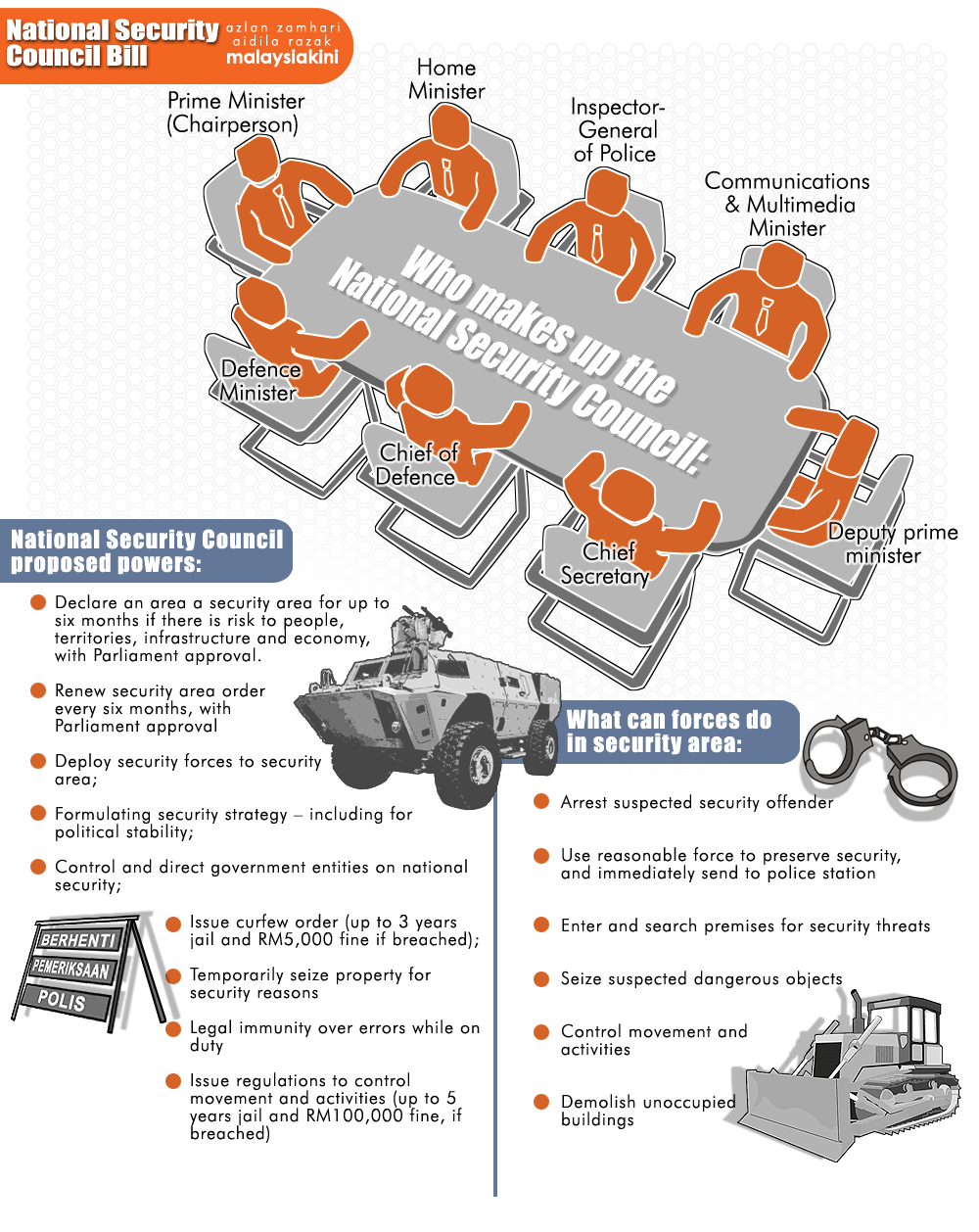
The NSC will also have the power to “ control ” and “ issue directives ” to “ any ministry, department, office, agency, authority, commission, committee, board or council of the federal government, or of any of the state governments, established under any written law or otherwise ” on operations or matters concerning national security.
Thus, a whole host of instrumentalities of the federal government or state governments - which could include Bank Negara Malaysia, the Securities Commission and the Malaysian Anti-Corruption Commission - would be made subservient to the NSC.
The independence of these entities could be irreversibly compromised or undermined. Further, the authority of state governments can be overridden;
This appears to be an unprecedented conferring of executive powers on a statutory body by Parliament, and these enormous powers are available to the NSC even where the conditions for the declaration of a security area are not met.
In short, the NSC’s powers are akin to emergency powers, but exercisable without a declaration of emergency under Article 150 by the Yang di-Pertuan Agong;
The Bill further infringes Article 137(1) of the Federal Constitution, which states that it is the Yang di-Pertuan Agong, who shall be responsible for the command, discipline and administration of, and all other matters relating to, the Armed Forces. In addition, Section 168(3) of the Armed Forces Act 1972 states that no power vested in the Yang di-Pertuan Agong may be affected by any written law;
The director-general of the NSC is also to be appointed by the prime minister. In contrast, the equivalent NSC in France, that is the Council of Defence and National Security, includes the head of state (the president) in its composition, which provides a measure of check-and-balance;
This provision gives the NSC a broad discretion, predicated on wide and vague grounds, to advise that an area be declared as a “ security area ”.
Thus, the clause undoubtedly allows for the exercise of emergency powers that only the Yang di-Pertuan Agong may exercise under Article 150, and is therefore a provision that is unconstitutional;
Thus, the prime minister may extend the period of the declaration for an unlimited number of times, and therefore for an indeterminate duration of years.
There is provision for the declaration to be “ laid before Parliament ” but this is in the nature of notification to Parliament and not for the purposes of debate and ex post facto sanction by Parliament;
The Bill does not provide for the qualifications of the Director of Operations, who is to have enormous and unrestricted powers, such as the power to remove any person from the security area, impose curfew and control the movements of persons or vehicles;
The security forces also have powers to stop and search individuals; enter and search any premises; and take possession of any land, building or movable property (such as cars) in a security area.
All constitutional guarantees and fundamental rights of citizens in respect of arrest, search and seizure of property can be ignored or suspended for infringing “ any written laws in the security area ”. This is a grave violation of the Federal Constitution;
Further, the law of armed conflict dictates that unless the threat is a “real threat” and “not a perceived threat”, and that it is an act of war between nations, the threat falls within the jurisdiction of the police or any other government agencies, and not under the military;
Finally, there is power to dispense with inquests in respect of members of the security forces and persons killed within the security area, as long as a magistrate “ is satisfied that the person has been killed in the security area as a result of operations undertaken by the security forces for the purpose of enforcing any written laws ”.
“ Written laws ” are not defined, and could well include laws in respect of minor offences. Thus, this provision permits security forces to use disproportionate force that could result in the loss of lives, with impunity.
Bringing back Emergency Ordinance
We consider the Bill to be a serious threat to our system of constitutional government. It is apparent that the Bill vests and concentrates enormous executive and emergency powers in the NSC and the prime minister.
This upsets the delicate separation of powers in the constitution between the Executive, Legislature and Judiciary on the one hand, and the constitutional monarchy on the other hand.
It would appear that the powers are in effect emergency powers, but without the need for a proclamation of an emergency under Article 150.
This usurps the powers vested in the Yang di-Pertuan Agong, and effectively resurrects the powers granted to the government under the Emergency Ordinances, which were repealed by Parliament in 2011.
We are aware of the constant refrain that new powers, such as found in the Bill, are necessary to combat the threat of terrorism.
However, we would remind the government that it has more than enough laws giving it powers to address security concerns.
The Bill extends those powers even further, allowing the government to restrict movement, abandon civil liberties and administer areas centrally and directly, bypassing state and local government.
It avoids public scrutiny and proper accountability, and promotes unfettered discretion and an environment of impunity.
The Malaysian Bar, the Advocates’ Association of Sarawak and the Sabah Law Association urge the government to seriously reconsider the Bill and not bring it into force, and to engage with all concerned parties on the proper role and function of the NSC.
There are fundamental concerns and consequences associated with the NSC Bill that require careful discussion by, and input from all stakeholders involved. For the sake of the nation, the government should take a step back to properly address these concerns.


Are you sure you want to delete this comment?
This action cannot be undone.