
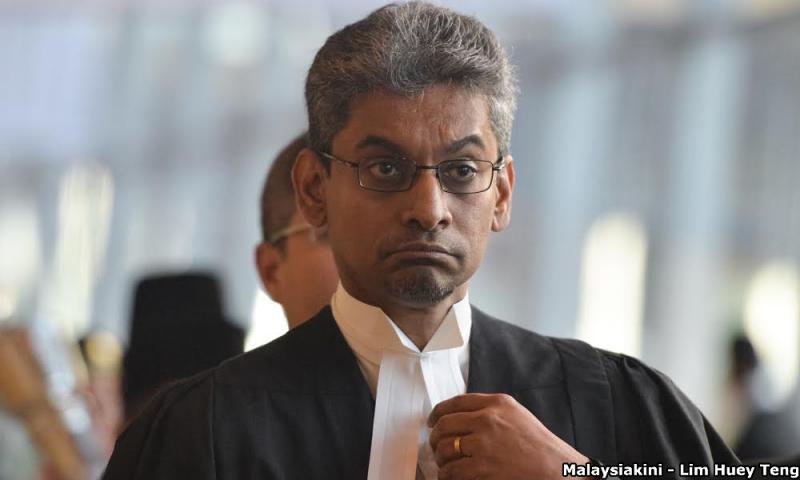
Malaysian Bar president Steven Thiru expressed concern with the passing of three legislations last year which lawyers feel are curtailing fundamental rights.

He cited the Prevention of Terrorism Act, amendments to the Sedition Act 1948, and the National Security Council (NSC) Bill, which is likely to become law soon.

Thiru said the NSC Bill, which was passed in the last session of Parliament, was not only unconstitutional, but further usurped the power of the Yang di Pertuan Agong to declare emergency.

The Bar Council chairperson also called on the judiciary to continue to protect minority rights.

“The NSC Bill further provides that the prime minister may, on the advice of the NSC, declare any area in Malaysia, which could include the whole of Malaysia, as a ‘security area’ on very broad and vague grounds.

"The initial period of the declaration is for a period of six months and the PM may extend the period of declaration an unlimited number of times, and therefore for an indeterminate duration of years.

“The NSC Bill enables the PM to either unilaterally or through the NSC, to exercise powers that are in effect emergency powers, but without the need for a proclamation of an emergency under Article 150. This usurps the powers vested in the Yang di-Pertuan Agong,” Steven said.

As for Pota, he said the law was totally unnecessary as there were ample counter-terrrorism provisions in the statute books, such as in the Penal Code and the Security Offences (Special Measures) Act 2012 (Sosma).

“The Malaysian Bar is supportive of efforts to combat the threat of terrorism but such measures must not be at the cost of sacrificing our ideals and principles that would stimulate the terrorist.

“Detention without trial is repugnant to the rule of law and has been widely repudiated as counter-productive,” he said.

The amendment to the Sedition Act 1948, Steven said, reneged the government's promise in 2012 that the Act would be replaced with a National Harmony law.

He said the amendments should not be brought to force as it would further imprison thought, speech, and expression.

“The sentence of a fine is abolished and there is now a minimum and maximum jail sentence ranging from three to 20 years. Judges are prevented from taking into account factors such as first-time offenders, young offenders, and the possibility of a conditional discharge or binding over,” he said.

He cited the need to repeal the law and replace it with the National Harmony laws.

Steven said recent incidents such as the Taman Medan church protest and the Low Yat Plaza incident were examples why the Sedition Act 1948 did not work.

Far-reaching implications

The Bar Council chairperson also called on the judiciary to continue to protect minority and constitutional rights.

He cited the examples of Zi Publications Sdn Bhd, R Yuneswaran, Azmi Sharom ( photo ), and the transgender case, along with the Sarawak re-delineation case involving See Chee How, Tuan Mat Tuan Wil, and Indira Gandhi, as cases involving constitutional rights of speech, expression, assembly, and religion, as well as equality and the right to life.

“The decisions in these cases have far-reaching implications on fundamental rights and minority rights under our federal constitution.

“The seemingly expansive interpretation of restrictions to fundamental liberties has not been well-received. The apparent reluctance of the court to invalidate legislation or state enactments on constitutional grounds is worrying, and has given rise to the public perception that the interests of the state prevails over the constitutional rights of citizens.

“The willingness on the part of the court to cede its jurisdiction has been decried as an abdication of responsibility. These decisions are seen as being inimical to the protection of fundamental rights enshrined in our constitution,” he said.

Steven reiterated that two fundamental doctrines - the courts as the guardian of constitutional rights and access to justice as a rule of law principle - must be seen as a fundamental right that cannot be abrogated.

He said if a person cannot approach the courts for legal redress, it meant constitutional rights were an illusion.

The Bar president also expressed concern over recent actions taken by the police targeting lawyers for investigations and arrests.

“The principle of legal professional privilege must remain inviolate and absolute,” he reminded, in obvious reference to the arrest, detention and charge of lawyer Matthias Chang under Sosma.