




Tsunami survivor's astonishing tale of weeks at sea
An Indonesian man who survived for two weeks after being swept out to sea by the Asian tsunami has told an astonishing tale of courage and luck which washed him onto a Robinson Crusoe-style hut floating in the middle of the Indian Ocean.
An Indonesian man who survived for two weeks after being swept out to sea by the Asian tsunami has told an astonishing tale of courage and luck which washed him onto a Robinson Crusoe-style hut floating in the middle of the Indian Ocean.
When a passing cargo ship spotted the bizarre hut on a bamboo raft about 200 nautical miles from Indonesia's Sumatra island on Monday, New Zealand Captain John Kennedy ordered the ship's whistle to be blown, without much hope of a response.
 "I thought the chance of finding someone alive two weeks after the tsunami was very slim," Kennedy told reporters when his ship docked in Malaysia's Port Klang late yesterday. "To our surprise, a frail looking man emerged."
Describing the events leading up to his rescue, Ari Afrizal, 22, of Desa Kabong in Aceh Jaya said he had been working on a house in Kota Aceh Jaya near the provincial capital Banda Aceh on Sumatra when the tsunami hit on December
"I dropped everything and started running towards a nearby hill. I turned around and could not believe what I saw, the biggest wave that was swallowing everything in its path. Within seconds it reached me," he told reporters in Port Klang.
Grabbing a passing plank he was swept out to sea, along with the bodies of those already dead, while watching four of his friends also clinging to pieces of wood slowly disappear.
Sumatra was the worst-hit of all areas affected by the tsunamis, with more than 100,000 killed.
On the second day adrift he spotted a small sampan (boat) that had capsized, turned it upright and, despite pain from his injured legs, clambered aboard.
Later that day he saw a man in the sea waving for help, but could do nothing.
"There were no oars for me to row the boat towards him and I could not swim that far. I did not see him on the third day," Afrizal was quoted as saying by the New Straits Times .
Surviving on rainwater
Drinking only rainwater, he stayed in the sampan until, on the morning of the fifth day, he spotted his ark - a 10 metre fishing raft with a hut on it.
"I thought I had been rescued. I swam to the raft and climbed onto it. Only then I realised that it was empty," he said.
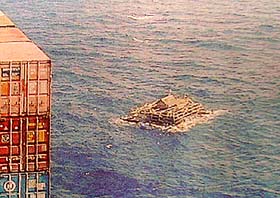 But on board he found about three litres of water in a small tank, about 20 litres of kerosene, hurricane lamps and some clothes. He settled in, eating coconuts he fished from the water.
"I saw many ships passing while I was floating in the sea. I shouted ' tolong, tolong ' (help, help) and waved my hands frantically. Perhaps they did not see because none responded."
He began hallucinating and became depressed. "I gave up all hope of living," he said.
But on the fifteenth day at sea, Captain Kennedy's Liberian registered container ship MV Al Yamamah, sailing from Port Muscat in Oman, passed by and took the trouble to blow its whistle.
Once the crew got over its surprise at the apparition in the hut's doorway, "we immediately went alongside the raft and threw a line to him," said Kennedy, 62.
Third survivor
He said Ari looked fine, except for parched lips, and even managed to climb up onto the ship without help.
After soup and meals with the crew, the ship docked at Port Klang around midnight, and Afrizal told reporters: "I treat the captain as my father and the rest of the crew as my brothers.
"I pray that my family in Aceh is also as lucky as me and survived the disaster."
Afrizal was the third Indonesian survivor picked up by passing ships and brought to Malaysia since the tsunamis which killed more than 156,000 people around Asia.
The other two - Rizal Shahputra, 20, who was at sea for eight days, and pregnant housewife Malawati Daud, 23, who drifted for five days - survived by clinging to floating trees.


