



Bauxite mining - a sorry reflection on the state of M'sia
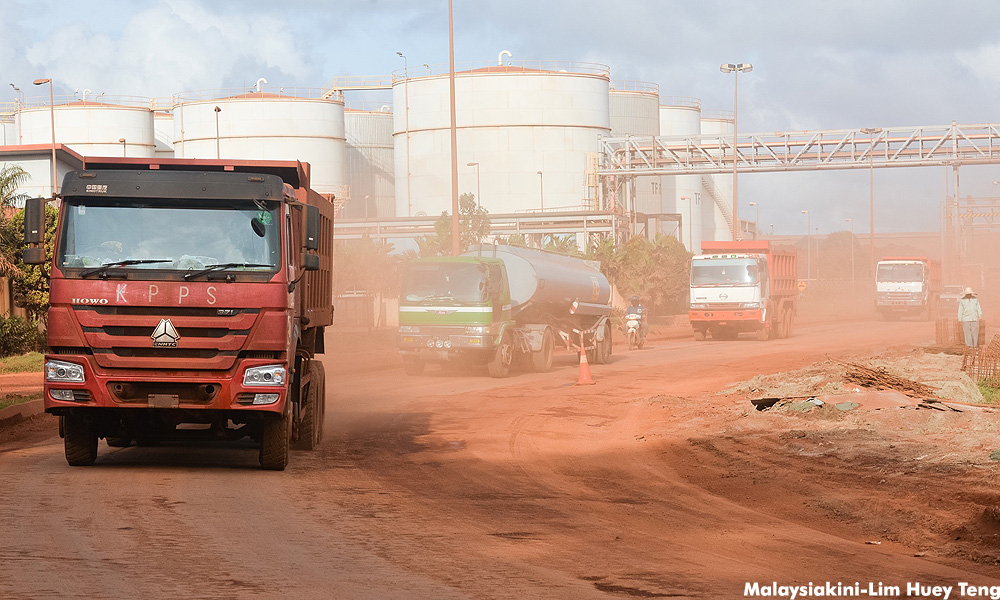
COMMENT The issue of bauxite mining in Pahang has caught the attention of the public lately due to the recurrence of related news in the media. The public are naturally outraged that environmental disasters are once again rearing their ugly head.
It would seem that natural resources and mineral-rich states such as Pahang are susceptible to environmental tragedies - because of the greed of the operators. To be fair, this greed is in turn conditioned by the insatiable demand fuelled by the (then) increase in domestic production - which includes materials for the construction sector - in China, as the country shifts gear towards a more consumption-driven economy.
According to data obtained by Kuantan MP Fuziah Salleh, some 15 million tonnes of bauxite ore are exported from the Kuantan Port to China every month. A Singapore environmental risk analysis that was reported in the Huffington Post , pointed out that Malaysia accounted for 40 percent of China’s 49 million imports in 2015 - which represents a staggering jump of 700 percent, as compared to 2014!
COMMENT The issue of bauxite mining in Pahang has caught the attention of the public lately due to the recurrence of related news in the media. The public are naturally outraged that environmental disasters are once again rearing their ugly head.
It would seem that natural resources and mineral-rich states such as Pahang are susceptible to environmental tragedies - because of the greed of the operators. To be fair, this greed is in turn conditioned by the insatiable demand fuelled by the (then) increase in domestic production - which includes materials for the construction sector - in China, as the country shifts gear towards a more consumption-driven economy.
According to data obtained by Kuantan MP Fuziah Salleh, some 15 million tonnes of bauxite ore are exported from the Kuantan Port to China every month. A Singapore environmental risk analysis that was reported in the Huffington Post , pointed out that Malaysia accounted for 40 percent of China’s 49 million imports in 2015 - which represents a staggering jump of 700 percent, as compared to 2014!
The geological reason for bauxite’s popularity is because it is a main source for metal. Strictly speaking, bauxite is not actually a mineral as such, but a red coloured clay rock rich in alumina (aluminium oxide) - which is transformed into silvery, nonmagnetic boron or metal matter with ductile, i.e. malleable properties that can withstand stress and corrosion.
The clay-like colour of bauxite ore is why the rivers and seas polluted by the mining and extraction operations had turned red - as seen in and around Kuantan. The toxic, red mud-like water or sludge contains naturally radioactive minerals and carcinogenic metals like arsenic, beryllium, cadmium, chromium, lead, manganese, mercury nickel, strontium and cesium.
Furthermore, dust from the mining and extraction operations would be radioactive as well. The environmental terror also extends to potential landslides and mud floods if there is any heavy rain - caused by the presence of the piles of earth that had been dug out and heaped near residential areas. Health effects can include respiratory problems and skin rashes in the short run, as well as (lung and epidemiological) cancer, in the long run.
Why only action taken now?
The other co-efficient cause has to be corruption - where corrupt officials responsible receive bribes in exchange for not enforcing compliance to the law.
Thus far, four suspects from the state land and mines office have been arrested . The staff were detained for alleged involvement in the sale of the mineral transfer form (Form 13D) to operators of illegal mines. The form, known as a “docket” by locals, is issued for a RM1 fee. However, the Malaysian Anti-Corruption Commission (MACC) found that it was sold at between RM150 and RM200 each.
The question on the minds of many - particularly the more cynical ones - is that why only now have the authorities sprung into action?
The timing could not have been more coincidental, given that the past month or so has seen China’s demand slowing down as oversupply finally becomes a reality across the sectors due to the mediocre economic performance - caused not least by unsustainable debt binges racked in the shadow banking system and the stock market crash.
Lower demand means lower asking price by Chinese buyers. Market intelligence reports that there is currently a mismatch in pricing between suppliers and importers. This means that there is no urgency or necessity for suppliers to add to, or replenish, the existing stocks.
Nonetheless, will there be a sustained and concerted effort to ‘clean up’ (pun intended) this latest environmental disaster that has left what could well be lasting scars on both the landscape and the people’s impressions?
The lands that had been leased for the mining and extraction activities have not only become unsightly, but not least barren too, (i.e. no longer fit for replantation purposes, or even for housing developments).
According to the geotechnical and infrastructure engineering department of Universiti Malaysia Pahang, detoxifying and rehabilitating the former mining and extraction areas - like soil recovery, in terms of nutrients and minerals - will take a very long time.
As for developments, it will also be time-consuming for the land structure to become stable and compact again. The mining and extraction areas will have to be first covered with top soil to level it, and then compressed with heavy machinery for a long period of time.
Best safe mining practices
In taking stock of the situation, both the federal and state governments should now promote best and environmentally safe mining practices. How can we make bauxite mining safer? The best way to do it is to not mine at all - since Malaysia lacks the “safety distance” operating procedure implemented in other countries, such as Australia (principally in Western Australia).
There is no “corridor” in which the mining and extraction activities can be quarantined and insulated. In this, Malaysia should go further than Indonesia and institute an indefinite ban unless, and until, viable and environmentally safe mining practices are introduced and implemented. These would probably take the form of:
- Banning of all forms of drilling and explosives in the initial stage of mining process - that will ensure minimal disruption to soil structure, as well as the release of the radioactive matter. In their place is the soil-cutting methods that only affect the top layer, thus promoting soil stabilisation and conditions of rehabilitation such as replantation (or re-vegetation) and development.
Ultimately, there must be political will to tackle and resolve the environmental problems which plague our beloved country. This belongs to politicians and administrators. There must also be a paradigm shift and cultural attitude which involves both the state and the rakyat - in that monetary reward must always be tempered and balanced with environmental concerns.
The “get rich quickly” mentality that is still prevalent in some sections of our society - which is, paradoxically, deeply religious - is perhaps an indictment on the shape of our nation-building and a sorry reflection on the role of the state in Malaysia today.
JARON KENG is secretary, Green and Blue Environmental Protection Society of Malaysia.


Are you sure you want to delete this comment?
This action cannot be undone.