


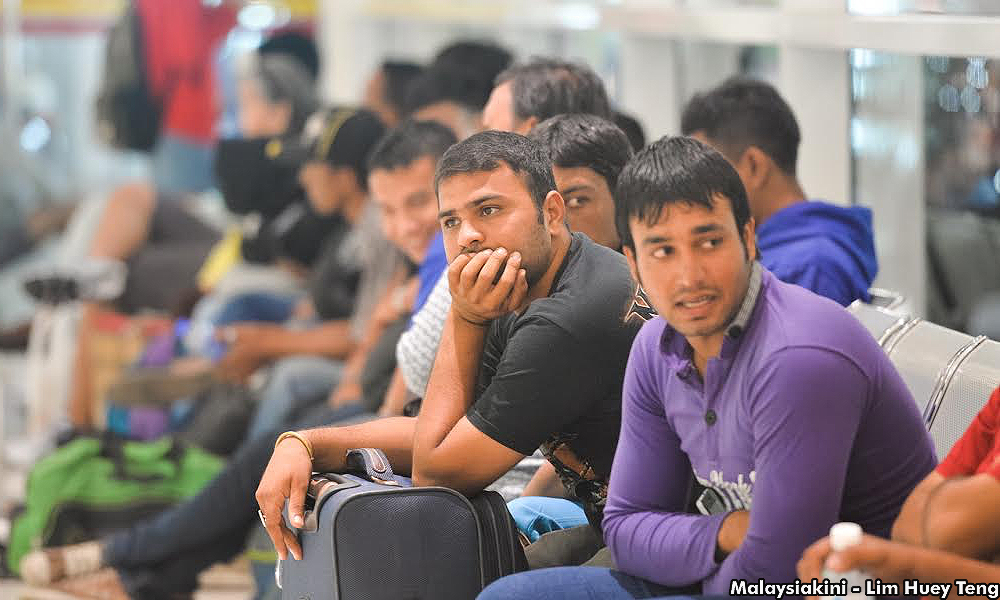

Immoral and unjust to increase levy on migrant workers
COMMENT We welcome the announcement by Prime Minister Najib Abdul Razak that there will be an exercise to ensure all undocumented workers will be documented.
However, we are appalled and shocked by Deputy Prime Minister Ahmad Zahid Hamidi's statement about the restructuring of the levy rate system. Additionally, the Federation of Malaysian Manufacturers has stated its objections to the levy hike from the business perspective.
The government’s decision to increase the levy is immoral and unjust. It is immoral because migrant workers, already among the lowest paid and most exploited workers in the country, will see a further erosion of their meagre income.
The government appears intent on continuing this oppressive and corrupt system that continuously profits from the poor and vulnerable. This cruel process results in continued disrespect for the fundamental human rights of migrant workers.
The government seems to be confused over the basic purpose of the levy. The system of levy was introduced in 1992, fully borne by the migrant workers. However, in 2009, the government moved this responsibility onto employers with the objective of reducing the reliance on migrant workers and ensuring local workers are a priority in employment.
With the reversal of that decision, it is clear that the government is no longer concerned about the country’s over-reliance on foreign workers but on the revenue for the country. Why does the state continue to rob from the poor – the migrant workers?
They’re among highest taxpayers
Once again, migrant workers, who toil for long hours in difficult conditions for a meagre sum of RM900, are not given proper recognition and dignity for furthering the development of Malaysia.
At what cost and for whose benefit? We must consider that the extra cost for levy of RM1,000 imposes a heavy burden on the migrant worker.
A migrant worker justifiably may contemplate, "What do I get in return for the raised levy that I have to pay now? I have to pay for my work permit. I have to pay for my own medical cost, which has risen tremendously over the years. I have to pay for my accommodation – electricity, water transport, etc. At the end of the day, I take home a reduced salary to support my family back home."
The levy is definitely a burden for the worker. Assuming all migrants will earn the minimum wage of RM900, the levy deductions will range from five to 17 percent a month.
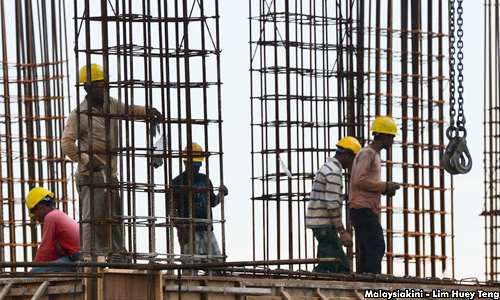 On the other hand, Malaysians need to pay taxes only when they earn more than RM3,000 per month. Thus, migrant workers are in fact the highest taxpayers in terms of income and levy.
At the same time, the migrant workers do not enjoy any benefits from these taxes. In fact, they have to pay exorbitant medical bills that make it almost impossible to access medical care; their children cannot go to school; they have no safety nets such as the Employees Provident Fund, and they are excluded from the social security scheme.
The government gains from the levy but is not made accountable for how it is used.
The Malaysian government is estimated to gain RM2.5 billion in revenue from the levy of about 2.3 million documented workers. With the upcoming exercise of documenting undocumented workers, there will be even greater earnings.
Where does the money go? What is the money going to be used for? As morally conscious members of society, we must consider what benefits will the poor migrant workers gain.
The relentless drive for more profits at the expense of migrant workers, particularly regarding decent wages, is not something that we as a nation can be proud of. Slavery, too, is very profitable. Any self-respecting Malaysian would cringe at the thought of being slave masters.
It is unjust because a basic minimum wage regulation must be applied to all workers, as it enables workers to meet their basic needs and live above the poverty line.
Businesses are already hard hit with the downturn of the economy and rising costs. Is it right to raise the levy for migrant workers? What is the rationale for raising the levy? If we want to downsize the number of migrants in the country, why bring in 1.5 million more?
No checking mechanism
The migrant workers are already in a highly vulnerable situation where their work permits can only be obtained by their employers and where their passport is held by the employers. A migrant worker cannot apply for a work permit independently.
The government has no mechanism in place to ensure that employers who deduct the levy from workers, in fact do use it to obtain the work permit. In fact, Tenaganita has handled numerous cases where workers have paid for the levy but work permits were not done.
Employers are able to get away with this unscrupulous behaviour because when there is no work permit, it is the migrant worker who is arrested, detained, sentenced, whipped and then deported.
The predicted revenue gain of RM2.5 billion from increasing the levy for migrant workers has clearly shown that the sole motive of this move is to substitute the decrease of government revenue.
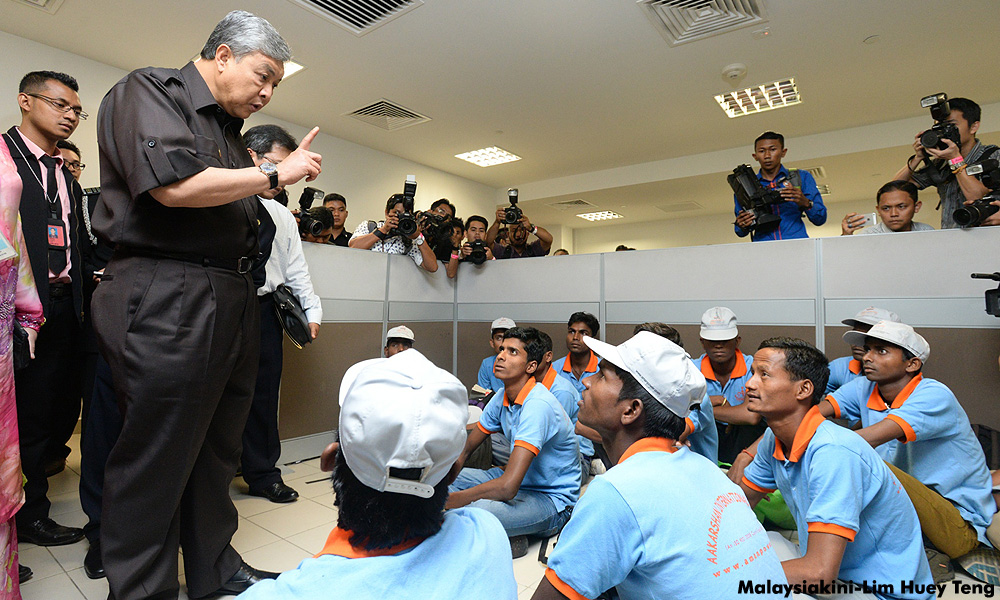 Zahid (
photo
) predicted that 2.135 million documented migrant workers would be charged; however, because of the upcoming rehiring exercise, the levy will come from both documented and undocumented workers. Thus, all migrant workers - regardless of their legal status - are taxpayers.
Zahid (
photo
) predicted that 2.135 million documented migrant workers would be charged; however, because of the upcoming rehiring exercise, the levy will come from both documented and undocumented workers. Thus, all migrant workers - regardless of their legal status - are taxpayers.
The government along with the Malaysian public must understand that the levy charged to migrant workers (paid by migrant workers, not the employer) is a tax. Tax in a civilised governance has to be paid back to the taxpayers in many forms of care - at the very least - health care, education, and social security.
Proper distribution of tax dollars is one of the moral obligations of a just government. Have the migrant workers in Malaysia gained from the tax that they have been paying to the Malaysian government?
Therefore, we at Tenaganita strongly urge the Malaysian government to channel part of the levy paid by migrant workers for:
1. Hospitalisation and treatment of migrant workers, including providing treatment for TB and other infectious deceases.
2. Supporting migrant workers to seek redress of their grievances.
3. Providing accommodation along with a social safety net.
4. And, more importantly, funding to bring together all stakeholders, especially NGO participants, to discuss and debate on migrant recruitment, laws and policies, and burning issues affecting migrant workers.
Civil society participation is not only important but is also a necessity as it affects relations inside and outside Malaysia's borders, thereby, affecting all people.
We appeal once again that the Malaysian government shall not use 'middle men' or recruitment agencies profiteering from this documentation process. Only employers should directly deal with Immigration in the hopes that corrupt practices will be reduced.
We also urge the governments of source countries, their foreign missions, and migrant rights defenders not to bow down to the exploitative policy demands of the Malaysian government while, at the same time, to support efforts to combat corruption, which is the root of this exploitation.
The continued emphasis on knee-jerk reactions to rising problems has only led to a system that supports extreme forms of exploitation of migrants and a culture of modern-day slavery.
The Malaysian government is in debt to migrant workers. Therefore, the Malaysian government can only begin to repay its debts by respecting the rights and dignity of migrant workers. The debt is due now.
GLORENE A DAS is Tenaganita executive director.


Are you sure you want to delete this comment?
This action cannot be undone.