




Barriers forced MACC to downgrade 'charges' against PM?
The Malaysian Anti-Corruption Commission (MACC) may have downgraded the alleged charges recommended for Prime Minister Najib Abdul Razak due to obstacles faced during the course of its investigation, opines a former graftbuster.
According to retired Anti-Corruption Agency (ACA) director Mohamad Ramli Manan, this would explain the decision to allegedly recommend charges under Section 403 of the Penal Code for 'dishonest misappropriation' as opposed to criminal breach of trust (CBT).
In an email interview with Malaysiakini , Mohamad Ramli cited hostile witnesses, interference in the investigations and the likelihood that the prime minister would know the case against him before his statement is recorded, as the reasons that motivated the decision.
Drawing on his experience in the ACA, he said under different conditions, his team would have tried to establish a case under Section 17 of the Malaysian Anti-Corruption Act 2009.
"However, as key witnesses (in the case) are hidden and some have absconded overseas - as mentioned by former police Special Branch deputy director Abdul Hamid Bador - it is quite difficult to get evidence from the affected officers.
"They could not get evidence from hostile witnesses who are safe overseas and could give false or inaccurate statements," he added.
A qualified lawyer, Mohamad Ramli believes the MACC investigators were operating on the premise that there were corrupt payments.
However, he said, since there were no witnesses who could testify, the commission had to allegedly opt for the lesser offence under Section 403, on 'criminally misappropriating property'.
Under this section, the former ACA director explained, those receiving money are deemed guilty, irrespective of whether the person knows or does not know who the giver is.
"If you know (the person who gave you the money), it will be Section 409 for CBT and if you do not know, it will be a Section 403 offence, since MACC found out that most, or all the monies, had been used," he said.
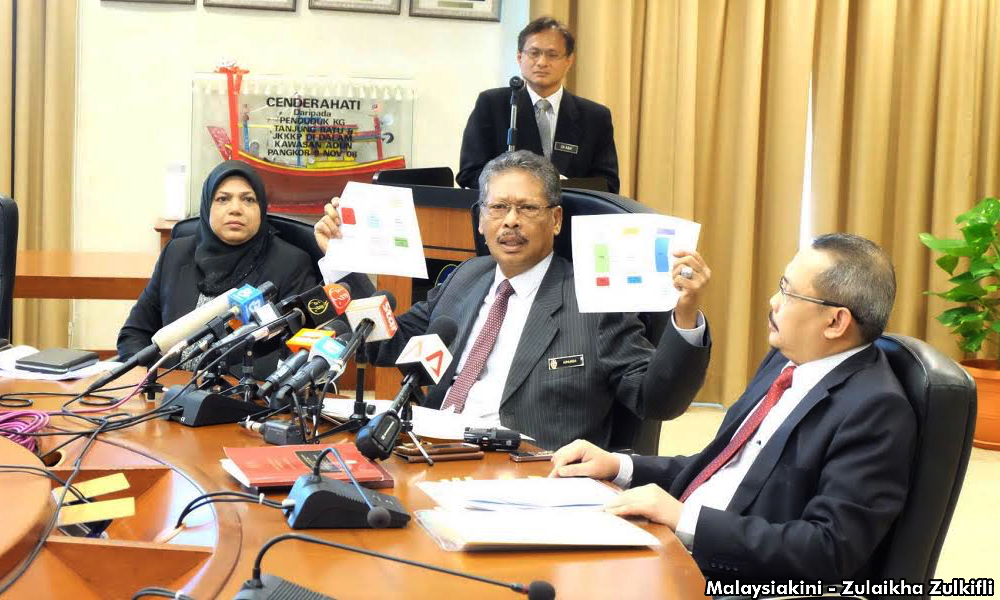 Last Tuesday, attorney-general Mohamed Apandi Ali cleared Najib of any wrongdoing with regard to the RM2.6 billion donation and RM42 million from SRC International that were transferred into the prime minister's private accounts.
As for the SRC money, Apandi said the prime minister was not aware, nor informed, that the RM42 million from the former 1MDB subsidiary was transferred into his accounts and believed that all payments made originated from the RM2.6 billion donation.
The attorney-general also directed MACC to close its investigations.
However, sources familiar with the investigations told Malaysiakini that MACC had allegedly recommended three charges under Section 403.
Najib has repeatedly denied abusing public funds for personal gain and blamed the allegations on those conspiring to topple him.
Meanwhile, Mohamad Ramli said although he has not seen the paperwork, he believes that based on the evidence divulged by the attorney-general, this is a straightforward case.
He claimed that Section 403 is almost a shoo-in, since Najib had alleged he did not know who credited the money from SRC International into his accounts.
"We prefer this charge when we cannot prefer the more serious charge of CBT. The rate of success is very high since it is easy to prove.
"In the Penal Code, there is an illustration at paragraph (f) to further explain Section 403. It says, 'A finds a valuable ring, not knowing to whom it belongs. A sells it immediately without attempting to discover the owner, A is guilty of an offence’," he explained.
Mohamad Ramli said as prime minister and finance minister, Najib could have asked the bank to provide him with information as to whom the creditors were.
Yesterday, the former ACA director said the AG's decision not to charge the prime minister could be investigated under Section 212 for allegedly "harbouring (an) offender" , or Sections 217 or 218, related to a public servant disobeying a direction of law with the intent to save a person from punishment or property forfeiture.
Ramli had served as ACA deputy chief in three states - Kedah, Perak, Negeri Sembilan - before being appointed to head the agency in Kelantan, Malacca, Johor and Sabah.


Are you sure you want to delete this comment?
This action cannot be undone.