


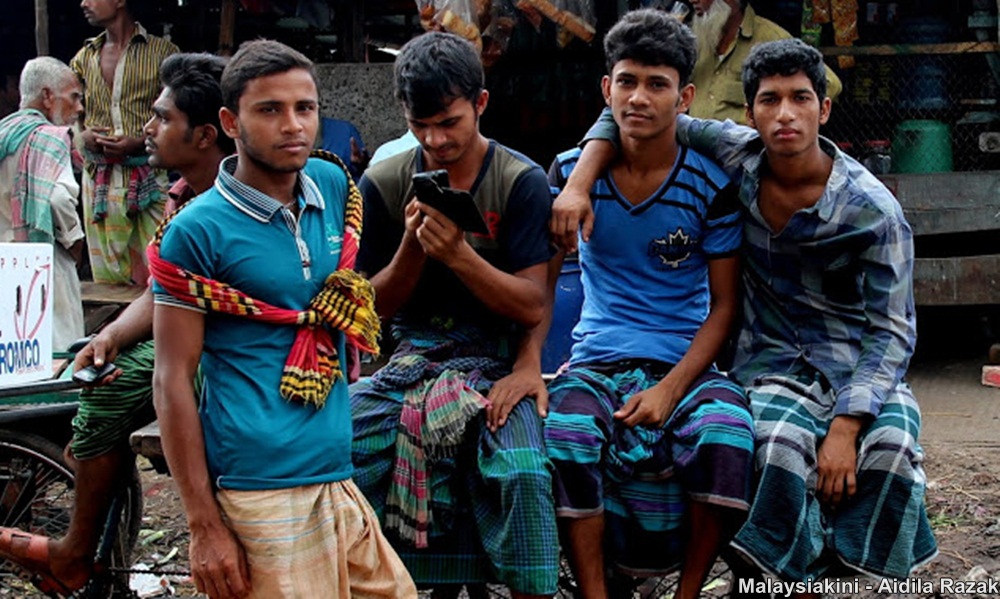

Disaster looms with incoming 1.5m Bangladeshi workers
COMMENT The controversial nature of bringing in foreign workers to Malaysia is not something new. It dates from the British colonial days.
During the colonial days, hundreds and thousands of workers from India and China came to work in the plantations, urban areas and tin mines.
By the time of World War II, the import of foreign workers was stopped for various reasons, mainly due to unhealthy working conditions.
While the import of labour from India had been done under the auspices of both the governments in Malaya and India, the import of Chinese labour was mainly by private recruiters.
COMMENT The controversial nature of bringing in foreign workers to Malaysia is not something new. It dates from the British colonial days.
During the colonial days, hundreds and thousands of workers from India and China came to work in the plantations, urban areas and tin mines.
By the time of World War II, the import of foreign workers was stopped for various reasons, mainly due to unhealthy working conditions.
While the import of labour from India had been done under the auspices of both the governments in Malaya and India, the import of Chinese labour was mainly by private recruiters.
There was also a small flow of labour from Indonesia; however, the Dutch later put a stop to this.
In the post-Independence Malaysia, the concern was the flow of labour from Indonesia. They mainly came to work in the construction and plantation sectors - many went back, but many more became citizens of the country, given their affinity with the Malays on religion and ethnicity.
While there had been a hue and cry about the coming of Indonesian labour from Malaysians - mainly Chinese and Indians - there were less social problems associated with Indonesians. However, this did not prevent the locals from blaming them for thefts and robberies; how far this was true, nobody could ascertain.
In the 1980s and onwards, the major exodus of foreign labour was from Bangadesh - and to a lesser extent, from countries such as Myanmar, Thailand, Vietnam, India, Nepal and others.
With the exception of Bangladesh, where the government cared little about its workers going to other countries as long as they remitted funds, other countries started clamping down on agencies and recruiters who brought in workers under questionable circumstances.
Soon enough, the recruitment of Bangladeshi workers became the preferred target of both the government and employers.
It is estimated that more than 30 percent of the Malaysian workforce consists of foreign workers - both legal and illegal - and of this, a high proportion are workers from Bangladesh.
Unlike workers from Indonesia and Nepal, it is claimed that Bangladeshi workers are not robust and are not able to engage in hard work. They are less independent, malleable, docile and completely under the mercy of unscrupulous employers.
Not preferred by all employers
Those who are interested in Bangladeshi workers are employers who engage in economic activities that are based on "primitive production" - in other words, low-skill jobs which require minimal wages, and its workers under “captivity”.
Bangladeshi workers are not preferred by all employers, those in skilled categories would prefer workers who are skilled and educated. However, those in the lower-end categories would require a docile and timid labour force.
The docility of Bangladeshi workers could be the main reason why employers in the low-skilled employment sector would prefer them.
Employers in Malaysia are generally not altruistic, and would not want a labour force that could contribute by the way of capital deepening to increase relative profits over a period of time.
There is a direct relationship between a captive labour force and the derivation of absolute profit. The plantation sector is an infamous example of this - where workers are squeezed to the maximum with long working hours, absence of social mobility and most importantly, maximum employers’ control.
We understand that the recruitment and retention of foreign labour in Malaysia is not a simple arithmetic of supply and demand. This is what Home Minister Ahmad Zahid Hamidi wants to impress upon Malaysians.
Recently, he said that the impending recruitment of 1.5 million Bangladeshi workers over a period of three years is not the fault of the government, but the request of employers who are facing labour shortages in sectors that are frowned upon by Malaysian workers.
While empirically, Zahid can be disputed and even his argument possibly rendered hollow, the point is: how can employers hold the government to ransom on this recruitment?
Surely, Zahid is not that ignorant to not realise there are millions of foreign workers - including large numbers of Bangladeshis - currently in the country. If nearly half of the total 15 million workforce are foreigners, how then could these unscrupulous employers convince him to hire more foreign workers?
Why is the government particularly interested in workers from Bangladesh and not from other countries? The only country that condones and closes its eyes to the cruel treatment of its workers is Bangladesh, a country that unashamedly depends on the sweat of its citizens to bring in foreign exchange from other countries like Malaysia and the Middle East.
Where is Richard Riot?
Why can't Malaysians fault the government? It is not employers who are issuing visas for these workers, it is the government of the day. Why should Malaysians pick a quarrel with employers, knowing very well that they would sleep with the devil to make money?
We have to fault the government for simply being convinced by the half-baked arguments of employers, and the fact that they complained of a supposed labour shortage in the country.
Furthermore, Zahid has blamed Malaysians for not choosing menial jobs, nor those that require working long hours under the hot sun. Is there a basis for his wild and unsubstantiated statements?
Can the Human Resources Ministry substantiate Zahid's argument? Where is the elusive Human Resource Minister Richard Riot Jaem?
I suppose there must be a "riot" before he would comment on the labour issues in our country. Most of the time he spends in Sarawak, his home state, so much so that he appears to be uninterested in federal matters.
While Zahid puts the blame on employers for wanting to hire Bangladeshi workers, isn't he sidestepping another important issue that remains more or less submerged in the whole recruitment process?
He must be bold enough to name the persons or agencies that have been licensed to undertake this recruitment, and how much money they are earning from this whole exercise, too.
If 1.5 million Bangladeshi are to be recruited over three years, one can just imagine the kind of money these agents would be making. Who are these agents, and what is their relationship (if any) to those in power?
It was rumoured that one of the main recruiters was none other than Zahid's brother , is this true? In other words, the recruitment of foreign workers seems to bear all the hallmarks of a family-based scheme and the emergence of a rentier class in a hitherto unknown area of the labour recruitment sector.
Malaysians of all walks of life want this nefarious and corruption-ridden recruitment of foreign labourers, to speedily come to an end.
There are enough foreign workers in Malaysia who could be utilised in the various economic sectors. In fact, the government could even legalise the undocumented workers for them to work in the country for a while.
Unemployment issues for locals?
If the rate of foreign labour recruitment goes unabated, sooner or later Malaysia would be faced with issues of unemployment for local workers. Not only this, we will surely have social and cultural problems of a huge magnitude.
In fact, if 1.5 million Bangladeshi workers come into the country - together with the existing workforce - they would outnumber other ethnic and religious communities in Malaysia. In Sabah and Sarawak, the local natives could be outnumbered, too. In the peninsula, Indians would be outnumbered in a matter of years.
Malaysia will go down as the only country that had displaced its own population by wittingly, or unwittingly, bringing in foreigners!
Not to mention, there are rumours already circulating that the government's move to bring the Bangladeshi workers might complicate the electoral arithmetic in the country.
There had been an argument stating that some sections of the workforce could be even given voting rights if Umno realises that it might lose in the coming general election.
While this argument may seem a bit far-fetched, there is still a general fear that desperate politicians might end up doing desperate things for their own survival.
I urge Malaysians to strongly oppose this ill-considered move to bring in Bangadeshi workers. There are already enough foreign workers, and we don't want to create a situation where local workers are displaced from seeking gainful employment.
So, it is not the government or employers we want to blame; Malaysians want this stupid move to be rescinded once and for all!
P RAMASAMY is Deputy Chief Minister II of Penang and the assemblyperson for Perai.


Are you sure you want to delete this comment?
This action cannot be undone.