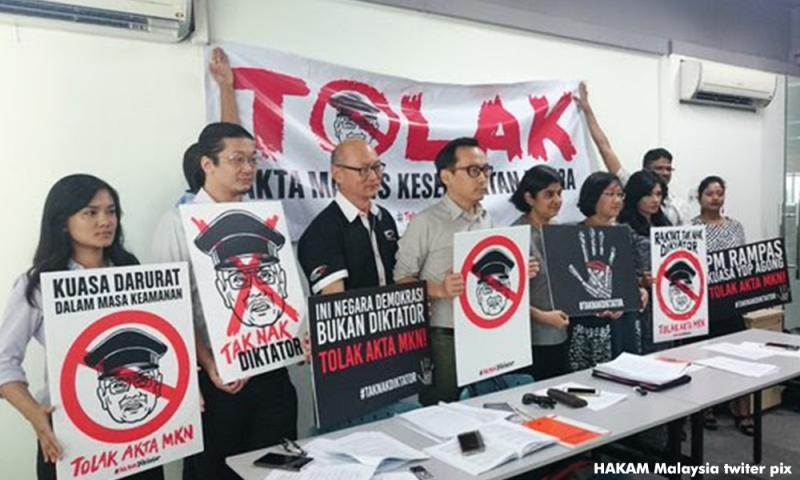

The crackdown on freedoms in Malaysia has intensified in the last year, Amnesty International says in its annual report released today.
“The crackdown on freedom of expression and other civil and political rights has intensified,” the report says.
Among the notable developments last year, it noted, was the jailing of then-opposition leader Anwar Ibrahim based on perceived politically-motivated charges and the passing of the National Security Council (NSC) Bill, which granted expansive powers to the government.
It noted that the Sedition Act was also amended in April, which resulted in “further erosion of freedom of expression”.
“The scope of offences was amended to cover electronic media, including harsher penalties such as mandatory and increased prison sentences.
“It was used to silence government critics. At least 15 people were charged under the Act, including political cartoonist Zulkiflee Anwar Haque (also known as Zunar).
“All cases were ongoing at the end of 2015,” Amnesty International said.
Restrictions on media outlets
It added that the authorities also continued to use the Printing Presses and Publications Act to set restrictions on and suspend media outlets and publishing houses, as well as ban material critical of the government.
The report also noted curbs against the freedom of assembly, with the government using the Sedition Act and Peaceful Assembly Act against protesters.
“Peaceful protesters were often charged under Section 124 of the Penal Code for ‘acts detrimental to parliamentary democracy’,” it said.
The report also noted that arbitrary arrests continue to persist, including under the Security Offences (Special Measures) Act.
It also noted the passing of the Prevention of Terrorism Act, which likewise allowed for detention without trial.
“Unnecessary or excessive use of force and allegations of torture and other ill-treatment of detainees by the police continued to be reported.
“There were 11 recorded deaths in custody as a result of alleged torture or other ill-treatment.
“The government continued to reject urgings to establish an Independent Police Complaints and Misconduct Commission as recommended by a royal commission in 2005,” Amnesty International said.
The report also criticised Malaysia for trying to stop refugees from landing on Langkawi, Kedah, as well as the discovery of mass graves related to human trafficking on the Thai-Malaysian border.
It said Malaysia continued to impose the death penalty but noted that reforms were expected this year.
“Official figures indicate that 33 executions were carried out between 1998 and 2015,” the Amnesty International report said.