




Gov't unsure how to handle 'deviationist' Ayah Pin
Last week, a tiny predominantly-Malay village near Jerteh in Hulu Besut, Terengganu, hosted a gathering which is unheard of in Malaysia - a sharing of faith by a 15-member Christian group from Kuala Lumpur.
Last week, a tiny predominantly-Malay village near Jerteh in Hulu Besut, Terengganu, hosted a gathering which is unheard of in Malaysia - a sharing of faith by a 15-member Christian group from Kuala Lumpur.
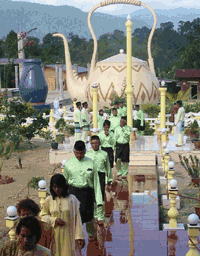 The bilingual Christian worship took place in a controversial kampung which is home to an equally-controversial character - a 65-year-old man known as Ayah Pin whose self-styled leadership is proving to be a spiritual magnet to many in recent years.
More than 500 women, men and children, mostly Malay-Muslims, including Orang Asli representatives from Gua Musang and Johor, watched the church group sing, play music and share the Bible.
Thursday night, which was also the eve of Hari Raya Haji, was unique for both Kampung Batu 13 villagers and visitors who thronged the main hall situated at the heart of the 2ha commune which has received many visitors, mostly driven by curiosity.
The atmosphere within the rectangular enclosure fell quiet as the 15-member Christian group started their Bible sharing and singing about 30 songs in both English and Bahasa Malaysia accompanied by a four-piece band.
Rosly Abdul Samad, a close aide of Ayah Pin and a former underground musician, played the drums.
Praying on their own
 "This is the first time we're holding such an event where a Christian group and the Orang Asli share their faith and culture," said Ayah Pin, or his real name Ariffin Mohammad, watching the performance from his circular dais in the center of the main hall.
"Such a gathering is not to convert the Malays but to pray on their own. Malays have their religion and lead their own way of life."
He believes that similar religious-cum-cultural events would form a good uniting force for people from different background in a pluralistic society such as Malaysia.
But not everyone within striking distance of Kampung Batu 13 is happy with Ayah Pin's seemingly harmless spiritual activities.
Last October, the government threatened to detain him and his band of followers under the Internal Security Act for spreading 'deviationist teachings". The Islamic Development Department considered them as a national security risk similar to Al-Ma'unah and Al-Arqam.
In 2001, Ayah Pin was charged for 'insulting Islam' and was sentenced to 11 months in jail.
Hulu Besut state assemblyperson Nawi Mohammad said he has received a number of complaints from surrounding villages.
"We in Terengganu generally do not favour carnivals, festivals or celebrations. There have been objections, both in writing and verbally, from people in surrounding areas about Ayah Pin's activities," he said when contacted today.
"I've been accused of ignoring action against him and of neglecting the interests of my constituents." he added.
Complaints forwarded
"It would be a different story if an event was held in an enclosed area and nothing is heard outside but this was loud enough to be heard outside the hall, which poses a problem," said the local politician.
Nawi said he has forwarded the public complaints to the state religious department for further action.
"State laws strictly prohibit proselytising of Malays," he said, referring to the presence of the Christian group.
"But it is up to the state authorities to consider the necessary action based on the people's complaints."
Terengganu exco member in charge of Islam Hadhari development Wan Mohd Wan Hassan was unavailable for comment.
The police have been consistently keeping a tab on Ayah Pin and his members, including a routine intelligence-gathering exercise at the village itself.
Group leader Peter Poore said similar Christian fellowships may be organised at the village or in other venues around the country, including a possible trip to the Orang Asli settlement in Gua Musang, Kelantan.
First such experience
The evangelist said Ayah Pin had invited them over for the fellowship on Thursday night and Friday morning to "demonstrate the spirit of unity among Malaysians regardless of race and religion".
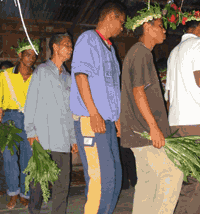 "This is the first such experience for us. Overall, it felt good to be able to share our personal experiences with those of other faiths without fear of trouble," he said when contacted.
"For me, this was something new. I shared my life's turning point with a clear conscience and without any ulterior motive."
The event saw a group photo session, with Ayah Pin sitting in the middle dressed in a traditional yellow-and-gold Malay costume flanked by his four wives, children and followers, after the inter-faith gathering on the morning of Hari Raya Haji.
Earlier in the main hall, he told the crowd that the current massive destruction around the world was a clear sign of faithlessness among the people and urged them to return to God.
The event included a cultural show by the Orang Asli who performed a tribal dance known as 'sewang' that is usually held for all occasions.
The villagers and visitors participated in it from night until the next morning over two days.


Are you sure you want to delete this comment?
This action cannot be undone.