




Najib: Ringgit peg stays despite falling dollar
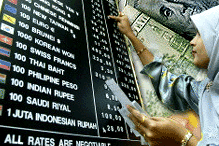
Deputy Prime Minster Najib Razak reiterated the country's stand on keeping the national currency peg on the US dollar and said it would remain as such, given that the ringgit is still competitive with regional currencies.
Deputy Prime Minster Najib Razak reiterated the country's stand on keeping the national currency peg on the US dollar and said it would remain as such, given that the ringgit is still competitive with regional currencies.
 "We won't change this or review it unless there is a huge disparity with regional currencies and for now that is not the case," he told reporters after attending the 2005 Malaysia Strategic Outlook Conference in Kuala Lumpur today.
Najib said the government believes the continued peg will provide a much needed predictability and competitiveness for Malaysian exports.
However, when addressing economic prospects for the world's "largest economic powerhouse" at the conference earlier, he said that the US dollar has declined significantly and will continue to depreciate this year.
"The US economy is expected to face a slowdown in 2005 due to twin trade and budget deficits and the significant decline of the US dollar.
"The US' commitment to the global war against terror has meant an increase in military spending and the electoral commitment to tax cuts will combine to worsen the budget deficit," he added.
His revelations were supportive of Prime Minister Abdullah Ahmad Badawi's hit-back at former premier Dr Mahathir Mohamad who introduced the peg - USD1 to RM3.8 - six years ago.
The country's premier for 22 years recently suggested that the peg be lifted as the weakening dollar was affecting import costs.
Slowdown in 2005
Najib did say however that the ringgit was affected by the US dollar's depreciation in relation to the ringgit's exchange power with the euro and pound sterling.
The ringgit has dropped by 4.1 percent against the euro and 5.1 percent against the pound sterling in the past year.
 Participants at the conference, the seventh of its kind organised by the Asian Strategy and Leadership Institute (Asli), were also told to expect a slowdown in the local economy for 2005.
"Despite reporting a moderate growth for the third quarter of 2004, the Malaysian economy is expected to be on track to record a seven percent growth rate for the whole of 2004. Expecting a slowdown, the government has set the 2005 GDP growth forecast at six percent," he revealed.
Despite the Malaysian projection, he said the country continues to be one of the world's fastest growing economies and that foreign direct investments (FDI) remain healthy.
He however was cautious about the effects of rising global oil prices.
"Although oil prices have eased from its peak, concerns still remains regarding its volatility and this will have an impact on inflation rates," he told the conference which was co-sponsored by Microsoft Malaysia Sdn Bhd, Rolls-Royce International Ltd and Titan Chemicals Corp Bhd.
No lavish spending
He added that the government will carefully monitor and manage the gradual reduction of domestic fuel subsidies to minimise inflationary pressures. This is despite the country being insulated from global price-hikes given its net export position.
Local petrol prices have increased twice over the past two years and the country is currently facing a diesel shortage.
Malaysians were also warned not to spend too lavishly in the coming year.
"The government is confident Malaysia can overcome the numerous challenges that lie ahead. However, we should not be extravagant in our spending especially on luxury goods (and) where possible buy Malaysian made products," he advised.
He also assured that the government will "continue to manage national resources prudently" while providing incentives and support to private sectors and improving public service delivery and transparency.
Najib also spoke of China's forecasted "sizzling" economic growth at 8.8 percent this year, recording only a 0.6 slowdown from 2004.
"Although declining slightly, China will continue to enjoy robust growth compared to the rest of Asia," he predicted and said economies in India and Japan are also expected to grow significantly.


