


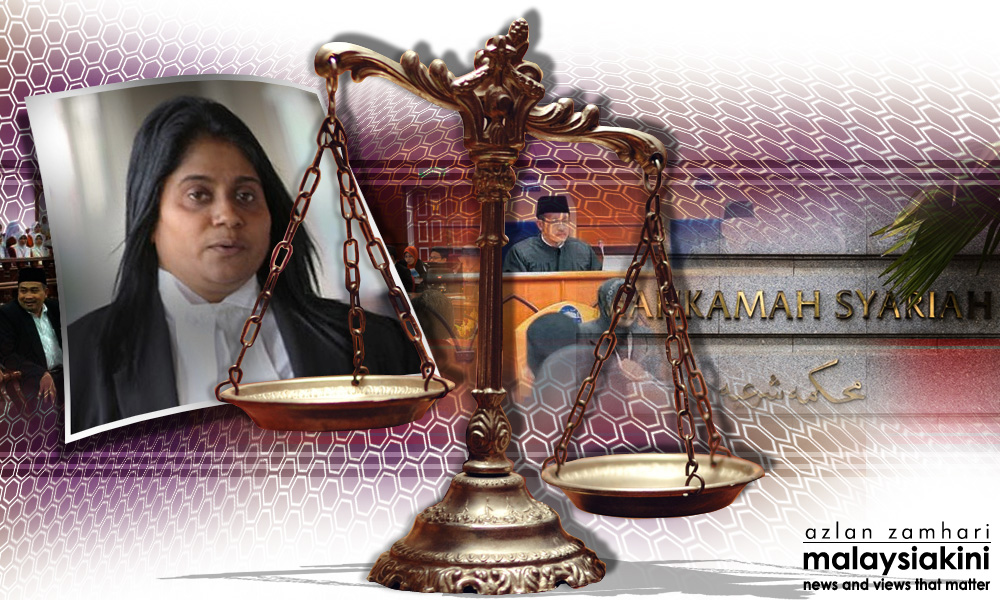

Apex court: Non-Muslims can't practise in syariah courts
The Federal Court today shot down lawyer Victoria Jayaseele Martin's bid to become a non-Muslim admitted as a syariah lawyer in the Federal Territories.
In an unanimous decision, the apex court decided that Rule 10 of the Syariah Lawyers' Rules 1993 is not unconstitutional. The said rule mandates that only Muslims can be admitted as syariah lawyers.
The Federal Court today shot down lawyer Victoria Jayaseele Martin's bid to become a non-Muslim admitted as a syariah lawyer in the Federal Territories.
In an unanimous decision, the apex court decided that Rule 10 of the Syariah Lawyers' Rules 1993 is not unconstitutional. The said rule mandates that only Muslims can be admitted as syariah lawyers.
On another point of law, by a 3-2 majority, the court further decided that the rule was not ultra vires (beyond the powers) the Administration of Islamic Law (Federal Territories) Act 1993.
The five-member bench was chaired by Court of Appeal president Md Raus Sharif and alongside Federal Court Judges Ahmad Haji Maarop and Azahar Mohamed, they made the majority decision.
Federal Court Judges Suriyadi Halim Omar and Zaharah Ibrahim dissented.
The judgement upholds an earlier high court ruling against Victoria, setting aside an appeals court decision in her favour.
The court made no orders as to costs.
The hearing today is a joint hearing of two related cases – Federal Territories Islamic Religious Council (MAIWP) against Victoria, and the Attorney-General’s Chambers against Victoria.
Speaking to reporters later, Victoria's lawyer Ranjit Singh Harbinder Singh told reporters that Victoria would be very disappointed by the court's decision but would respect it.
“She has a passion in this area, as you can tell. Not only she has done her diploma, she has also got her Masters.
“So she is very passionate, but this is as far as her passion will go because passion alone is not enough to take her to syariah court,” he said.
Nevertheless, Ranjit pointed out that five out of nine judges who have heard this case have agreed with his arguments.
While the Federal Court judgement today is supreme, Ranjit hopes that the minority judgements will become law one day.
Meanwhile, when asked if the decision today applies to syariah courts outside of the Federal Territories, MAIWP lawyer Sulaiman Abdullah said it would.
However, he said those trying to become syariah lawyers in other states may still want to challenge the state authorities in court, by arguing that state laws are different from those in the Federal Territories.


