



‘Save Malaysia’ seeks to reach out to BN supporters, says Ambiga
“A patriot must always be ready to defend his country against his government.”
- Edward Abbey
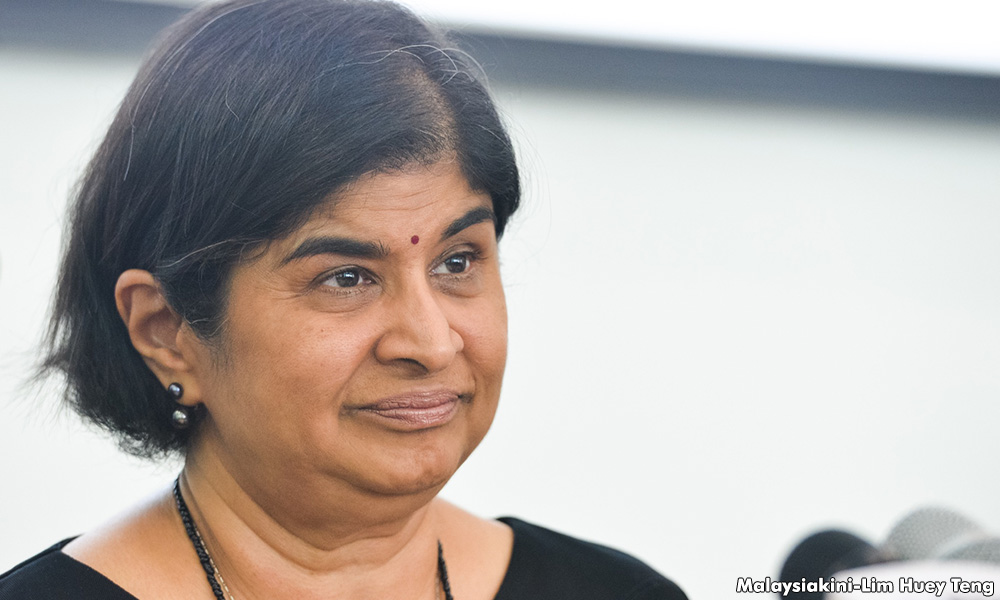
In a two-part interview, Hakam president Ambiga Sreenevasan discusses the recent Citizen’s Declaration, articulates the need to reach out and move beyond partisan rhetoric and makes it very clear that the struggle for a just Malaysia is journey that everyone needs to make.
She is a passionate advocate for reform but does not allow polemics to get in the way of reasoned discourse.
We often hear from people who oppose the policies of former prime minister Dr Mahathir Mohamad. However, there are people who support him and his policies. How do you reconcile the progressive agendas of civil society and the underlying ideology of the former prime minister and those who support him, including ordinary citizens?
The progressive agenda of civil society will never change. Neither will the events of the past which has led us to our current situation.
Members of civil society and I have spent so many years of our lives fighting this government for the problems that have resulted in the current crisis we are facing. (Social activists) Maria (Chin)’s husband and Hisham (Rais) were held under the ISA. Why did we (including Cynthia Gabriel) choose to sign this Citizens’ Declaration?
The rallying point is that the country is on the brink of destruction and something has to be done and done now. If indeed we have all agreed that there is a crisis facing the country, the only issue that remains is what do we do about it?
“A patriot must always be ready to defend his country against his government.”
- Edward Abbey
In a two-part interview, Hakam president Ambiga Sreenevasan discusses the recent Citizen’s Declaration, articulates the need to reach out and move beyond partisan rhetoric and makes it very clear that the struggle for a just Malaysia is journey that everyone needs to make.
She is a passionate advocate for reform but does not allow polemics to get in the way of reasoned discourse.
We often hear from people who oppose the policies of former prime minister Dr Mahathir Mohamad. However, there are people who support him and his policies. How do you reconcile the progressive agendas of civil society and the underlying ideology of the former prime minister and those who support him, including ordinary citizens?
The progressive agenda of civil society will never change. Neither will the events of the past which has led us to our current situation.
Members of civil society and I have spent so many years of our lives fighting this government for the problems that have resulted in the current crisis we are facing. (Social activists) Maria (Chin)’s husband and Hisham (Rais) were held under the ISA. Why did we (including Cynthia Gabriel) choose to sign this Citizens’ Declaration?
The rallying point is that the country is on the brink of destruction and something has to be done and done now. If indeed we have all agreed that there is a crisis facing the country, the only issue that remains is what do we do about it?
What we are seeing with the Citizens’ Declaration is an alignment of diverse forces to face a crisis. What we need to do is to set aside our obvious differences for a higher cause. We need to stop the ship’s captain before he steers us into the iceberg.
It is also about appealing to a wider spectrum of people from both sides of the political divide and for them to know that it is okay to have differences but still work together to save the nation.
Don’t forget that whilst the reform agenda was largely suggested by civil society, everyone agreed to it and signed onto it. As far as we are concerned, there is consensus on the issue of reform.
History is replete with many examples of such temporary alliances that are formed to face and overcome an immediate danger.
In Malaysia, game changing political events always seem to happen in secrecy. Why were there no public consultations with citizens’ groups and publication of Mahathir's original draft in the weeks leading up to the press conference?
Civil society was brought into the picture on the Tuesday before the signing (of the declaration) on Friday. There was little time for us to consult but we consulted as many people as we could.
We know that it was not extensive but we were working on a short timetable. We are now reaching out to our friends in civil society so that they can ask us questions and understand why we did what we did. We owe it to them to explain our actions.
Given the nature of the declaration, I am not in the least surprised that it was not disclosed widely to the public. If it was widely and openly discussed, I am certain it would not have seen the light of day.
What does civil society groups gain by aligning with the former prime minister who was the cause of the systemic dysfunction we now face?
First, this is a declaration signed by citizens. There are those in civil society who have said they will not sign the declaration but equally, there are those who are prepared to do so.
Ultimately, the advantage to civil society that I see is to ensure that in this move to bring change, the reform agenda is not left out of the conversation. Then there is the issue of (jailed opposition leader) Anwar Ibrahim. That too must be on the table.
The other advantage is that we now have an opportunity to reach out to a different audience and speak about the need for reform. There was a time when BN supporters would not hear of any reform.
We now have a chance to reach out to them to bridge this gap, to lessen the distrust and to get them to hear us out. To me, that is a big step forward.
In response to the scepticism from certain quarters, you said, "What is important is that we have someone committed to reform". My question is, this declaration has its foundation in Umno's internal schism, how credible is the argument that the anti-Najib forces are willing or capable of instituting systemic reforms?
(I do not recall making that statement in precisely those terms!)
We are not in power, so it is impossible to promise change as some people want us to. We cannot guarantee anything. What we are trying to do here is to galvanise people’s power to make a difference.
Whilst I understand the skepticism that the anti-Najib forces who come from the BN/Umno background will institute systemic reforms, I do believe there is a shift in the thinking to some extent. Some of them have themselves suffered the effects of institutional failure and in particular the clamping down on free speech.
It must be clear that we are facing a crisis due to a failure of the institutions and rampant corruption. Hence the need to reach out and convince them of this at a time when they are prepared to listen.
True reform is only possible when the majority of the people of Malaysia, on both sides of the political divide, see the need for it and demand it. If this means forging a temporary alliance to make this happen, so be it.
The original draft only paid lip service to reform, is this not a warning sign that the primary purpose is dislodging Najib and not serious systemic reform and how do the movers behind this declaration hold those who signed accountable for their actions or inactions?
First, I disagree that it was mere lip service.
All the signatories have signed up for the reform and the opposition members and civil society must ensure it becomes a reality. Whilst the main agenda for some may be the removal of Najib, this is in my view, a necessary first step in any event.
This prime minister should not remain for all the reasons that are obvious to us. We have to take it on faith that those who signed the declaration will also ensure that they keep their word on reform. If they do not, then we will continue our fight. We will be no worse off than we are now in that regard.
Further, I do not believe that it will reflect well on the signatories if they ignore the reform agenda.
The best way to ensure reforms is to convince the public whom we speak to that it is vital for the survival of our beloved nation. This is the reaching out I spoke of earlier. These are the conversations across the political divide that we need to have. The Citizens’ Declaration gives us the opportunity to do that.
Part 2: Ambiga: Save M’sia shows we can go beyond partisan politics
Support Save Malaysia to prevent Mahathir's control, critics told
Anwar wants family to mend ties with Dr M, says Khairuddin
Critics grill signatories over Dr M's role in Citizens' Declaration


Are you sure you want to delete this comment?
This action cannot be undone.