




Let nature NGOs handle mangrove project, govt told
The proposed cultivation of a mangrove swamp forest in Penang should not be made turned into a mega-project in order to avoid corporate bodies or multi-national companies from raking in a huge profit.
The proposed cultivation of a mangrove swamp forest in Penang should not be made turned into a mega-project in order to avoid corporate bodies or multi-national companies from raking in a huge profit.
However, if the government insists on turning it into a mega-project, then it must contract the work to sincere non-government nature organisations.
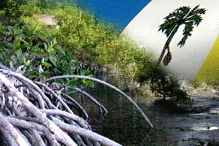 Penang Inshore Fishermen Welfare Association (Pifwa) chairperson Saidin Hussein said it would be a major blunder if the government was to offer the multi-million ringgit contract to corporate bodies and multi-national companies that lack knowledge in planting, replanting and maintaining the mangrove forest.
"These companies would not be sincere and honest in developing these forests. They will be keener to pocket the huge gains," he said, adding that it would also be cost-effective if the work is carried out by a local NGO.
Saidin was commenting on the recent suggestion by Prime Minister Abdullah Ahmad Badawi that the government would plant and replant mangrove forests along the country's coast lines to act as buffer zones against natural disasters such as the recent tsunami.
While the government was jolted into realising the importance of mangrove forests only after the Dec 26 Tsunami tragedy, Pifwa members had already planted and cultivated 32,000 mangrove trees along the coast lines of Balik Pulau, Kuala Sungai Pinang, Sungai Chenang and Batu Kawan.
They have been developing these forests since 1997.
Crucial buffer
Pifwa advisor P Balan said mangrove had proven to be a crucial damage control buffer along the coastal areas by minimising the destruction brought about by giant waves.
"Several villages were spared from severe damage during the tsunami disaster due to mangrove buffer zone," he added.
However, he cautioned the government against starting a mega mangrove cultivation programme in the absence of a thorough study.
He also warned that unscrupulous corporate bodies could manipulate the situation to reap huge profits from the project.
Besides being a crucial buffer zone, mangrove provides several herbal medicines, firewood and honey. It is also a natural breeding ground for various marine life, provides stability to the eco-system and acts as a filter to air pollution.
At present Penang has 1.036ha of mangrove areas, mainly along the southwest coastline, which is a far cry from the 3,243ha that existed 10 years ago. Another 376ha is a permanent mangrove reserve forest.
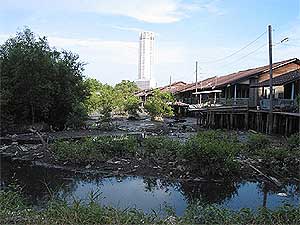 Since 1995, on average of 130ha of mangrove land has been cleared annually to make way for housing projects, industrial zones and, prawn and fish farms.
Based on the present rate, Pifwa believes Penang would not have any mangrove forests in the next 20 years.
Fearing the danger, Pifwa members started the mangrove cultivation programme voluntarily by using their own funds.
"Penang needs 10,000ha of mangrove forests to protect the environment. Otherwise, we would face hazardous environment problems and a shortage of marine life," said Balan.
ATHI VEERANGGAN is malaysiakini 's Penang-based stringer.


