


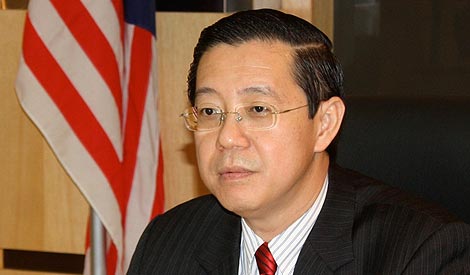

Will Guan Eng be Dear Leader for life?
COMMENT Sadly, the sceptre of DAP’s godfather-centric feudalism continues to haunt.
This article is not primarily about the merits or demerits of term limits. It is a continuation of observations regarding the creeping dominance of feudal culture within the party and its supporters, examined through the lens of discussions regarding term limits for the chief minister of Penang.
Penang assemblyperson Teh Yee Cheu, who I’d bet will not be named as a candidate anywhere for anything for the next elections, once again submitted a proposal to limit the CM’s tenure to two terms.
COMMENT Sadly, the sceptre of DAP’s godfather-centric feudalism continues to haunt.
This article is not primarily about the merits or demerits of term limits. It is a continuation of observations regarding the creeping dominance of feudal culture within the party and its supporters, examined through the lens of discussions regarding term limits for the chief minister of Penang.
Penang assemblyperson Teh Yee Cheu, who I’d bet will not be named as a candidate anywhere for anything for the next elections, once again submitted a proposal to limit the CM’s tenure to two terms.
Joshua Woo wrote an informed, spirited defence of why no term limits should be imposed on the CM. The fact that such clearly demonstrated intelligence could be funneled towards making arguments I humbly feel are significantly misguided is all the more sad and unfortunate.
I will attempt an alternative view, discussing comparisons to other countries and cases, transparency and accountability, and most importantly, the calibre of Malaysians as leaders as well as the concept of value-based institutions versus personality cults.
In the company of dictators
Woo essentially suggests that a good leader should be allowed to lead indefinitely.
What insight can history provide regarding this approach? One way to answer this question logically is to look at the types of people who tend to stay in power for a long time.
We can begin with a list of longest serving heads of state .
Some luminaries from this 40 person list: Kim Il-sung, Muammar Gaddafi, Francisco Franco, Robert Mugabe, Mao Zedong, Hun Sen, and Josef Stalin.
Lee Kuan Yew is on that list as well, but to someone of the persuasion that this speaks to the merits of a no term limit system, none of the fundamental principles underlying this article would make sense anyway.
Who will our example be?
What kind of countries do enforce term limits? Perhaps we can explore the G8 to begin with.
France, Germany, the UK and the US all impose term limits; Japan, Italy, Russia and Canada do not.
Japan’s longest serving prime minister was in office (beginning in 1901) for less time than Lim Guan Eng has been CM of Penang. (Perhaps they need minimum rather than maximum term limits).
Lim has also been CM longer than all except three of Italy’s prime ministers, in reverse order: scandal ridden Silvio Berlusconi, Giovanni Giolitti who served as PM for five non-consecutive terms between 1892 and 1921, and Benito Mussolini.
The three longest serving Canadian prime ministers did not serve uninterrupted consecutive terms.
I think Russia’s history with regards to corruption and human rights abuses speaks for itself.
So, in whose company do we want to be? North Korea, Libya and Zimbabwe? Or France, Germany, the UK and the US?
Or maybe Malaysia is just special and can buck all the trends. Just like how race-based parties in Malaysia believe they can buck the trend and continue being dominant, despite how there are almost no other such parties thriving anywhere else in the world.
An authoritarian with term limits?
Woo makes a number of bold claims: that term limits do not help prevent authoritarianism or cronyism, and have no connection to accountability.
My dad once told me, the minute a politician comes into power, his first priority becomes how to stay in power.
The first list mentioned in this article I think speaks considerably to the question of whether term limits have anything to do with authoritarianism.
Let’s look at these long ‘serving’ individuals once again: Kim Il-sung, Muammar Gaddafi, Francisco Franco, Robert Mugabe, Mao Zedong, Hun Sen, and Josef Stalin.
Let’s think about the brutal suffering they unleashed upon their citizens, and upon the world. Now imagine, just hypothetically, if they had term limits enforced upon them?
How much damage could have been avoided? How many genocides prevented? How many lives could have been saved?
Unbridled power
Of course, we can expect Lim fanatics to burn at the stake anyone who dares compare his esteemed self to these villainous dictators of history.
No one is expecting Lim to launch pogroms in Butterworth or anything ridiculous like that; but the principle is not so different - the longer one is in power, the stronger the bent towards dictatorship and authoritarianism. How many examples in history can one possibly find that bucks this trend?
In Malaysia, Mahathir Mohamad is the most relevant case study - the man so often decried as doing the most damage to our country’s institutions of checks and balances. The same man many consider responsible for the exact situation he seems to desperately be trying to undo now - the invulnerability of the Malaysian incumbent.
Another simple recent example is the Youth and Sports Ministry civil servant Otman Arshad, charged with embezzling RM38.5 million. Apparently he successfully resisted four attempts to transfer him to another ministry.
“In fact, this officer in the (Youth and Sports) Ministry was asked to be moved four times by JPA (Public Services Department), but it was stopped by the ministry, telling (us) that he is a key player, a very important officer so we cannot move him. So that was the thing. So this person became very powerful,” said chief secretary Ali Hamsa.
The longer one can remain in power, and even more so when ‘longer’ can mean ‘indefinite’, the easier it is to build a network of cronies and corruption. To deny this would be, to borrow Woo’s words, ‘a leap of logic’.
Tomorrow: Term limits - does DAP lack faith in Malaysians?
Nathaniel Tan's cherry-picking and missing the elephant in the room
NATHANIEL TAN is a former member of the Malaysiakini Team. He believes in 'tegur kerana sayang', and is only offering humble, constructive criticism to those whom he actually believes have the potential to be better.


Are you sure you want to delete this comment?
This action cannot be undone.