
COMMENT Freedom of expression constitutes one of the essential foundations of a democratic society and one of the basic conditions for its progress and for each individual’s self-fulfilment. Concepts such as pluralism and tolerance are the hallmarks of a democratic society. However, there is a need to tread carefully in areas related to free speech and expression.

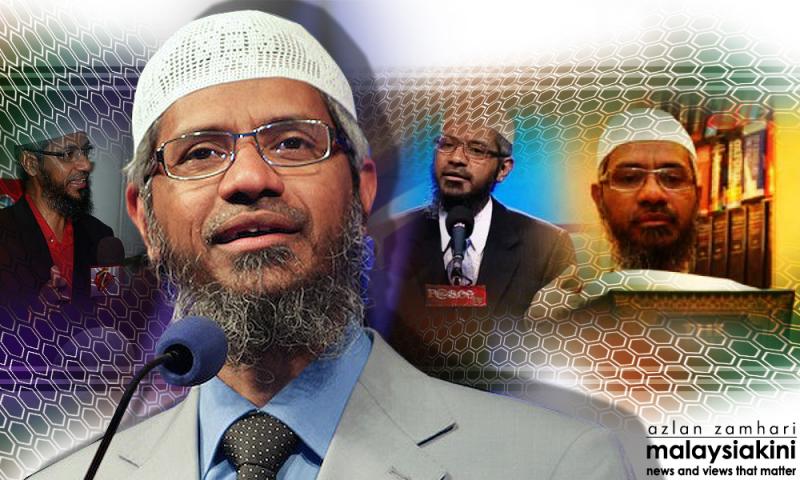
In the past few days, there have been urgings by Malaysians to ban Zakir Naik, a leading Muslim writer and public speaker, from conducting a series of seminars in Malaysia. Zakir is the chairperson of the Islamic Research Foundation International (IRFI), a charity based in the United Kingdom.

He is involved in a number of not-for-profit broadcast companies in the broadcasting field, including Lords Production Inc Ltd, a UK company, which holds the broadcast licence for Peace TV.

It must be noted that Zakir has been banned from entering the United Kingdom and Canada. There have been claims that the affairs of other countries have nothing to do with Malaysia to the extent that we are asked to ignore Zakir’s ban in the United Kingdom. This statement is wrong in many ways.

Let us be clear that Malaysia has very strong regard for the promotion and preservation of international relations with other countries. Apart from being the chair of Asean in 2015, Malaysia has recently initialed the EU- Malaysia Partnership and Cooperation Agreement where the focus of the Agreement will be to reinforce political dialogues on a range of issues, among them counter-terrorism and the promotion of human rights and of international justice.

As such it would be apt to say that Malaysia would benefit tremendously from analysing the trends in international human rights, in this case, the reasons for Zakir’s ban in the United Kingdom. For a moment, let us set aside our prejudices and favoritism towards this controversial figure and objectively assess the reasons for his ban in the United Kingdom.

The reported cases of Zakir Naik vs Secretary of State for the Home Department [2010] EWHC 2825 (Administrative Court) and Naik v Secretary of State for the Home Department [2011] EWCA Civ 1546 (Court of Appeal) will be discussed for this exercise.

The brief facts of the cases are as follows, Zakir was due to arrive in the United Kingdom on June 18, 2010. The home secretary made the decision to exclude him personally on June 16, 2010. That decision was conveyed to Zakir in two letters. The first was a brief letter of June 17, 2010 from the Deputy British High Commission in Mumbai, informing him of the decision and of the revocation of his visa:

“On July 15, 2008 you were issued a multiple entry visit visa, valid until July 15, 2013. However, on June 16, 2010 the secretary of state decided to exclude you from the UK for engaging in unacceptable behaviour by making statements that attempt to justify terrorist activity and fostering hatred.

“On the basis of the secretary of state’s exclusion decision the Entry Clearance Officer has been instructed to revoke your visa in accordance with paragraph 30A(iii) of the Immigration Rules on the grounds that your exclusion from the UK would be conducive to the public good. There is no right of appeal against this decision.”

Letter from UK Border Agency

The second letter was a somewhat longer letter of the same date from the UK Border Agency. It began by outlining the unacceptable behaviour policy. Having carefully considered that policy, the letter said, the home secretary had personally directed that Zakir should be excluded from the United Kingdom on the grounds that his presence here would not be conducive to the public good.

The home secretary noted that Zakir had made “the following statements amongst others”. The statements are set out in the letter :

“Statement 1: As far as a terrorist is concerned, I tell the Muslims that every Muslim should be a terrorist... What is the meaning of the word terrorist? Terrorist by definition means a person who terrorises. When a robber sees a policeman he’s terrified. So for a robber, a policeman is a terrorist. So in this context, every Muslim should be a terrorist to the robber... Every Muslim should be a terrorist to each and every anti-social element.

“I’m aware that terrorist more commonly is used for a person who terrorises an innocent person. In this context, no Muslim should even terrorise a single innocent human being. The Muslims should selectively terrorise the anti-social element. And many times, two different labels are given to the same activity of the same individual... Before any person gives any label to any individual for any of his actions, we have to first analyse, for what reason is he doing that?”

“Statement 2: Beware of Muslims saying Osama bin Laden is right or wrong. I reject them... we don’t know. But if you ask my view, if given the truth, if he is fighting the enemies of Islam, I am for him. I don’t know what he’s doing. I’m not in touch with him. I don’t know him personally. I read the newspaper.

“If he is terrorising the terrorists, if he is terrorising America the terrorist, the biggest terrorist, every Muslim should be a terrorist. The thing is, if he’s terrorising a terrorist, he’s following Islam.”

“Statement 3: How can you ever justify killing innocent people? But in the same breath as condemning those responsible we must also condemn those responsible for the deaths of thousands of innocent people in Iraq, Afghanistan and Lebanon.”

“Statement 5: Strongest in enmity towards the Muslims are the Jews and the pagans... It [The Quran] does not say that the Muslims should fight with the Jews... the Jews, by nature as a whole, will be against Muslims... there are many Jews who are good to Muslims, but as a whole... The Quran tells us, as a whole, they will be our staunchest enemy.”

In expressing such views, the letter continued, the home secretary considered that Zakir’s comments fell within the behaviours in the unacceptable behaviours policy and that in particular he was justifying terrorist violence and fostering hatred. She therefore considered that his views were unacceptable and that should he be allowed to enter the United Kingdom he might continue to espouse such views.

In light of these factors she was satisfied that he should be excluded from the United Kingdom on the grounds that his exclusion was conducive to the public good.

Challenge by way of judicial review

Zakir challenged the secretary of state’s decision by way of a judicial review. The main challenge to the decision of the secretary of state was the alleged violation of the right to freedom of expression pursuant to Article 10 of the European Convention on Human Rights (‘ECHR’ or ‘the Convention’).

The Administrative Court dismissed Zakir’s application for judicial review of this decision, holding that the secretary of state’s responsibility for the protection of national security is a central constitutional role, and encompasses a duty owed to the public at large. It could not be overridden by reference to any representation or practice relating to an individual entrant.

Zakir submitted to the Court of Appeal that the exclusion breached his rights under Article 10 of the Convention namely his freedom of expression.

At the outset of its judgment, the Court of Appeal affirmed that there is no doubt as to the secretary of state’s power to refuse an entry visa, or to revoke an existing entry visa, on the grounds that exclusion is “conducive to the public good”. This is referred to specifically in rule 320(6) of the Immigration Rules , which includes in a list of grounds on which entry clearance or leave to enter “is to be refused”:

“(6) where the secretary of state has personally directed that the exclusion of a person from the United Kingdom is conducive to the public good;”

The Courts then went on to discuss the “unacceptable behaviour” policy. In August 2005, following the London bombings of July 7, the then-home secretary adopted a new policy of exclusions based on a list of “unacceptable behaviours”:

The list of unacceptable behaviours

3. The list of unacceptable behaviours is indicative rather than exhaustive. It covers any non-UK national whether in the UK or abroad who uses any means or medium including:

  • Writing, producing or distributing material;

  • Public speaking including preaching;
  • Running a website; or
  • Using a position of responsibility such as teacher, community or youth leader.
  • To express views which:

    • Foment, justify or glorify terrorist violence in furtherance of particular beliefs;

  • Seek to provoke others to terrorist acts;
  • Foment other serious criminal activity or seek to provoke others to serious criminal acts or;
  • Foster hatred which might lead to inter-community violence in the UK.”
  • This policy was reviewed and revised in October 2008. The home secretary announced to Parliament that there would be a presumption in favour of exclusion of those found to have engaged in the types of behaviour listed in the August 2005 statement. Where an individual claimed to have repudiated such views, “the burden of proof would be on them to demonstrate that they had done this and had done so publicly”.

    Against this background, the Court of Appeal decided that there was an overwhelming case for concluding that the statements, considered as a whole, brought Zakir clearly within the unacceptable behaviours policy.

    That then brings us to the Article 10 argument.

    Article 10 of the Convention provides:

    “Everyone has the right to freedom of expression. This right shall include freedom to hold opinions and to receive and impart information and ideas without interference by public authority and regardless of frontiers. This Article shall not prevent States from requiring the licensing of broadcasting, television or cinema enterprises.”

    However, the exercise of these freedoms, since it carries with it duties and responsibilities, may be subject to such formalities, conditions, restrictions or penalties as are prescribed by law and are necessary in a democratic society, in the interests of national security, territorial integrity or public safety, for the prevention of disorder or crime, for the protection of health or morals, for the protection of the reputation or rights of others for preventing the disclosure of information received in confidence, or for maintaining the authority and impartiality of the judiciary.

    Zakir Naik refuted the claims that his statements were inflammatory, including his declaration that the Jews are “the staunchest enemy” of Muslims, which was part of a discussion in Mumbai in 2007. His refutations were not accepted by the Court of Appeal who held that the secretary of state was entitled to conclude that Zakir’s explanations “unjustifiably marginalised”. Lord Justice Carnwath stated:

    “On the first question I readily accept her conclusion that some at least of the statements brought Dr Naik within the policy. It is not necessary to review them all in detail. The stark message to an ordinary listener of statement 1 (“every Muslim should be a terrorist to every anti-social element”) is hardly mitigated by the explanatory reasoning which surrounds it.

    “Equal objection could be taken to statement 2 (“if [Bin Laden] is terrorising America, the biggest terrorist... every Muslim should be a terrorist”), even if spoken before 9/11. Other statements, at least taken on their own, seem needlessly provocative and inflammatory: statement 9 (comparing Americans to pigs), and statement 10 (apparently defending the death penalty for apostasy).

    “The language of the former (not in terms repudiated in Zakir’s evidence) is gratuitously offensive, and difficult to reconcile with Zakir’s claim to be a serious religious thinker, let alone a messenger of peace.”

    The Court of Appeal concluded that those of the appellant's statements were fostering hatred and he had not satisfied the burden of demonstrating that he had publicly repudiated the views which had brought him within the policy. The necessity for restricting the appellant's Article 10 rights had therefore been convincingly established.

    On that premise, it is also pertinent to note that the Courts in the United Kingdom have equally banned critics of Islam from entering the country in the recently reported case of Geller vs Secretary of State for the Home Department [2015] EWCA Civ 45.

    This case concerned two well-known US writers whose critical views of Islam led to them being prevented from entering the country in May 2013, to speak at a rally in the aftermath of the terrorist murder of Drummer Lee Rigby. The police had advised the Secretary of State that significant public disorder and serious violence might ensue from the proposed visit.

    The proposed visit was to join a rally in Woolwich at a time of great inter-community tension and sensitivity, in the relatively immediate aftermath of an incident of a particularly shocking nature, unprecedented on a British street, at any rate in recent history. The police had particularised associated incidents of violence which had occurred despite significant police operations.

    The police had been unable to prevent violence on the previous occasions and feared that their task on this occasion would be made the more difficult by the proposed presence of the appellants. An exclusion order was issued against them on grounds of public order, of which they sought judicial review. The Court of Appeal dismissed their judicial review application and held that:

    “The police were properly mindful of their responsibilities in seeking to keep the various factions apart and, generally, to curtail or to contain violence and disorder. The gravamen of their advice was however that their powers would not be adequate to safeguard public order.”

    Reason to justify restriction of freedom of expression

    It is obvious that the secretary of state in Gellar’s case and Zakir Naik’s case had to consider whether the presence of the applicants might lead to some form of violence in the UK on the occasion of their proposed visit, which was in fact by any standards imminent.

    Even when the speaker himself does not intend to incite violence, but if his presence may lead third parties to incite and commit violence, that has become a reason to justify the restriction of freedom of expression in the United Kingdom.

    Therefore, the overriding question here would be whether the visitor’s presence or activities is conducive to the public good. If this is answered in the negative, the authorities need to decide the sort of restrictions that can be placed upon the freedom of expression. This is the balancing exercise.


    DR M SARAVANABAVAN is an Advocate & Solicitor and Adjunct Professor of Law.